
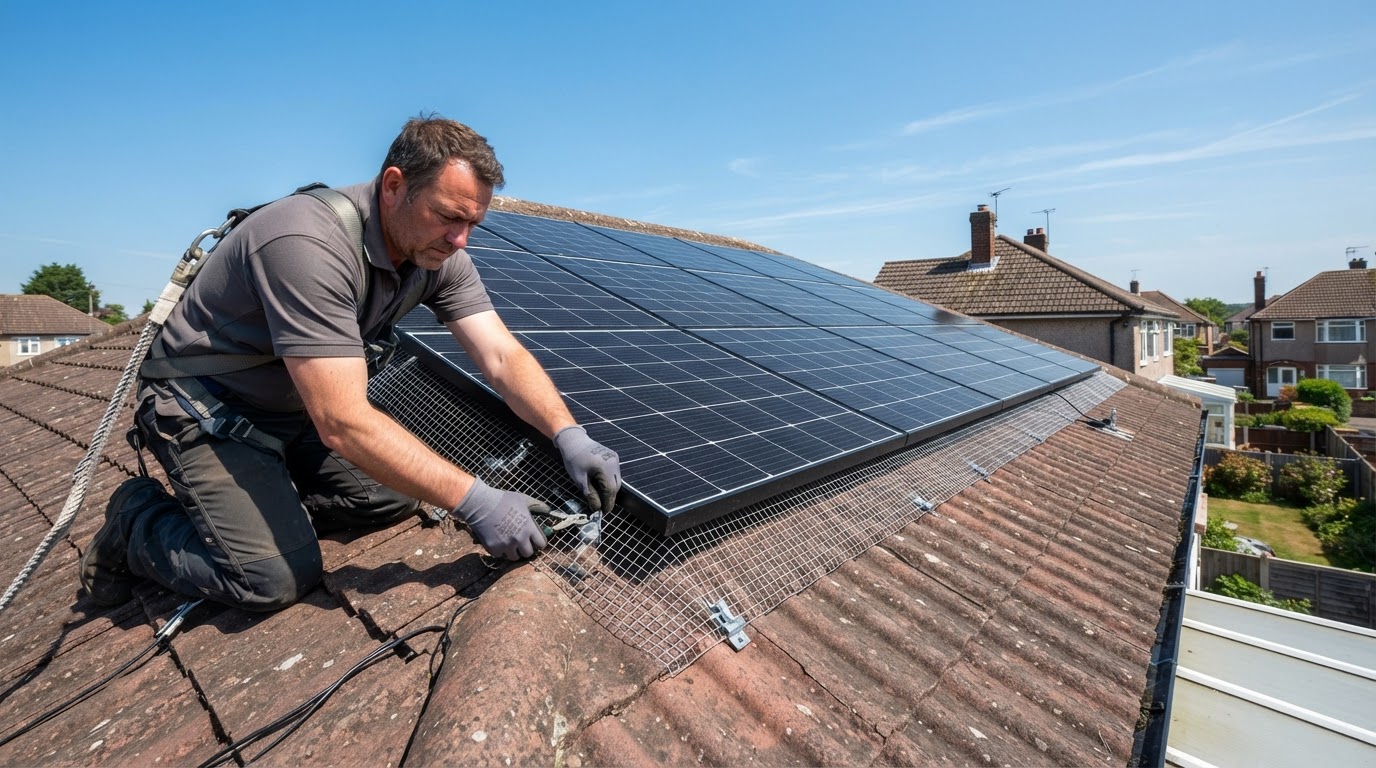
How to Stop Pigeons Nesting Under Solar Panels
The most reliable way to stop pigeons nesting under solar panels is to physically seal the gap between the roof tiles and the underside of the array using professionally installed perimeter mesh. Once the nesting space is closed off, pigeons can no longer access the sheltered area they favour and typically move on. This guide explains how the process works, when it should be carried out and the legal considerations that apply in the UK.
Pigeons are territorial and return to the same nesting site each season, so the problem rarely resolves itself. Deterrents such as spikes, reflective tape or ultrasonic devices have limited effect on birds already established beneath an array. A physical barrier is the approach that genuinely works.
Why Mesh Is the Effective Solution
The gap beneath a roof-mounted solar panel — typically 15 to 30 centimetres — is what attracts pigeons in the first place. It offers warmth from the roof and the panels, shelter from rain and wind, and elevation away from ground predators. Mesh works by sealing that gap along the entire perimeter of the array without covering the panel surface itself.
Because the mesh does not sit on the glass, it does not affect sunlight reaching the photovoltaic cells or interfere with airflow around the panels. It is a discreet physical barrier that prevents entry while leaving the system fully functional. You can read more about how the material works in our guide to solar panel bird mesh.
The Steps Involved in Stopping Nesting
1. Assess the level of bird activity
Before any work is carried out, the roof and array should be assessed to confirm the extent of the problem. Signs include droppings on the panels or surrounding roof, nesting material visible at the panel edges, birds seen entering and leaving beneath the array, and blockages in the gutters caused by nesting debris. Our guide to the signs of pigeons nesting under solar panels explains what to look for.
2. Check for active nests and follow wildlife law
This is a critical step. Under UK wildlife legislation — principally the Wildlife and Countryside Act 1981 — all wild birds, their nests and their eggs are legally protected while in use or being built. It is an offence to intentionally take, damage or destroy a wild bird's nest while it is in use or being built, or to kill or injure a wild bird or take or destroy its eggs.
This means that if pigeons are actively nesting — with eggs or chicks present — the nest should not be disturbed. Bird proofing work should be planned for a time when nesting has finished and the young have fledged and left the area. A professional installer will assess this before proceeding and schedule the work accordingly. If you are uncertain whether a nest is active, seek professional advice rather than attempting removal yourself.
3. Remove existing debris and contamination
Once it is legal and safe to proceed, any nesting material, droppings and accumulated debris beneath the panels should be cleared. Leaving debris in place traps moisture against the roof and can encourage moss and organic growth even after the mesh is fitted. Clearing the void allows the mesh to be fitted cleanly and the roof to dry out properly.
4. Fit perimeter mesh securely
Mesh is cut to size and fixed around the full perimeter of the array using purpose-made clips that attach to the panel frame. The key to an effective installation is completeness — every section of the gap must be sealed, including corners, valleys and junctions where panels meet roof features. Pigeons will exploit even a small gap, so a thorough, professional fit is essential.
5. Clean the panels and surrounding roof
With the mesh in place, cleaning the panel surface removes existing droppings that would otherwise continue to reduce efficiency. Many homeowners combine this with roof cleaning to address moss and organic growth on the surrounding tiles, and gutter clearing to remove nesting material that has already washed into the drainage system.
When Is the Best Time to Bird-Proof Solar Panels?
The timing of bird proofing matters because of the legal protection of active nests. The main nesting season for pigeons in the UK runs broadly from early spring through late summer, though pigeons can breed for much of the year in mild conditions. The safest approach is to arrange proofing outside the active nesting period, or once a professional has confirmed that any nest beneath the panels is no longer in use.
Planning ahead is sensible. If you notice birds investigating your panels in late winter or early spring, arranging proofing before nesting begins is far simpler than waiting until birds are established with eggs or chicks present.
Why DIY Approaches Often Fail
Off-the-shelf mesh kits are available, but they frequently fail for two reasons. First, safe roof access is difficult without proper equipment and training, particularly on two-storey properties. Second, DIY installations tend to leave gaps at corners and junctions where the mesh is hardest to fit neatly — and those gaps are exactly where pigeons regain entry.
A professional installation ensures the mesh runs continuously around the entire perimeter, is securely fastened, and is fitted in compliance with wildlife legislation. It is the difference between a barrier that works for years and one that fails within a season.
What About Properties Without Solar Panels?
Pigeons also roost on roofs without solar panels, particularly on ledges, valleys and flat sections. If you do not have panels but are experiencing bird-related roof problems, the approach differs — typically involving roof cleaning to remove contamination and, where appropriate, targeted deterrents. Our article on whether birds can damage roof tiles covers this in more detail.
Concerned About Pigeons Under Your Solar Panels?
If pigeons are nesting beneath your solar panels, the most effective long-term solution is professionally installed bird proofing combined with cleaning of the panels and surrounding roof. Skyhawk Exterior Cleaning provides specialist solar panel bird proofing across Sussex and Surrey, carried out safely and in accordance with UK wildlife law.
Arrange a free video quotation and we will assess your roof, confirm the level of bird activity and recommend the most appropriate solution.