Can Birds Damage Roof Tiles?
Birds rarely damage roof tiles directly, but they can contribute to a range of roof maintenance issues that affect the condition, appearance and performance of your roof. Nesting materials, droppings, blocked gutters and increased organic debris can all take their toll if left unmanaged — and the problems rarely stay confined to one part of the roof.
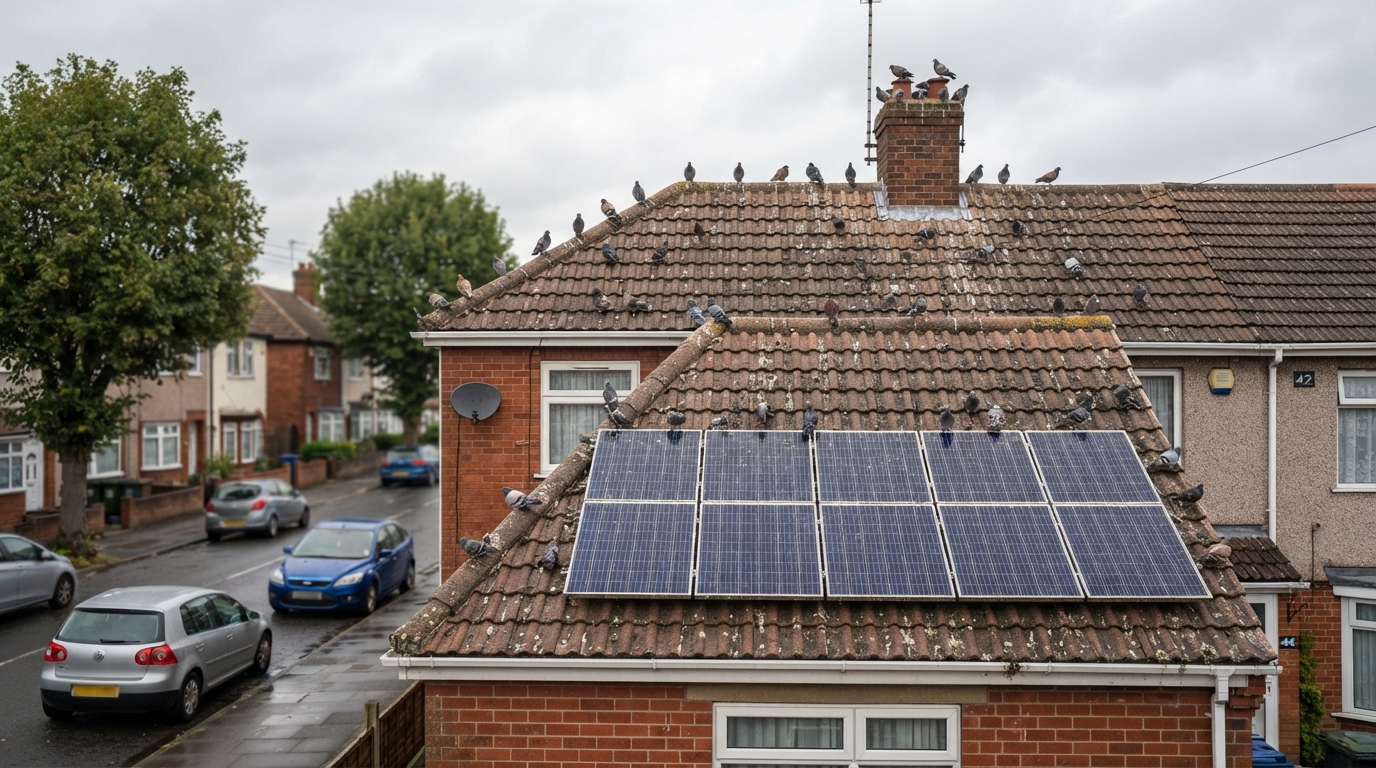
Across Sussex and Surrey, pigeons are the most common culprit. They are drawn to roofs for warmth, shelter and the protective gap beneath solar panels. Once they settle, the knock-on effects spread quickly: droppings on the tiles, feathers in the gutters, moss flourishing in the damp conditions, and solar panels becoming steadily more contaminated.
In this guide, we will explain what birds actually do to your roof, why the biggest risks come from the maintenance issues associated with bird activity rather than direct damage to the tiles themselves, and how looking after the whole roof system — through roof cleaning, gutter cleaning, solar panel cleaning and bird proofing — helps protect your property long-term.
Do Birds Actually Damage Roof Tiles?
The short answer is that birds very rarely damage roof tiles directly. Pigeons and other birds common to UK rooftops do not have the physical ability to crack, peck through or dislodge well-installed concrete or clay tiles. The tiles themselves are robust and designed to withstand decades of British weather.
However, that does not mean birds are harmless. The real damage comes from what happens around and beneath the tiles when birds are allowed to nest and roost unchecked. The accumulation of droppings, nesting material and organic debris creates conditions that can affect the roof, the gutters, the fascias and any solar panels installed on the roof.
So whilst a pigeon sitting on a tile is not going to crack it, the same pigeon nesting beneath your solar panels for two seasons can contribute to blocked gutters, moss growth, contaminated panels and a roof that needs significantly more maintenance than it should.
Why Pigeons Choose Roofs
Roofs offer pigeons exactly what they are looking for: height, warmth, shelter and safety from ground-level predators. The ridge of a roof provides a convenient perching spot with a clear view of the surroundings, while valleys and gaps beneath solar panels offer protected nesting sites.
Solar panels have made rooftops even more attractive to pigeons. The gap between the panels and the roof tiles creates a warm, sheltered space that mimics the cliff ledges and cave entrances pigeons naturally favour. Once a pair establishes a nest, they tend to return to the same spot year after year, and other birds may follow.
This is why bird activity on a roof tends to escalate rather than resolve itself. A single pair of pigeons in year one can become a persistent colony within a few seasons if the situation is not addressed.
What Happens When Birds Nest Beneath Solar Panels?
Nesting beneath solar panels is where the most significant maintenance issues begin. The gap beneath a typical roof-mounted array provides an ideal nesting environment, and once birds move in, a chain of problems follows:
- Bird droppings accumulate on the panels, the surrounding tiles and sometimes the walls below.
- Nesting material — twigs, straw, feathers and debris — builds up beneath the panels and around the roof.
- Feathers and debris are dislodged by wind and rain, washing into the gutters and causing blockages.
- Moss and organic growth flourish in the damp, debris-rich environment around the nest.
- Increased roof maintenance becomes necessary as the cycle of fouling and contamination repeats.
None of this damages the tiles directly, but all of it affects the condition of the roof as a whole. Over time, a roof with persistent bird activity requires more frequent cleaning, more frequent gutter clearing and more attention to the solar panels than a roof without birds.
Can Bird Droppings Affect Your Roof?
Bird droppings are more than just an unsightly nuisance. They are acidic and can adhere firmly to surfaces over time, particularly after exposure to sun and rain. On roof tiles, droppings can contribute to surface staining and, in concentrated areas, may affect the appearance of the tiles long after the birds have moved on.
On solar panels, droppings are even more problematic. They create opaque patches that block sunlight from reaching the photovoltaic cells, and they can become increasingly difficult to remove the longer they are left. This is one of the reasons why we recommend addressing bird activity promptly rather than waiting until the panels are heavily fouled.
Professional roof cleaning can remove accumulated droppings, moss and organic staining from the tiles, restoring the appearance of the roof and removing the conditions that encourage further growth.
How Birds Contribute to Blocked Gutters
One of the most common — and most overlooked — consequences of bird activity on a roof is blocked gutters. When pigeons nest beneath solar panels or roost regularly on a roof, feathers, nesting material and droppings are continually dislodged by wind and rain. Much of this debris ends up in the gutters.
Over time, the gutters become packed with a dense mix of organic material that blocks the flow of rainwater. Water then overflows over the edges of the gutters, running down the walls and potentially contributing to damp issues, staining and damage to the fascia boards.
This is a clear example of why solar panels and gutters cannot be maintained in isolation. Cleaning the panels without clearing the gutters leaves a significant problem unresolved, and cleaning the gutters without addressing the nesting means the blockages will simply return.
Professional gutter cleaning removes the accumulated debris and restores proper drainage, but for long-term results, the source of the debris — the bird activity — also needs to be addressed.
Can Bird Activity Encourage Moss and Organic Growth?
Yes. The damp, sheltered environment created by bird nesting — combined with overflowing gutters washing water back onto the roof — encourages moss, algae and lichen growth on the tiles surrounding the nesting site. Moss thrives in these conditions, and once established, it spreads across the roof and sheds spores and fragments onto the solar panels and into the gutters.
This creates a cycle: birds nest, debris accumulates, moss grows, moss sheds onto the panels and into the gutters, gutters block, water overflows, and the roof becomes progressively harder to maintain. Breaking the cycle requires addressing all of the contributing factors, not just one.
Professional roof cleaning removes the moss and organic growth, but without bird proofing to prevent the nesting from returning, the conditions that encouraged the moss in the first place will simply re-establish themselves.
Why Regular Roof Cleaning Helps
Regular roof cleaning is one of the most effective ways to manage the effects of bird activity. By removing moss, algae, droppings and organic debris from the tiles, roof cleaning:
- Restores the appearance of the roof.
- Removes the organic material that moss and algae feed on.
- Reduces the amount of debris washing into the gutters.
- Makes it easier to identify developing issues such as cracked tiles or damaged flashing.
- Complements solar panel cleaning by reducing the source of contamination.
For homes with a history of bird activity, combining roof cleaning with gutter cleaning and solar panel cleaning in a single maintenance visit is often the most efficient approach. It addresses all of the affected areas at once and helps keep the roof in better condition for longer.
Why Bird Proofing Protects More Than Just Solar Panels
Bird proofing is often discussed in the context of solar panels, but its benefits extend across the whole roof. By preventing birds from nesting beneath the panels, bird proofing also:
- Reduces the amount of droppings on the tiles and panels.
- Prevents feathers and nesting material from washing into the gutters.
- Removes the damp, debris-rich environment that encourages moss growth.
- Reduces the frequency of roof and gutter maintenance required.
- Protects the appearance and condition of the roof as a whole.
Professional bird proofing should always be installed responsibly and in accordance with UK wildlife legislation. Active nests and nesting birds are legally protected, which means any proofing work should be planned for a time when nesting is not active. A professional will be able to assess the situation and advise on the most appropriate timing.
Looking After the Whole Roof System
The most important takeaway from this guide is that the roof is one complete system. Birds, moss, gutters, solar panels and roof tiles all interact with each other, and treating one problem in isolation often leaves the others unresolved.
At Skyhawk Exterior Cleaning, we help homeowners across Sussex and Surrey maintain the complete roof system through a combination of:
- Roof cleaning — removing moss, algae, droppings and organic debris from the tiles.
- Gutter cleaning — clearing blockages and restoring proper drainage.
- Solar panel cleaning — removing contamination from the glass to help the panels operate as intended.
- Bird proofing — preventing pigeons from nesting beneath the panels and creating the conditions for ongoing maintenance issues.
By addressing all of these areas together, we help reduce future maintenance, protect the appearance of the property and prevent the cycle of contamination from repeating.
| Bird Activity | Possible Roof Maintenance Issue |
|---|---|
| Nesting beneath solar panels | Debris accumulation, droppings on panels, increased moss around the array |
| Bird droppings on tiles | Surface staining, acidic build-up, unsightly appearance |
| Feathers in gutters | Blocked gutters, overflowing water, potential damp issues |
| Nesting debris on roof | Organic build-up encouraging moss and algae growth |
| Regular perching on ridges | Accumulated droppings in concentrated areas, gradual staining |
| Roof Maintenance Service | Why It Helps |
|---|---|
| Roof cleaning | Removes moss, droppings and organic debris from the tiles |
| Bird proofing | Prevents nesting, reducing the source of contamination |
| Gutter cleaning | Clears blockages caused by feathers and nesting material |
| Solar panel cleaning | Removes droppings and debris from the glass surface |
| Roof inspection | Identifies developing issues before they become serious |
A Real Example From Sussex
A homeowner in Horsham, West Sussex, contacted us after noticing pigeons congregating on their roof each morning. The property had a solar array installed two years earlier, and the homeowner had begun to notice dark staining on the panels, moss growing along the valleys and water overflowing from the gutters during heavy rain.
On inspection, we found an established pigeon nest beneath the solar panels. Droppings covered much of the array, feathers and nesting material had washed into both gutters, and moss was beginning to spread across the tiles surrounding the panels. The tiles themselves were intact — the birds had not damaged them directly — but the cumulative effect of the nesting was creating a growing maintenance problem.
We carried out a planned maintenance programme: the solar panels were cleaned, the gutters were cleared, the roof was cleaned to remove moss and organic staining, and bird proofing mesh was installed around the array once nesting had concluded. The result was a roof that looked significantly better, panels that were clean and clear, gutters that flowed freely, and — most importantly — a system in place to prevent the cycle from starting again.
Questions We Get Asked On Site
Can pigeons crack roof tiles?
No. Pigeons do not have the physical ability to crack or break well-installed roof tiles. The damage associated with bird activity comes from the accumulation of droppings, nesting material and debris, not from the birds physically damaging the tiles.
Are bird droppings harmful to my roof?
Bird droppings are acidic and can cause surface staining over time, particularly in concentrated areas. On solar panels, they can block sunlight and become increasingly difficult to remove. Professional cleaning can restore the affected surfaces.
Can birds block my gutters?
Yes. Feathers, nesting material and droppings dislodged by wind and rain are a common cause of gutter blockages on properties with bird activity. Regular gutter cleaning helps, but addressing the source of the debris through bird proofing provides a longer-term solution.
Should I remove nests myself?
No. Active nests and nesting birds are legally protected under UK wildlife legislation. Nests should not be removed while birds are actively nesting. Bird proofing should be planned for a time when nesting is not active, and a professional can advise on the most appropriate approach.
Does roof cleaning remove bird mess?
Yes. Professional roof cleaning removes accumulated droppings, moss, algae and organic debris from the tiles, restoring the appearance of the roof and removing the conditions that encourage further growth.
Common Mistakes Homeowners Make
- Ignoring repeated pigeon activity. A few pigeons on the roof may seem harmless, but the problems escalate quickly once nesting begins.
- Cleaning gutters but not addressing nesting. Clearing the gutters provides temporary relief, but the blockages will return if the birds are still nesting.
- Leaving roof moss untreated. Moss sheds debris onto the panels and into the gutters, perpetuating the cycle of contamination.
- Attempting to remove active nests unlawfully. Active nests are legally protected. Proofing should be planned responsibly and carried out at the appropriate time.
- Assuming birds will move on by themselves. Pigeons return to the same nesting sites year after year. Without intervention, the problem typically gets worse, not better.
Key Takeaways
- Birds rarely damage roof tiles directly, but they contribute to a range of maintenance issues affecting the whole roof.
- Nesting beneath solar panels is the most common source of problems, leading to droppings, blocked gutters and moss growth.
- The biggest risks come from the maintenance issues associated with bird activity, not from the birds physically damaging the tiles.
- Looking after the whole roof system — roof, gutters, solar panels and bird proofing — produces far better long-term results than treating each problem separately.
- Bird proofing should always be carried out responsibly and in accordance with UK wildlife legislation.
- Skyhawk Exterior Cleaning provides roof cleaning, gutter cleaning, solar panel cleaning and bird proofing as one coordinated maintenance solution across Sussex and Surrey.
Frequently Asked Questions
Can birds damage roof tiles?
Birds very rarely damage roof tiles directly. The main issues come from the maintenance problems associated with bird activity, including droppings, blocked gutters, moss growth and nesting debris. These affect the condition and appearance of the roof rather than the tiles themselves.
Can pigeons crack roof tiles?
No. Pigeons do not have the physical ability to crack or break well-installed concrete or clay roof tiles. Any damage associated with pigeon activity comes from the accumulation of droppings, nesting material and debris over time.
Can bird droppings stain roof tiles?
Yes. Bird droppings are acidic and can cause surface staining, particularly in concentrated areas. Professional roof cleaning can remove accumulated droppings and restore the appearance of the tiles.
Can birds block gutters?
Yes. Feathers, nesting material and droppings dislodged by wind and rain are a common cause of gutter blockages. Addressing the bird activity through proofing helps prevent the blockages from returning.
Should I remove a bird nest from my roof?
Active nests and nesting birds are legally protected under UK wildlife legislation. Nests should not be removed while birds are actively nesting. Bird proofing should be planned for a time when nesting is not active, and a professional can advise on the correct approach.
Does roof cleaning remove bird mess?
Yes. Professional roof cleaning removes droppings, moss, algae and organic debris from the tiles, restoring the appearance of the roof and removing the conditions that encourage further growth.
Can bird activity encourage moss on my roof?
Yes. The damp, debris-rich environment created by bird nesting encourages moss, algae and lichen growth. Removing the moss through roof cleaning and preventing the nesting through bird proofing helps break the cycle.
Do I need bird proofing if I do not have solar panels?
Bird proofing is primarily designed for solar panel installations, where the gap beneath the panels creates an attractive nesting site. If you do not have solar panels but have persistent bird activity on your roof, roof cleaning and gutter cleaning may be more appropriate.
How often should I have my roof cleaned if I have bird activity?
Properties with a history of bird activity often benefit from more frequent roof and gutter maintenance. An annual inspection is a sensible starting point, with cleaning recommended whenever contamination or blockages are visible. Bird proofing helps reduce the frequency of maintenance required.
When should I arrange professional roof maintenance?
If you have noticed bird activity on your roof, visible droppings, moss growth or overflowing gutters, it is worth arranging a professional assessment. Addressing the issues early helps prevent them from escalating and keeps the roof in better condition. Book a free video call with our team to discuss your property.
Conclusion
Birds rarely damage roof tiles directly, but the maintenance issues they create can have a significant impact on the condition and appearance of your roof. Nesting beneath solar panels, droppings on the tiles, blocked gutters and moss growth are all connected — and the most effective solution addresses them together rather than in isolation.
At Skyhawk Exterior Cleaning, we help homeowners across Sussex and Surrey maintain the complete roof system through roof cleaning, gutter cleaning, solar panel cleaning and professional bird proofing. If you have noticed bird activity on your roof or want to arrange a preventative maintenance visit, book a free video quotation with our team today. You can also read our full FAQs or explore our complete guide to solar panel cleaning and bird proofing for more information.