Yes—but usually only when the wrong equipment, excessive pressure, or poor technique is used. Professional driveway cleaning is about selecting the correct method for the individual surface rather than simply using the highest pressure possible.
Block paved driveways and patios across Sussex and Surrey are popular for their durability, traditional aesthetic, and high kerb appeal. However, as years pass, moss, algae, lichen, and weed growth inevitably accumulate across block faces and joint lines. When homeowners decide it is time to restore their driveway, a common question arises: can pressure washing damage block paving?
The short answer is that pressure washing can cause damage if performed incorrectly—such as using overpowered domestic lances, holding narrow jet nozzles too close to block faces, or failing to re-sand joints afterwards. However, when carried out by trained technicians using commercial rotary surface cleaners, calibrated water flow, and professional soft-wash treatments, pressure washing is a safe, highly effective maintenance process.
In this comprehensive guide, we explain what actually causes block paving damage during cleaning, the difference between DIY and professional methods, when alternative cleaning techniques are required, and why proper re-sanding is essential.
Does Pressure Washing Damage Block Paving?
Pressure washing itself is not inherently bad for block paving. Standard concrete blocks and clay pavers are designed to withstand heavy vehicle loads and UK winter weather. However, water under extreme pressure possesses tremendous kinetic energy.
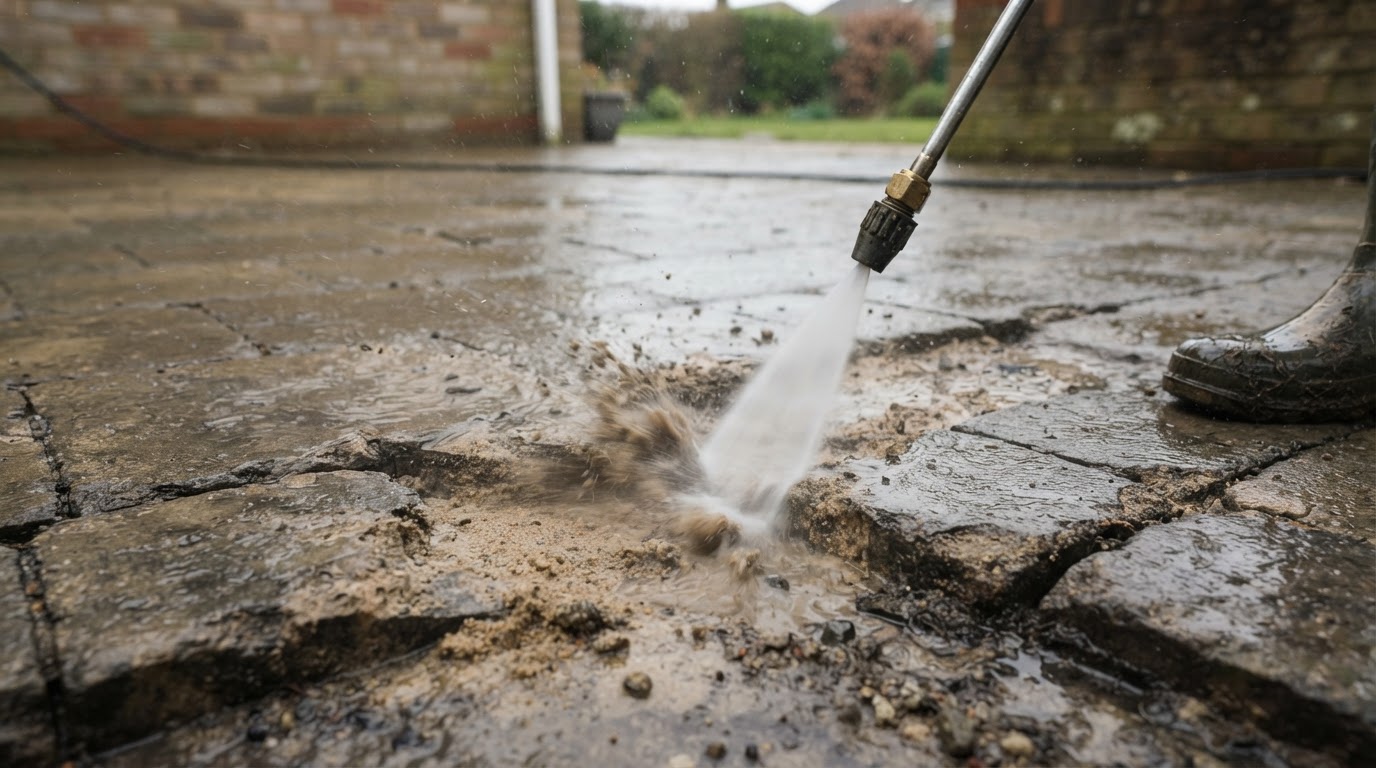
If that kinetic energy is delivered via an improper tool—such as a 0-degree red pencil-jet nozzle or a turbo lance held 2 inches from the surface—it can strip away the fine aggregate layer on concrete blocks, gouge out jointing sand beneath the sub-base, and cause surface pitting.
Conversely, professional driveway cleaning services use high-flow, regulated-pressure washers connected to enclosed rotary surface cleaners (often referred to as 'whirlybirds'). These tools split water volume across dual spinning jets that hover at a fixed height and precise 45-degree angle, removing grime evenly without blasting away the block face.
What Actually Causes Block Paving Damage During Cleaning?
When block paving suffers damage during cleaning, it is almost always caused by one of six specific factors:
- Excessive Pressure (PSI) with Low Water Flow (GPM): Cheap domestic pressure washers rely on extreme pressure (3,000+ PSI) forced through a tiny water nozzle to create cleaning power. Professional machines rely on high water flow (15–21 litres per minute) at moderate pressure (1,800–2,200 PSI), which floats away debris without scouring the block surface.
- Incorrect Nozzle Angle: Blasting water directly down into block joints at a 90-degree angle strips out deep bedding sand layer below the blocks, washing away the sub-base and causing localized sinking.
- Tiger-Striping Stains: Using a standard handheld lance back and forth across block paving creates uneven streaks known as 'tiger-striping'. Some areas get scoured while adjacent areas remain dirty.
- Surface Scouring on Aged Concrete Blocks: Older concrete blocks (15+ years old) often have a thin cement-rich top coat over coarser aggregate. High-pressure jetting can strip this top layer, exposing the rough stone underneath and accelerating future moss growth.
- Failure to Re-Sand: Washing out jointing sand without sweeping in fresh kiln-dried or polymeric sand afterwards destabilizes the paving blocks. Read our dedicated article on why re-sanding block paving is essential after cleaning for a complete breakdown.
- Ignoring Existing Structural Sub-Base Damage: If a driveway already has sunken blocks or cracked sub-bases from heavy lorries, high-pressure water can wash further sand out from beneath the blocks, expanding the sunken area.
Can Pressure Washing Remove Jointing Sand?
Yes, and in fact, it should remove the top layer of contaminated jointing sand. Over time, original jointing sand gets filled with windblown soil, dead leaves, and weed seeds (as explained in our guide on why weeds grow between block paving).
To clean a driveway thoroughly, the old, organic-rich top sand must be washed out so that moss taproots and algae spores are completely extracted. However, the key is removing only the top 15mm to 25mm of jointing sand—not blasting 100mm deep into the bedding layer beneath the blocks.
Once the driveway dries completely over 24 to 48 hours, fresh, dry kiln-dried silica sand or hard-setting polymeric sand must be brushed back into the joint voids to restore structural interlock.
Can Pressure Washing Loosen Blocks?
On a structurally sound driveway where edge restraints (kerbs and concrete haunching) are intact, pressure washing will not loosen blocks. Flexible block paving stays locked in place by lateral sand friction.
However, if a driveway has broken edge restraints, loose border blocks, or areas where ants have excavated bedding sand, aggressive pressure washing can push unbonded blocks out of alignment. A professional technician will inspect edge haunching prior to washing and adjust pressure levels accordingly around vulnerable perimeter zones.
Can Pressure Washing Damage Old or Weathered Block Paving?
Older block paved driveways—particularly those installed 15 to 25 years ago—require a gentler touch. Over decades of exposure to UK rain, frost, and traffic, the surface paste on concrete blocks naturally wears down.
If an inexperienced operator uses maximum pressure on a weathered concrete block driveway, they can wash away loose aggregate particles, leaving the surface rough and porous. Once porous, blocks absorb water more readily, making them even more susceptible to lichen ('white spot' and 'black spot') and winter frost damage.
For older or delicate block paving, professionals utilize low-pressure soft-washing techniques. Soft-washing uses specialized biocide solutions to break down organic growth chemically at low pressure, requiring only a gentle rinse afterwards.
DIY Pressure Washing vs Professional Driveway Cleaning
Understanding the difference between a DIY hire machine and commercial driveway restoration explains why results and safety vary so significantly:
| Feature | DIY Pressure Washing | Professional Driveway Cleaning |
|---|---|---|
| Equipment Type | Domestic electric washer (1.5–2.5 GPM, fixed lance) | Commercial petrol washer (15–21 L/min, rotary surface cleaner) |
| Pressure Control | Fixed high pressure; high risk of surface scouring | Fully variable pressure calibrated to block age and type |
| Surface Finish | Frequent tiger-striping and uneven streaking | 100% uniform, swirl-free deep clean across every block |
| Joint Sand Protection | High risk of digging deep into sub-base bedding layer | Controlled depth extraction of top organic silt only |
| Chemical Treatment | Water only; algae spores return within months | Soft-wash biocide kills lichen and moss spores deep in joints |
| Re-Sanding & Finishing | Often omitted or brushed into damp joints improperly | Expert re-sanding with dry kiln-dried or polymeric sand |
When Pressure Washing Is Appropriate for Block Paving
Pressure washing—when executed with professional rotary equipment—is the ideal cleaning solution for:
- Modern Concrete Block Paving: Drives under 15 years old in good structural condition.
- Clay Pavers: Highly dense clay blocks that resist water absorption and surface scouring.
- Heavy Moss & Lichen Infiltration: Surfaces where thick moss cushions must be mechanically dislodged from joints.
- Oil & Grime Removal: Driveways with accumulated motor oil or traffic film that require heated water or specialized detergents alongside surface washing.
When an Alternative Cleaning Method Is Better
For certain block paved surfaces across Sussex and Surrey, high-pressure washing should be replaced or supplemented by alternative methods:
- Very Old / Crumbling Concrete Blocks: Pure soft-wash biocide treatments apply chemical cleaning agents at low garden-hose pressure, allowing black spot lichen to dissolve over several weeks without disturbing fragile block surfaces.
- Sunken or Damaged Driveways: Where blocks have already shifted or edge concrete is cracked, localized repairs and re-laying must take place before any pressure washing occurs.
- Patio & Natural Stone Extensions: For delicate sandstone or slate patios attached to driveways, low-pressure steam cleaning or dedicated patio restoration techniques protect soft stone faces.
Real Homeowner Example: Comparing Two Surrey Block Driveways
To illustrate why tailored approach matters, consider two properties serviced by Skyhawk Exterior Cleaning in Guildford and Horsham:
Property A (Guildford): A 5-year-old 100m² driveway featuring modern Marshalls clay pavers covered in heavy winter moss. Because clay pavers are extremely hard-wearing, our team used a commercial 21 L/min rotary surface cleaner operating at 2,000 PSI. The moss and dirt were removed effortlessly in under 3 hours with zero paver damage. Once dry, fresh kiln-dried silica sand was brushed in, restoring the driveway to showroom condition.
Property B (Horsham): A 22-year-old 70m² driveway constructed with soft concrete blocks showing severe aggregate weathering and widespread 'black spot' lichen. High pressure would have scoured the weathered block face. Instead, we applied a professional soft-wash biocide treatment at low pressure, brushed the surface with medium-bristle brooms, rinsed at low pressure (800 PSI), and re-sanded the joints. The black spots vanished, the blocks remained completely undamaged, and the surface was preserved.
Both homeowners achieved outstanding results because the cleaning technique was matched precisely to the driveway's age and condition.
Key Takeaways
- Technique Over Power: Pressure washing only damages block paving when incorrect nozzles, excessive pressure, or poor angles are used.
- Rotary Cleaners Are Essential: Industrial rotary surface cleaners deliver uniform cleaning without streaking or blasting away surface aggregate.
- Controlled Sand Removal: Cleaning should flush out top organic silt from joints without gouging into the bedding sand below.
- Always Re-Sand: Replacing lost jointing sand with dry silica or polymeric sand is mandatory to maintain structural stability.
- Tailored Solutions: Older, weathered concrete blocks benefit from low-pressure soft-washing rather than aggressive high pressure.
Frequently Asked Questions
Can pressure washing damage block paving?
Yes—but usually only when excessive pressure, narrow pinpoint nozzles, or incorrect angles are used. Professional equipment and controlled pressure allow block paving to be thoroughly cleaned without surface damage.
Can pressure washing remove jointing sand?
Yes. Effective pressure washing naturally washes out the top layer of jointing sand along with moss and dirt. That is why replacing jointing sand with fresh kiln-dried or polymeric sand is an essential post-cleaning step.
Should block paving always be re-sanded after pressure washing?
Yes. Every flexible block paving surface relies on sand friction between blocks for load-bearing stability. Leaving joints empty leads to wobbly blocks, edge chipping, and water pooling.
Can pressure washing move paving blocks?
If a narrow high-pressure nozzle is held too close or aimed directly underneath loose edges, water pressure can dislodge unbonded blocks. Professional operators use flat rotary surface cleaners to distribute pressure evenly.
Can old or weathered block paving be pressure washed?
Old block paving can be cleaned, but requires lower pressure and specialized soft-wash treatments to prevent stripping away weathered decorative aggregate or damaging delicate clay block faces.
Should weeds be removed before pressure washing block paving?
Heavy taproot weeds are best scraped or treated with biocide prior to washing, allowing high-pressure surface cleaning to flush out remaining organic matter cleanly.
How often should block paving be cleaned?
Most driveways in Sussex and Surrey benefit from professional cleaning every 1 to 3 years depending on shade, nearby tree cover, drainage, and vehicle traffic. See our guide on how often to clean your driveway.
Can I pressure wash my own block paved driveway?
While DIY pressure washers can clean surface dirt, domestic machines lack variable pressure control and flat surface cleaners, increasing the risk of tiger-striping, joint gouging, and incomplete weed removal.
How do professionals clean block paving safely?
Professionals inspect block condition first, use industrial rotary surface cleaners to control water force, apply eco-friendly soft-wash treatments to kill algae spores, and re-sand joint lines once dry.
Does professional driveway cleaning use maximum pressure?
No. Modern professional cleaning balances flow rate and moderate pressure with soft-wash chemistry. Using maximum pressure is unnecessary and risks damaging delicate surfaces.
Arrange Your Free Driveway Inspection & Quote
Is your block paved driveway or patio due for a safe, professional clean? Skyhawk Exterior Cleaning provides fully insured, expert driveway cleaning, soft-washing, and re-sanding services across 130+ locations in Sussex and Surrey.
Check our frequently asked questions or get in touch with our expert team today.
Arrange a free video call quote, call us on 01293 922 243, or explore our complete exterior cleaning services today.