
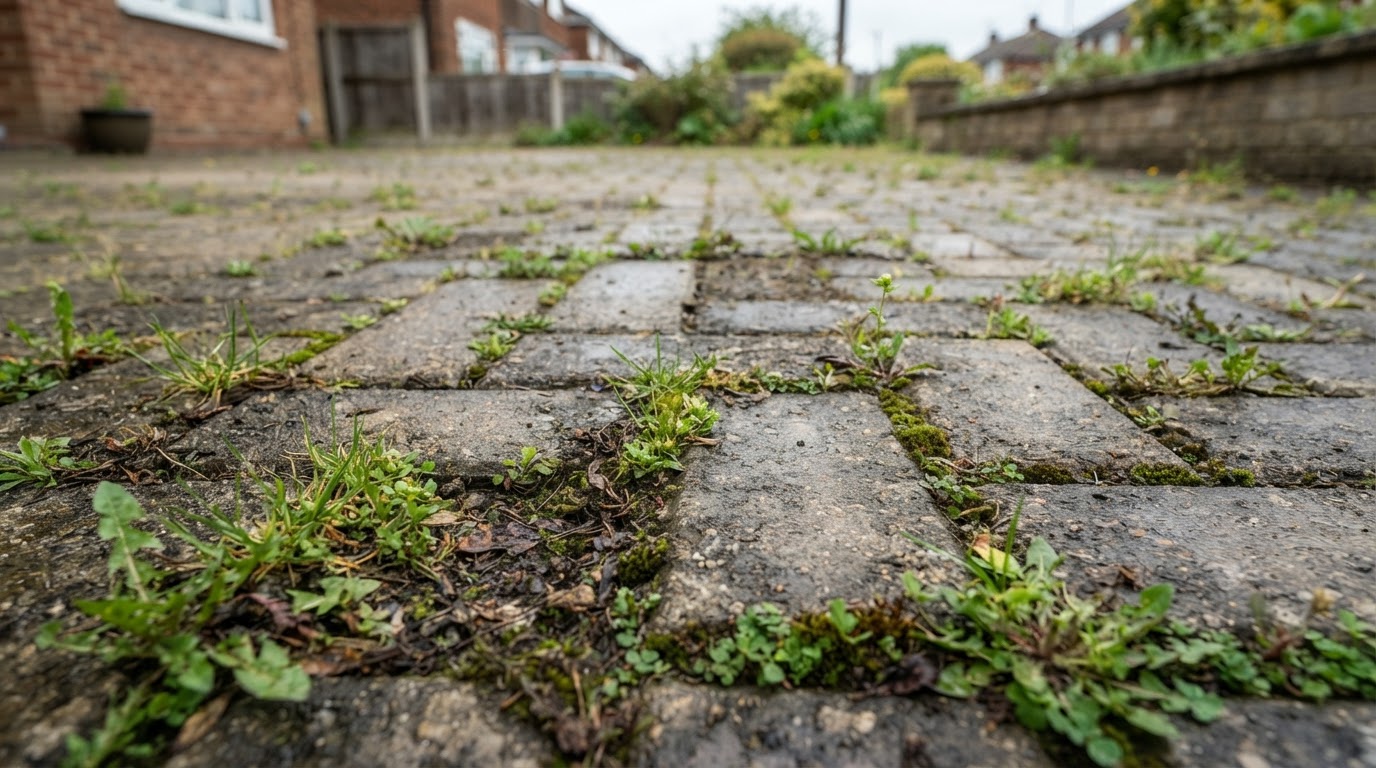
Block paving is one of the most popular, durable, and attractive choices for residential driveways and garden patios across Sussex and Surrey. From post-war suburban homes in Crawley and Horsham to executive properties in Guildford, Reigate, and Haywards Heath, block paved driveways create a smart, welcoming entrance to any property.
However, many homeowners face a constant, frustrating battle: green weeds, dandelions, moss, and grass sprouting uncontrollably along the narrow sand joints between the blocks. Within a few months of pulling them out, green shoots reappear, making an expensive driveway look untidy and neglected.
If you're asking: Why are weeds growing between my block paving? the direct answer is clear: Weeds do not grow up from underneath your driveway; airborne weed seeds land from above into the sand joints, where trapped organic dust, mud, and moisture create a perfect seedling bed.
Direct Summary:
Block paving weeds land from the air, taking root in the dirt and organic silt that collects in unsealed sand joints over time. Pressure washing alone won't keep them away—combining deep pressure washing, residual biocide treatment, and professional re-sanding with kiln-dried or polymeric sand is essential to prevent weeds returning.
In this guide, we break down the science of why block paving attracts weeds, explode the biggest myths about driveway maintenance, compare kiln-dried sand against polymeric jointing systems, and explain how professional driveway cleaning restores your paving to pristine condition.
The Biggest Myth About Block Paving Weeds
When homeowners see dandelions or stubborn taproots pushing out from between paving blocks, they almost universally assume that the weeds are growing up from the soil beneath the driveway sub-base.
This is a major misconception. A correctly installed block paved driveway consists of several heavily compacted structural layers:
- A compacted MOT Type 1 crushed stone sub-base (100mm–150mm thick)
- A layer of sharp sand bedding (25mm–40mm thick)
- Interlocking concrete or clay blocks (50mm–80mm thick)
- Silica jointing sand packed tightly into the vertical gaps
Light cannot penetrate these solid, compacted layers, and seeds cannot survive beneath 200mm of crushed stone and concrete. Unless your driveway was installed directly on raw topsoil without a geotextile membrane or sub-base—which is extremely rare—99% of weeds enter block paving from above.
How Dirt and Organic Matter Create Growing Conditions
If seeds aren't coming from below, where do block paving weeds come from?
Every single day, wind, traffic, lawnmowers, birds, and foot traffic deposit microscopic particles onto your driveway:
- Airborne Seeds: Dandelion clocks, thistles, wild grasses, and moss spores drift across Sussex and Surrey on the breeze, dropping directly onto your paving.
- Organic Silt & Soil: Rain and wind wash fine soil particles, tree sap, pollen, and decaying leaves off roof slopes and garden borders into the small recess at the top of each block joint.
- Vehicle Grime: Road dust, soot, and exhaust particulate settle into the jointing sand, providing essential minerals and nitrogen.
- Moisture Retention: Jointing sand absorbs rainwater and dries slowly, creating a warm, damp micro-climate inside the joint.
When an airborne seed lands in this moist, nutrient-rich pocket of organic silt, it germinates quickly. What started as clean jointing sand gradually becomes a mini flowerbed for weeds.
Why Pressure Washing Alone Doesn't Solve the Problem
When driveway weeds take over, many homeowners rent a domestic jet washer or fire up a pressure washer to blast the green shoots away. While high-pressure water delivers an immediate, satisfying transformation by stripping off top growth, jet washing alone is a short-term fix.
Here is why standard pressure washing without proper post-treatment fails to stop weeds:
1. Deep Taproots Remain Intact
Weeds like dandelions and dock leaves have long, fibrous taproots that anchor deep into joint crevices. A surface jet blast snaps the green stem off at ground level but leaves the root system alive inside the joint. Within 2 to 3 weeks, the surviving root sends up fresh shoots.
2. Washing Out Jointing Sand Creates Open Voids
High-pressure water blasts away the jointing sand holding the blocks together. If you clean the driveway but fail to replace this sand, you leave wide, hollow channels between every block. These empty gaps catch falling soil and seeds ten times faster than before!
3. Microscopic Spores Aren't Killed
Water alone cannot kill microscopic moss spores or lichen hyphae embedded in the porous concrete edges of the blocks. As soon as the sun comes out, remaining spores feed on residual moisture and multiply.
This is why professional pressure washing must always be paired with a soft-wash biocide treatment and fresh jointing sand.
Why Re-Sanding Is Essential After Block Paving Cleaning
Re-sanding block paving is not an optional extra—it is a fundamental structural requirement. The sand inside block paving joints serves two critical purposes:
- Structural Friction Interlock: Block paving relies on friction between individual blocks to spread heavy vehicle axle loads evenly across the sub-base. Without jointing sand, blocks can rock, tilt, sink, or spread apart when driven over.
- Weed & Water Barrier: Properly compacted, full sand joints restrict the space available for organic dirt to settle and prevent rainwater from pooling underneath the blocks.
When Skyhawk Exterior Cleaning carries out a block paving restoration, we allow the blocks to dry completely after washing before sweeping clean, dry jointing sand back into every gap and vibrating or brushing it deep into the joints.
Kiln-Dried Sand vs Polymeric (Hard-Setting) Sand
When re-sanding your driveway, homeowners in Sussex and Surrey can choose between two primary jointing materials: traditional kiln-dried silica sand or modern polymeric / hard-setting jointing sand. Here is how they compare:
| Feature | Kiln-Dried Silica Sand | Polymeric / Hard-Setting Sand |
|---|---|---|
| Best Use Case | Standard narrow joints (2mm–5mm), standard domestic driveways | Wider joints (3mm–15mm), high-weed risk areas, patios |
| Material Composition | 100% dry, fine natural silica sand | Graded silica sand blended with polymer binders |
| Curing / Setting Mechanism | Remains flexible, loose dry sand packed by gravity | Harden with water mist into a rubbery, erosion-resistant joint |
| Weed & Ant Resistance | Good (when combined with biocide post-wash) | Excellent (hard surface repels weed roots and ant digging) |
| Cost Level | Cost-effective, economical standard choice | Higher initial investment due to chemical polymer additives |
| Lifespan Before Maintenance | 1 to 2 Years | 3 to 5 Years |
Kiln-Dried Silica Sand
Kiln-dried sand is the traditional industry standard for standard block paving. Because it is completely dried in a kiln during manufacture, the fine particles flow smoothly into narrow 2mm to 4mm gaps without clumping. It provides excellent structural interlock at an affordable price. However, because it remains a loose sand, heavy rain or aggressive pressure washing can wash it away over time, requiring re-topping every 1 to 2 years.
Polymeric / Hard-Setting Sand
Polymeric sand contains organic binder polymers. After sweeping the dry mixture into the joints, it is lightly misted with water. The polymers activate and set into a firm yet flexible joint. This hard barrier resists erosion from heavy rain, prevents ants from digging out sand hills, and makes it extremely difficult for weed roots to penetrate. While polymeric sand costs more upfront, it extends the period between required driveway cleans.
How to Reduce Weeds Returning Between Block Paving
While no exterior cleaning company can prevent airborne seeds from landing on your property, taking a proactive approach dramatically reduces weed growth:
- Apply a Residual Biocide: Professional soft-wash biocide treatments (like BAC50) soak into the jointing sand and porous block edges, sterilising microscopic roots and delaying seedling germination for up to 12 months.
- Regular Sweeping: Sweeping your driveway once a fortnight with a stiff broom removes windblown seeds, soil, and leaves before they break down into fertile silt.
- Prompt Spot Treatment: If you spot a rogue dandelion seedling in midsummer, pull it out immediately or spray it before its taproot thickens.
- Consider Joint Sealing: Applying an acrylic or polyurethane paving sealer after re-sanding bonds the jointing sand together and seals block surfaces against dirt accumulation. Read how exterior maintenance enhances property value and appearance.
Can Weeds Damage Block Paving?
Yes. If left unchecked for years, weed infestation causes real physical damage to block paved driveways:
- Block Dislodgement & Shifting: Thick roots expand inside joints, pushing adjacent blocks apart and causing edges to chip or lip under car tires.
- Sunken Paving & Water Pooling: Deep roots absorb moisture and dislodge the underlying sand bed, causing localized dips where water collects in puddles.
- Paving Cracks: Woody weed roots (such as buddleia or sapling roots) exert enough pressure to crack concrete blocks over time.
In addition to driveway care, keeping adjacent hard surfaces clean—such as through professional patio restoration—prevents weed seeds from spreading across your garden landscaping.
Real Homeowner Example: Before and After Block Paving Restoration
Consider a typical 1980s 4-bedroom detached property in Maidenbower, Crawley. The block paved driveway had not been professionally cleaned in 4 years. Over 40% of the joint lines were choked with moss cushions, grass, and dandelions. The homeowner had tried pulling weeds by hand, but they returned within weeks.
Skyhawk Exterior Cleaning carried out a complete 4-step restoration:
- Deep Rotary Pressure Clean: Using a professional flat surface washer, we lifted built-up moss, dirt, and weeds while stripping out old, contaminated jointing silt.
- Biocide Application: We applied a deep-penetrating BAC50 biocide to sterilise joint crevices and kill remaining taproots.
- Drying Period: The driveway was allowed to dry completely over 24 hours to ensure no dampness remained in the joints.
- Kiln-Dried Re-Sanding: Fresh silica sand was brushed into every joint, restoring full structural interlock.
The result? The driveway looked brand new, the original rich red and charcoal block colours were fully restored, and the driveway remained 95% weed-free for over 18 months with basic sweeping.
Key Takeaways
- Weeds Come from Above: Weeds land as airborne seeds in organic silt trapped inside sand joints; they do not push up from underneath.
- Pressure Washing Is Only Step One: Blasting weeds with water without applying biocide leaves taproots alive and creates empty voids for fresh seeds.
- Re-Sanding Is Mandatory: Washing removes jointing sand; failing to re-sand causes blocks to sink, tilt, and rock under vehicle weight.
- Kiln-Dried vs Polymeric Sand: Kiln-dried sand is economical and ideal for standard joints; polymeric sand sets hard to provide superior weed and ant resistance.
- Biocide Extends Longevity: Professional soft-wash biocide treatments sterilise root pockets and delay weed germination for 12 to 24 months.
Frequently Asked Questions
Why do weeds grow between block paving?
Weeds grow in block paving because windblown seeds land in the narrow joints where accumulated organic silt, dust, and moisture provide a nutrient-rich seedling bed.
Can weeds grow up from underneath block paving?
No. It is a myth that block paving weeds push up through the hardcore sub-base or sand bed. Block paving sub-bases are compacted stone layers under heavy blocks; weeds almost exclusively enter from above via airborne seeds.
Does pressure washing block paving kill weeds?
Pressure washing removes visible green tops and washes out old jointing sand, but water pressure alone does not kill microscopic weed taproots or biological spores. Without biocide treatment and fresh sand, weeds return rapidly.
Why is re-sanding block paving essential after cleaning?
Jointing sand provides the friction interlock that locks paving blocks together. Washing removes this sand; failing to re-sand causes blocks to shift, tilt, and rock under vehicle weight, while leaving open voids for weed seeds.
What is kiln-dried sand?
Kiln-dried sand is ultra-fine, bone-dry silica sand specifically screened for block paving joints. Because it contains zero moisture, it flows freely to fill tiny joint crevices completely.
What is polymeric or hard-setting sand?
Polymeric sand is a blend of graded sand and binder additives. When brushed into joints and activated with a fine water mist, it hardens to form a durable flexible joint that resists weed root penetration and wash-out.
Will weeds come back after professional driveway cleaning?
No service can prevent windblown seeds from ever landing on a driveway again. However, professional cleaning combined with soft-wash biocide, fresh jointing sand, and optional sealants dramatically slows regrowth for 12 to 24 months. Read our guide on how often driveways should be cleaned for more tips.
How often should block paving be cleaned and re-sanded?
For most homes across Sussex and Surrey, a thorough clean, biocide treatment, and re-sanding every 1 to 2 years keeps block paving weed-free and structurally sound.
Can I spray weed killer on my block paving myself?
Domestic weed killers can kill existing surface weeds, but they leave dead roots and accumulated mud inside the joints, which promptly feeds the next batch of windblown seeds.
How do professionals stop block paving weeds from returning?
Professionals blast out dirt and deep roots using rotary surface cleaners, treat joints with residual biocide to sterilise root pockets, brush in clean kiln-dried or polymeric sand, and optionally apply a joint-locking sealer.
Arrange Your Free Block Paving Quote Today
We serve over 130 locations across Surrey and Sussex with fully insured, transparent, and high-quality exterior cleaning services. Explore our frequently asked questions or get in touch today.
Arrange a free video call quote, call our team directly on 01293 922 243, or explore our complete driveway cleaning services today.