
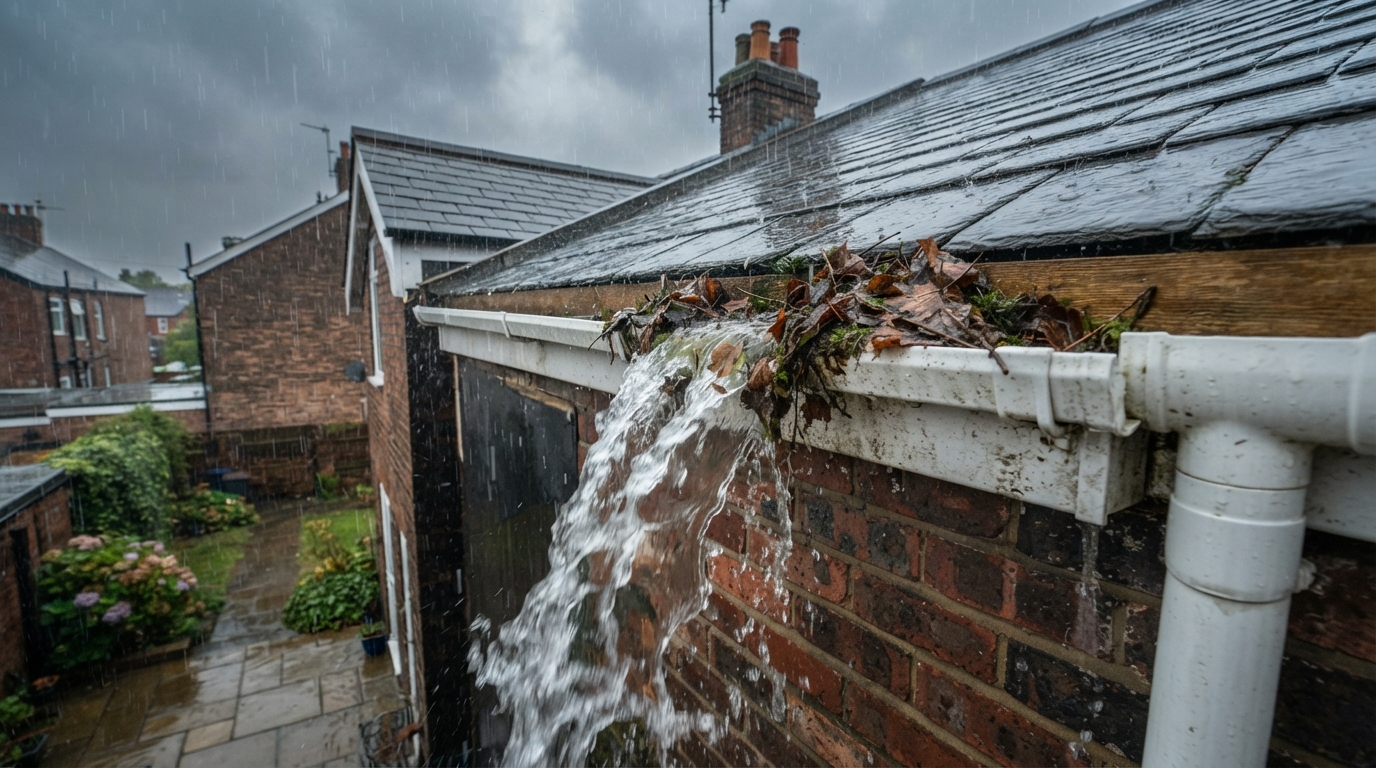
Gutters usually overflow because rainwater is unable to drain away efficiently. In many cases this is caused by leaves, moss or debris restricting the flow of water, although there can be several contributing factors such as blocked downpipes, incorrect pitch, or damaged joints.
Seeing water spill over the edge of your gutters like a waterfall during a rainstorm is a frustrating experience for any homeowner. Across Sussex and Surrey, rainy spells can quickly highlight weaknesses in domestic rainwater drainage systems. Left unaddressed, persistent rainwater overflow can wash away garden borders, saturate masonry, and eventually lead to external and internal damp issues.
Understanding why your gutters are overflowing is the first step toward rectifying the issue. While accumulated debris is the most frequent culprit, an overflowing gutter isn't always solved by cleaning alone—structural misalignments, damaged fittings, or inadequate capacity can also play a role.
How Gutters Are Designed to Work
Domestic rainwater systems are engineered to collect rainfall shedding off your roof tiles and transport it safely into ground-level drainage channels. A standard system comprises:
- Gutter Runs: Half-round, square, or ogee profile channels fixed along fascia boards, installed with a slight downward slope (fall) toward the outlets.
- Gutter Outlets & Swan Necks: Specialized drops that funnel collected water into vertical downpipes via curved swan-neck pipe fittings.
- Downpipes & Gullies: Vertical pipes that carry water to ground level, discharging into trapped drainage gullies, soakaways, or surface water sewers.
When every component is clear and correctly angled, rainwater flows continuously without pooling or spilling over the front or rear edges.
The Most Common Causes of Overflowing Gutters
When water begins spilling over your guttering during rainfall, one or more of the following issues is usually at play:
1. Blocked Gutters & Accumulated Debris
The single most common reason gutters overflow is a physical blockage inside the channel. Over months and years, gutters collect organic material including autumn leaves, pine needles, twigs, silt, and moss dislodged from roof tiles. As this material mats together, it forms a dense dam that stops water reaching the outlet. Rainwater accumulates behind the blockage until it spills over the lowest point of the gutter rim.
2. Blocked Downpipes & Swan Neck Bends
Sometimes the horizontal gutter channel looks relatively clear, yet water still backs up rapidly during rain. This usually points to a blockage in the vertical downpipe or swan-neck bend directly below the outlet. Leaves and clumps of moss easily lodge in the narrow 90-degree or 45-degree bends of downpipe swan necks. Because water cannot drop down the vertical pipe, it backs up into the gutter, causing sudden and dramatic overflowing around the drop outlet.
3. Roof Moss Washing Into Gutters
For homes across Crawley, Horsham, Guildford, and surrounding Sussex and Surrey towns with mature trees or shaded roof slopes, roof moss is a primary contributor to gutter blockages. Heavy rain dislodges clumps of moss, which roll down roof tiles directly into the guttering. Once inside, wet moss expands, trapping smaller leaves and silt to create stubborn obstructions. If your roof has heavy moss coverage, clearing gutters without addressing the roof moss means blockages will recur rapidly. Exploring professional roof cleaning or waterless roof moss removal eliminates the root cause.
4. Heavy Rainfall vs Blocked Gutters
Homeowners often ask whether extreme rainstorms naturally exceed gutter capacity. Modern UK uPVC gutters are sized to handle heavy rainstorms typical for Southern England. However, even a 10% reduction in channel capacity due to a light layer of silt or moss can cause gutters to overflow during torrential downpours. If water spills over during intense storms but flows normally during light drizzles, a partial blockage or minor capacity bottleneck is almost certainly present.
5. Gutters With the Wrong Fall (Incorrect Slope)
Gutters must be installed with a subtle downward gradient—typically 1 to 3 millimetres of fall per metre of guttering—toward the downpipe outlet. Over time, building movement, heavy snow loads, or loose fascia brackets can cause sections of guttering to lose their fall or develop low spots (belly dips). When this happens, water pools in the dip instead of flowing toward the downpipe, overflowing the front lip even when no physical debris is present.
6. Damaged, Leaking or Failed Gutter Joints
If water appears to be cascading from specific points along your gutter line rather than spilling evenly over the lip, you may be dealing with failed rubber union seals or cracked joints. Thermal expansion and contraction cause uPVC gutters to move slightly within union brackets. Over time, rubber gaskets perish or become displaced, allowing concentrated streams of water to leak through joints during rain.
7. Inadequate Number of Outlets or Undersized Gutters
On larger properties, extensions, or steep roof pitches with large surface areas, an insufficient number of downpipe outlets can cause water volume to exceed drainage capacity during sustained heavy rain. In these cases, water travels faster than the single outlet can drain, causing overflows near the ends of long gutter runs.
How to Tell Which Problem You Have
Observing your gutters during a rainstorm can help you identify the specific cause before booking professional assistance:
- Water spilling over the middle of a run: Typically indicates a localized debris blockage or a sagging low spot (incorrect fall).
- Water overflowing directly around the downpipe outlet: Points to a clogged swan-neck bend or downpipe blockage.
- Water dripping steadily from a single bracket or join: Suggests a perished rubber seal or cracked union joint.
- Water spilling over the back of the gutter against fascia boards: Indicates severe blockage or improper pitch tipping the channel inward.
Can Overflowing Gutters Damage Your Home?
While an overflowing gutter might seem like a minor cosmetic inconvenience, continuous unmanaged rainwater spill can lead to noticeable home maintenance issues over time:
- External Wall Staining & Algae: Cascading water leaves dark vertical tide marks and green algae growth across brickwork and render.
- Timber Fascia & Soffit Rot: Water backing up over the rear lip saturates timber fascias, leading to rot and structural weakness around rafter feet.
- Penetrating Damp: Persistent soaking of outer masonry can breach porous bricks or mortar joints, as explored in detail in our guide on whether blocked gutters cause damp.
- Ground-Level Splashback & Soil Erosion: Concentrated water dropping from height erodes garden beds, stains patio paving, and can bridge damp-proof courses.
How Professional Gutter Cleaning & Inspection Solves the Problem
Resolving an overflowing gutter begins with an accurate diagnosis. At Skyhawk Exterior Cleaning, we believe in honest advice—we determine whether your issue requires straightforward clearance, downpipe unblocking, or structural bracket adjustment.
Our professional gutter clearing service includes:
- High-Reach Vacuum Extraction: Utilizing powerful industrial vacuum systems with lightweight poles, we safely extract all leaves, moss, and silt from ground level.
- Downpipe & Swan Neck Clearance: We thoroughly inspect downpipe drops and clear trapped obstructions in swan-neck bends and gullies.
- Visual & Alignment Checks: We inspect gutter channels, bracket fixings, and joint seals, providing clear feedback if a joint repair or alignment correction is necessary.
- Combined Maintenance Options: Where roof moss is the primary source of gutter debris, we offer integrated solutions including gutter cleaning, professional roof cleaning, and preventative biocide treatments.
Key Takeaways
- Debris Is the Main Cause: Trapped leaves, moss, and silt account for the vast majority of overflowing gutter complaints.
- Check Downpipe Bends: Clogged swan-neck bends cause water to back up rapidly around the outlet drop.
- Roof Moss Feeds Blockages: Dislodged roof moss continuously fills guttering unless addressed at the source.
- Alignment & Seals Matter: Sagging brackets or perished union seals can cause overflows even when channels are free of debris.
- Proactive Maintenance Prevents Damage: Annual professional clearing ensures rainwater drains safely, protecting fascias and brickwork.
Frequently Asked Questions
Why do my gutters overflow in heavy rain?
Heavy rain exposes minor flow restrictions. Even a partial buildup of moss or leaves reduces channel capacity, causing rainwater to spill over the sides during intense downpours.
Can blocked downpipes cause overflowing gutters?
Yes. When a vertical downpipe or swan-neck bend becomes blocked, rainwater cannot drain away and backs up quickly into the main gutter channel, forcing water over the top.
Should gutters overflow at the joints?
No. Water dripping or pouring from gutter joints indicates perished rubber gaskets, unclipped union brackets, or cracked fittings that require resealing or replacement.
How do I know if my gutters are blocked or broken?
If water spills evenly over the lip or collects moss, it's likely blocked. If water leaks from specific seams or the channel visibly sags in the middle, bracket realignment or joint repair may be needed. You can review our full guide on 10 signs your gutters need cleaning for more detail.
Can roof moss cause my gutters to overflow?
Regularly, yes. Clumps of moss dislodged from roof tiles fall into gutter channels and swell when wet, creating thick dams that block rainwater flow.
Can overflowing gutters cause damp in my walls?
Yes. Continuous water cascading down exterior walls saturates masonry and mortar, which can eventually penetrate through to interior plasterwork.
Do gutters need repairing or just cleaning?
The vast majority of overflowing gutters simply require a thorough professional clearance and downpipe flush. However, if brackets are broken or joints have failed, targeted repairs may be recommended.
Should gutters overflow during major storms?
Well-maintained UK gutter systems are designed to handle heavy rainfall. Overflowing during typical storms usually indicates restricted channel capacity or inadequate outlet distribution.
How often should domestic gutters be cleaned?
We recommend having gutters professionally inspected and cleared at least once a year—ideally in late autumn after leaf fall—or more frequently if your property has overhanging trees or roof moss.
How can I get an accurate quote for gutter cleaning?
You can quickly book a free video call survey with Skyhawk, call our team on 01293 922 243, or consult our frequently asked questions page for honest, expert advice.
Arrange Your Free Gutter & Exterior Cleaning Quote
Don't let overflowing gutters compromise your property's exterior. Skyhawk Exterior Cleaning delivers professional, fully insured gutter clearing and exterior maintenance across Crawley, Horsham, Guildford, Reigate, and surrounding Sussex and Surrey areas.
Book a free video call quotation today, contact us on 01293 922 243, visit our gutter cleaning service page, or check our gutter cleaning cost guide for pricing from £85 + VAT.