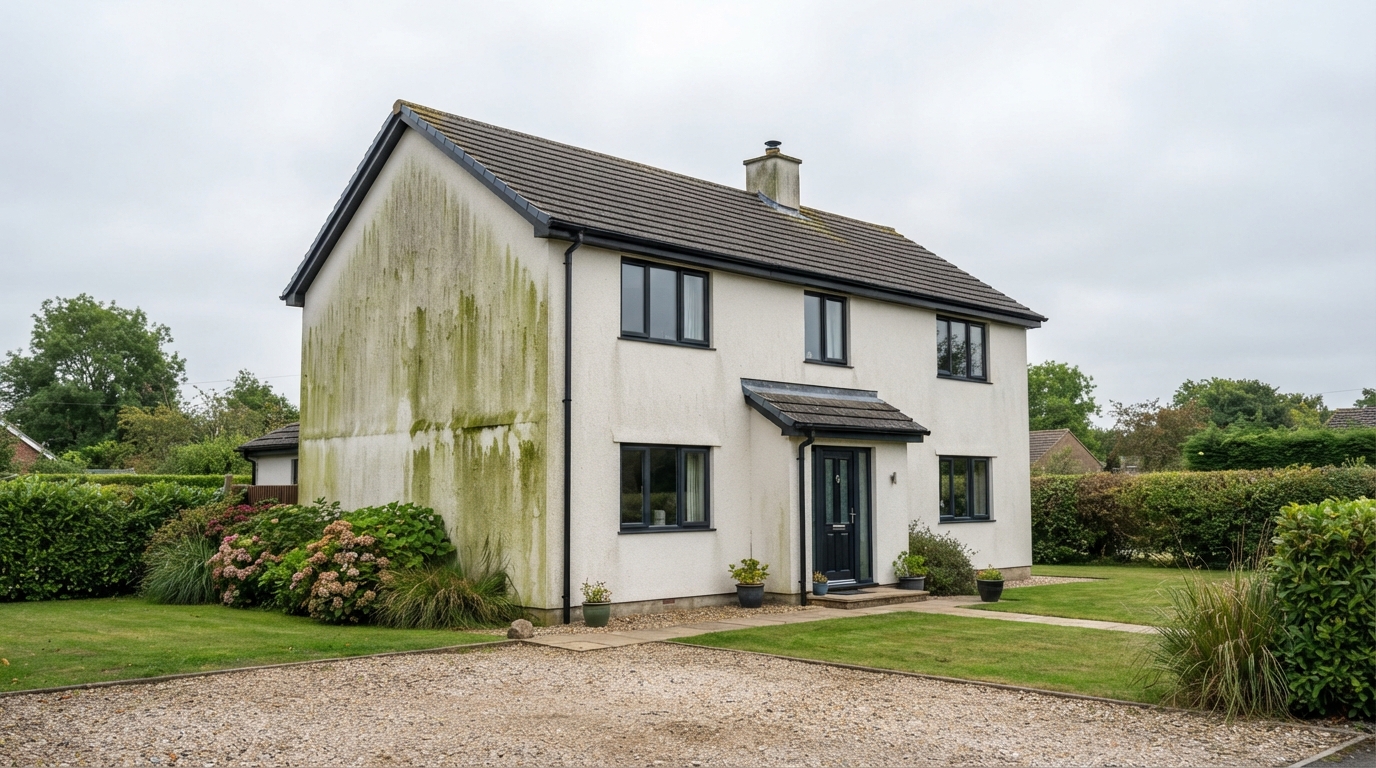
K Rend is one of the most widely used silicone render systems on homes across Sussex and Surrey. It provides a durable, attractive, low-maintenance finish that holds its colour well—but like any external surface, it is not immune to the effects of the British climate. Over time, algae, atmospheric dirt and organic staining can leave K Rend looking green, tired and neglected.
K Rend is designed to provide a durable, attractive finish, but like any external surface it can develop algae, dirt and atmospheric staining over time. Cleaning it safely requires selecting the correct method for the condition of the render rather than automatically using high-pressure washing.
In this guide, we explain what K Rend is, why it becomes stained, which cleaning methods are suitable, and why every K Rend installation should be assessed individually before any cleaning begins. If you have noticed green or black marks appearing on your rendered walls, this will help you understand the safest way to restore them.
What Is K Rend?
K Rend is a silicone-render system manufactured in the UK and commonly used on both new-build and renovated properties. Unlike traditional cement render, K Rend incorporates silicone technology that makes the surface water-resistant while still allowing the wall to breathe. The colour runs throughout the render, meaning there is no painted top coat to flake or fade.
Key characteristics of K Rend include:
- Through-coloured: The colour is integral to the render, not applied as a surface coating.
- Water-resistant: The silicone content helps the surface repel water and resist dirt.
- Vapour-permeable: The render allows moisture to escape from the wall, reducing the risk of trapped damp.
- Textured finish: K Rend is typically finished with a scraped or textured surface that gives it its distinctive appearance.
These properties make K Rend a popular choice, but they also mean the surface needs to be cleaned carefully. The textured finish and through-coloured surface can be damaged by aggressive cleaning methods.
Why Does K Rend Become Green or Black?
Despite its water-resistant properties, K Rend is not completely self-cleaning. Over time, organic and environmental contamination can build up on the surface, particularly in certain conditions.
The most common causes of staining on K Rend include:
- Algae: The most common cause of green staining. Algae thrive on damp, shaded surfaces where sunlight cannot dry the wall.
- Mould and mildew: Fungal growth can appear as black or dark grey patches, particularly in sheltered areas.
- Atmospheric dirt: Dust, pollution and airborne particles gradually settle on the render, especially in urban or roadside locations.
- Organic debris: Trees, climbing plants and nearby vegetation can deposit organic matter that encourages staining.
- Mineral staining: In some cases, water running across the render can leave mineral deposits that appear as white or dark streaks.
The rate at which K Rend becomes stained depends largely on the environment. Shaded, north-facing walls, properties surrounded by trees, and homes in damp or exposed locations will typically show staining more quickly than south-facing walls in open, sunny positions.
Can You Pressure Wash K Rend?
This is one of the most common questions we are asked, and the honest answer is: it depends. K Rend is more tolerant of water than some render systems because of its silicone content, but that does not mean it should be cleaned with a pressure washer at full power.
Manufacturer guidance generally advises against high-pressure washing of K Rend surfaces. The risks of using excessive pressure include:
- Surface damage: The textured finish can be altered or removed, leaving visible patches.
- Lance marks: Streaks and lines where the pressure washer has been held too close, which are difficult to blend.
- Water ingress: High-pressure water can be forced behind the render, potentially leading to damp or blown render.
- Colour alteration: Aggressive cleaning can leave the surface looking patchy or lighter in areas.
However, a controlled, low-pressure rinse used as part of a wider cleaning process may be appropriate in some situations. The key distinction is between high-pressure blasting and carefully managed low-pressure rinsing. A professional will only use low-pressure rinsing when the render is in sound condition and the cleaning products have already done the work of breaking down the staining.
You can read more about this distinction in our guide on pressure washing render.
What Cleaning Methods Are Commonly Used?
There is no single cleaning method that suits every K Rend installation. The most appropriate approach depends on the condition of the render, the type and severity of the staining, and the manufacturer's guidance where applicable.
The cleaning methods most commonly used on K Rend include:
- Soft washing: Applying specialist render cleaning products at low pressure to break down algae and organic growth, followed by a gentle rinse.
- Low-pressure rinsing: Using controlled, low-pressure water to remove loosened staining without saturating or marking the surface.
- Specialist cleaning products: Render-specific biocides and cleaning solutions designed to target organic growth without damaging the render.
In most cases, a combination of these methods produces the best results. The cleaning products do the work of breaking down the contamination, and a gentle rinse removes the loosened staining without risking damage to the render surface.
Why Soft Washing Is Often Suitable
Soft washing is often the preferred method for cleaning K Rend because it treats the cause of the staining rather than simply blasting the surface. Algae, mould and organic growth are broken down at a molecular level by specialist cleaning products, which means the staining is removed without the need for aggressive physical force.
The benefits of soft washing for K Rend include:
- Preserves the surface texture: No aggressive scrubbing or high-pressure water that could alter the scraped finish.
- Targets the root cause: Biocidal cleaning products kill algae and spores, not just the visible staining.
- Even results: Soft washing treats the entire surface uniformly, avoiding patchy results.
- Longer-lasting results: Because the spores are treated, regrowth is typically slower than with pressure washing alone.
For green algae in particular, soft washing is usually the safest and most effective option. If your render is turning green, you can learn more in our guide on why render turns green.
How Professionals Assess K Rend
Before any cleaning begins, Skyhawk Exterior Cleaning assesses every K Rend property individually. The factors we consider include:
- Render type: Confirming that the system is K Rend and identifying the specific product and finish where possible.
- Age: Older K Rend may be more porous or more deeply stained, requiring a gentler approach.
- Condition: Checking for cracks, blown areas, loose sections or previous patch repairs that need careful handling.
- Type of staining: Algae, atmospheric dirt and mineral staining each require different treatments.
- Previous repairs: Patched or repaired areas may need a gentler approach to avoid drawing attention to the repair.
- Manufacturer guidance: Where appropriate, we consider the manufacturer's recommendations for the specific K Rend system.
- Access: Height, obstacles and surrounding surfaces all influence the chosen method.
Only after this assessment do we decide on the safest and most effective cleaning process. Depending on the property, professional cleaning may include:
- Soft washing with specialist render cleaning products.
- Low-pressure rinsing where appropriate and safe.
- Specialist cleaning products designed for K Rend and similar silicone render systems.
We never apply the same cleaning method to every property. The objective is always to achieve the best possible result safely, without risking damage to the render.
How to Help Keep K Rend Cleaner for Longer
Whilst no cleaning method permanently prevents regrowth, there are steps that can help keep K Rend looking cleaner for longer after a professional clean:
- Trim nearby vegetation: Trees, hedges and climbing plants that shade the render or deposit organic matter should be cut back where possible.
- Address drainage issues: Overflowing gutters or leaking downpipes that saturate the render should be repaired to reduce dampness.
- Consider a biocide treatment: A professional biocide application after cleaning can help slow the return of algae and organic growth.
- Monitor shaded elevations: North-facing and heavily shaded walls will need attention more frequently, so keep an eye on these areas.
- Don't wait years between cleans: Regular, gentle maintenance is easier and more effective than attempting to clean heavily stained render after years of neglect.
Environmental factors such as shade, nearby trees and weather exposure all influence how quickly staining returns. A property surrounded by mature trees in a damp, shaded location will need cleaning more frequently than an exposed, south-facing wall.
Comparison of Cleaning Methods for K Rend
| Cleaning Method | Typical Use | Considerations |
|---|---|---|
| Soft washing | Algae, green staining, organic growth | Gentle, preserves surface texture, treats root cause |
| Low-pressure rinsing | Removing loosened staining after soft washing | Only when render is sound and pressure is carefully controlled |
| Specialist cleaning products | Targeted treatment for specific staining types | Must be render-safe and applied at correct dilution |
Common Mistakes Homeowners Make
When K Rend becomes stained, it is understandable that homeowners want to tackle the problem quickly. However, some common mistakes can cause more harm than good:
- Assuming all render can be cleaned the same way: K Rend, monocouche, Weber and acrylic render all have different properties and require different approaches.
- Hiring a pressure washer without identifying the render type: High-pressure washing can permanently damage the textured finish of K Rend.
- Using bleach or harsh household chemicals: Domestic cleaning products can discolour the render or leave residue that attracts further growth.
- Scrubbing aggressively with stiff brushes: Physical scrubbing can alter the surface texture and leave visible marks.
If you are unsure which render system you have or which cleaning method is appropriate, professional assessment is always the safest first step.
A Real Example from Sussex
Consider a property we assessed in a leafy Sussex village. The home was a modern build with K Rend on all elevations. The south-facing front of the property looked clean and bright, with the original render colour clearly visible. The north-facing rear elevation, however, was heavily shaded by mature oak trees and had developed a thick green coating of algae.
The homeowner had assumed the entire render needed repainting. After a professional assessment, we identified that the render was in sound condition and that the green staining was entirely organic. We recommended a soft washing treatment with a render-specific biocide, followed by a gentle low-pressure rinse once the cleaning products had broken down the algae.
The result was a dramatic restoration of the original colour without any damage to the render surface. The homeowner was spared the cost and disruption of repainting, and the biocide treatment helped slow the return of algae on the shaded elevation.
This example illustrates why assessment matters. Two elevations of the same property had the same render system but needed different approaches based on their condition and exposure.
Key Takeaways
- K Rend is a durable, through-coloured silicone render, but it can develop algae and staining over time.
- Green staining is usually caused by algae, which thrives on damp, shaded surfaces.
- High-pressure washing is generally not recommended for K Rend and can cause permanent surface damage.
- Soft washing with specialist render cleaning products is often the safest and most effective method.
- Every K Rend property should be assessed individually before cleaning begins.
- Trimming vegetation, fixing drainage and applying biocide can help keep K Rend cleaner for longer.
- Professional assessment ensures the correct method is chosen for the specific render and condition.
Frequently Asked Questions
How do you clean K Rend?
K Rend is typically cleaned using soft washing techniques with specialist render cleaning products, followed by a gentle low-pressure rinse where appropriate. The exact method depends on the condition of the render and the type of staining.
Can K Rend be pressure washed?
High-pressure washing is generally not recommended for K Rend. However, a controlled low-pressure rinse may be used as part of a professional cleaning process when the render is in sound condition. Professional assessment is essential before any pressure is used.
Why is my K Rend turning green?
Green staining on K Rend is usually caused by algae growing on the surface. Damp, shaded conditions—particularly on north-facing walls or near trees—create the ideal environment for algae to develop.
Can black marks be removed?
Black marks are often caused by mould, mildew or atmospheric dirt. Specialist render cleaning products can usually reduce or remove these marks, though results depend on how deeply the staining has penetrated the surface.
Does K Rend need maintenance?
Yes. Whilst K Rend is designed to be low-maintenance, it is not maintenance-free. Periodic cleaning helps preserve its appearance and prevents organic growth from becoming established.
How often should K Rend be cleaned?
There is no fixed interval. Shaded, north-facing walls and properties surrounded by trees will need cleaning more frequently than exposed, south-facing walls. Most rendered properties benefit from cleaning every few years.
Can I clean K Rend myself?
Basic rinsing with a hose may remove light surface dirt, but specialist cleaning products and professional assessment are recommended for algae, black marks or widespread staining. DIY pressure washing is not advisable.
What chemicals are used to clean K Rend?
Professional render cleaning typically uses render-safe biocides and specialist cleaning solutions designed to break down organic growth without damaging the render. The products used should be specifically formulated for silicone render systems.
How long do results last?
Results vary depending on the environment. Shaded walls near trees will stain more quickly than exposed, sunny walls. A biocide treatment after cleaning can help slow regrowth and extend the time between cleans.
When should I call a professional?
If you are unsure which render system you have, if the staining is widespread, or if the render is aged or delicate, professional assessment is the safest first step. A professional can identify the render type and recommend the safest cleaning method.
Final Conclusion
K Rend is a high-quality render system, but it is not immune to the effects of the British climate. Algae, mould and atmospheric staining can develop over time, particularly on shaded and exposed elevations. The key to cleaning K Rend safely is understanding that the render system must dictate the cleaning method—not the other way around.
Soft washing with specialist render cleaning products is often the safest and most effective approach, treating the cause of the staining without risking damage to the surface. High-pressure washing should generally be avoided, and any low-pressure rinsing should only be carried out by a professional who has assessed the render and confirmed it is safe to do so.
Every K Rend property is different, which is why professional assessment is so important. If you are considering cleaning the K Rend on your property, explore our render and cladding cleaning services or learn more about when pressure washing is appropriate.
To get an accurate, upfront price, book a free video call quote or call our expert team on 01293 922 243. You can also view our frequently asked questions for more information.
Skyhawk Exterior Cleaning Ltd
9 Hylands Close, Crawley, RH10 6RX
Phone: 01293 922 243
Website: skyhawkexteriorcleaning.co.uk
Serving 130+ locations across Surrey & Sussex
Skyhawk Exterior Cleaning – A Hawk Eye for Detail.