
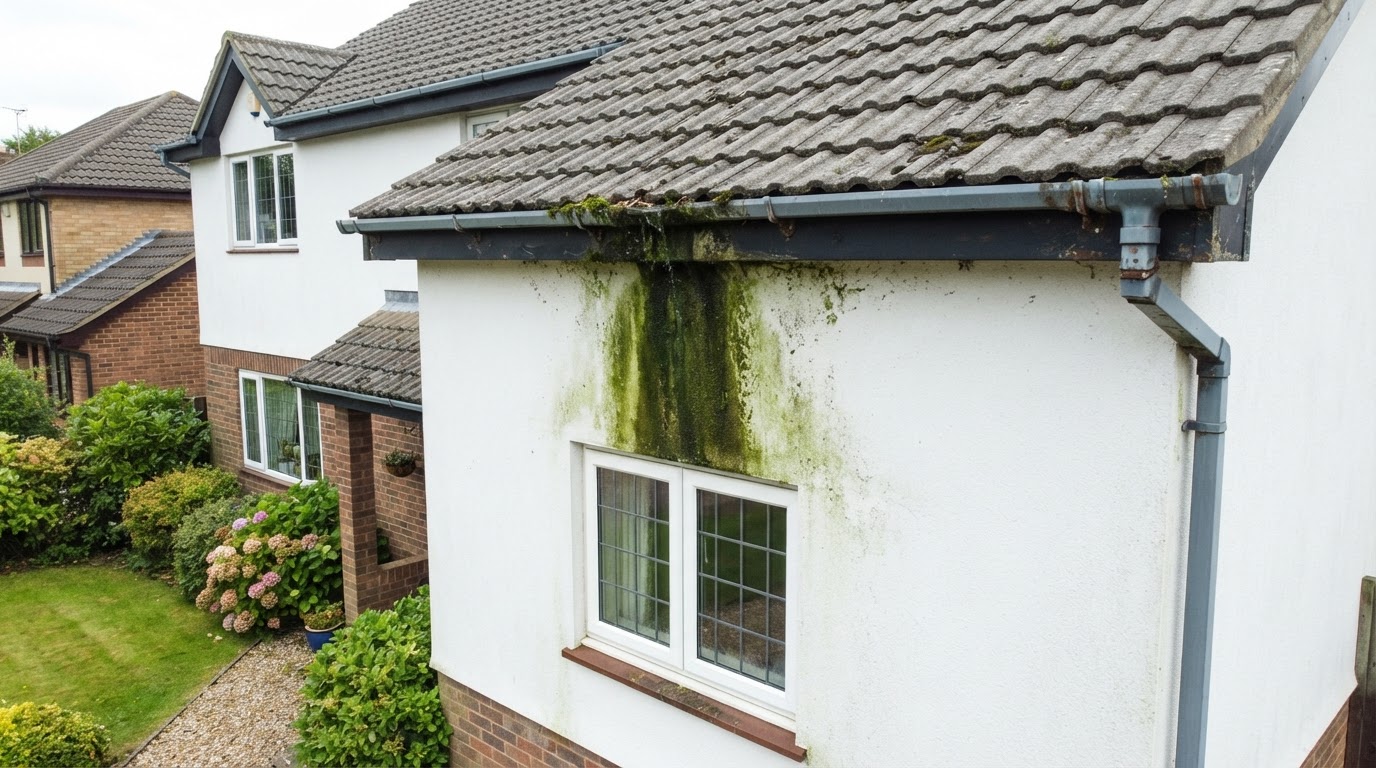
If you have noticed green patches, streaks or a dull green film spreading across the rendered walls of your home, you are not alone. It is one of the most common exterior maintenance questions we hear from homeowners across Sussex and Surrey, particularly during the damp, shaded months of the year.
Green staining on house render is usually caused by algae growing on the surface. Damp conditions, shaded areas and limited sunlight create the ideal environment for this organic growth to develop over time. The good news is that, in the vast majority of cases, green render can be safely and effectively cleaned without damaging the finish beneath.
In this guide, we explain exactly why render turns green, which properties are most affected, why pressure washing is rarely the right solution, and how professional render cleaning can restore the original appearance of your walls.
Why Does Render Turn Green?
Render is a porous surface. Even modern silicone and monocouche renders, which are designed to be more resistant to water absorption than older systems, still retain a microscopic texture that allows organic matter to settle and take hold over time.
The green staining you see is almost always algae. Algae are simple organisms that thrive wherever there is moisture, shade and a surface to cling to. When airborne spores land on a rendered wall and find those conditions, they multiply slowly, forming the green, brown or sometimes black film that gradually spreads across the surface.
This process does not happen overnight. It is usually the result of months or years of gradual growth, which is why many homeowners only notice it when the staining has become quite visible.
Is Green Render Causing Damage?
In most cases, green algae on render is not immediately damaging the structure of the wall beneath. It is a surface-level organic growth rather than a structural defect. However, that does not mean it should simply be ignored.
Left untreated, algae can:
- Continue to spread and become more deeply embedded in the render texture
- Trap moisture against the surface, which can accelerate weathering over time
- Leave behind permanent staining if left for extended periods
- Create a slippery, unsightly surface around shaded entrances and pathways
The longer algae is left, the harder it becomes to remove safely. Early cleaning is simpler, gentler and more effective.
Why Some Houses Are Affected More Than Others
Not every rendered property develops green staining at the same rate. The speed at which algae establishes itself depends almost entirely on the conditions the render is exposed to.
The most common factors are:
- Shade: Walls that receive little direct sunlight stay damp for longer, creating ideal growing conditions.
- Tree cover: Mature trees nearby drop organic debris and reduce airflow, keeping the render damp.
- Aspect: North-facing walls receive the least sun and dry slowest after rain.
- Drainage: Leaky gutters, overflowing downpipes or poor drainage can repeatedly saturate a wall.
- Weather exposure: Homes in more exposed, damp locations naturally see faster organic growth.
Two identical houses on the same street can develop very different levels of staining simply because one faces north and the other faces south.
Does North-Facing Render Become Dirty Faster?
Yes, in most cases. North-facing walls receive the least direct sunlight of any elevation, particularly during the autumn and winter months when the sun is low. This means the render stays damp for far longer after rainfall, and algae spores have the consistent moisture they need to thrive.
We frequently see this pattern across homes in Sussex and Surrey. A homeowner will contact us because one side of their property has turned noticeably green, whilst the opposite wall still looks relatively clean. In almost every case, the green wall is the north or east elevation, and the clean wall faces south or west.
This does not mean the algae is causing different damage on the shaded side. It simply means the conditions there are more favourable for growth, so the staining appears faster and more heavily.
Why Nearby Trees Make a Difference
Mature trees are a beautiful feature of many gardens across Sussex and Surrey, but they have a direct impact on exterior maintenance. Trees reduce airflow around a property, cast shade and drop organic debris such as pollen, sap and leaf fragments onto the render below.
This organic debris acts as a food source for algae and moss spores. Combined with the reduced sunlight and slower drying, a rendered wall beneath or close to mature trees will almost always develop green staining more quickly than an exposed wall in an open location.
If your property is surrounded by trees, you will likely need render cleaning more frequently than a home on an open, modern estate. This is not a fault of the render itself; it is simply a reflection of the environment.
Can Pressure Washing Damage Render?
This is one of the most important questions to ask before attempting to clean a rendered wall. The short answer is yes—pressure washing can damage render, and in many cases it is not the recommended approach at all.
Render is not the same as block paving or concrete. Many render systems, particularly monocouche, K Rend, Weber and silicone renders, have a coloured top coat or a delicate surface finish. High-pressure water can:
- Strip the surface coating and leave patchy, faded areas
- Force water behind the render, potentially causing damp issues internally
- Create visible lance marks or streaks that are difficult to blend
- Damage delicate details around windows, doors and architectural features
This is why professional pressure washing is not automatically the right choice for every surface. A professional assessment is essential before any cleaning method is selected.
How Professionals Safely Clean Render
Professional render cleaning is about selecting the gentlest effective method for the specific surface and type of staining. At Skyhawk Exterior Cleaning, we assess every rendered wall individually before deciding on the most appropriate approach.
The factors we consider include:
- Render type: Monocouche, K Rend, Weber, silicone, acrylic and painted render all behave differently.
- Age: Older render may be more fragile or more deeply stained.
- Existing condition: We check for cracks, blow areas or loose sections before cleaning.
- Type of staining: Algae, environmental dirt and mineral staining require different treatments.
- Access: Height, obstacles and surrounding surfaces influence the method.
- Previous repairs: Patched or repaired areas may need a gentler approach.
Depending on the assessment, professional cleaning may involve:
- Soft washing: Applying specialist render cleaning products that break down algae and organic growth at a low pressure, followed by a gentle rinse.
- Low-pressure rinsing: Where appropriate, a controlled rinse removes loosened staining without saturating the render.
- Specialist render cleaning products: Formulated to lift organic staining without damaging the render finish.
The aim is always to restore the original colour of the render without causing damage, patchiness or water ingress. This is why we never apply the same method to every property.
Which Render Systems Can Be Cleaned?
Skyhawk Exterior Cleaning has experience cleaning a wide range of render systems commonly found on homes across Sussex and Surrey, including:
- Monocouche render
- K Rend
- Weber render
- Silicone render
- Acrylic render
- Painted render, where the paint finish is sound enough to clean safely
Each system has its own characteristics. Some are more porous, some have a through-coloured finish, and others rely on a painted top coat. The cleaning method is always matched to the specific render to ensure the surface is treated safely.
Can Green Staining Be Prevented?
Green staining cannot be prevented entirely, because algae spores are always present in the air and will settle wherever conditions suit them. However, the rate of regrowth can be significantly reduced.
Practical steps include:
- Keeping gutters and downpipes clear so water does not overspill onto rendered walls. See our guide on why gutters overflow.
- Trimming back vegetation that shades or touches the rendered walls.
- Arranging professional render cleaning at the first sign of green staining, before it becomes deeply embedded.
- Considering a biocide treatment after cleaning, which helps slow the return of organic growth.
No cleaning method will keep render permanently free of algae, because the environmental factors remain. But regular, gentle cleaning keeps the walls looking fresh and prevents the staining from becoming permanent.
Common Causes of Green Render
| Cause | Likelihood | Typical Solution |
|---|---|---|
| Algae | Very high — the most common cause of green render | Soft washing with specialist render cleaning products |
| Shade | High — particularly on north-facing walls | Professional cleaning plus biocide to slow regrowth |
| Tree cover | High — organic debris feeds algae growth | Trim vegetation and arrange regular cleaning |
| Poor drainage | Moderate — overflowing gutters saturate walls | Repair drainage and clean the render |
| Weather exposure | Moderate — damp climates encourage growth | Periodic professional soft washing |
Common Mistakes Homeowners Make
When trying to deal with green render, homeowners sometimes take approaches that can make the situation worse rather than better.
- Using high-pressure washing. This can damage the render finish, force water behind the surface and leave permanent lance marks.
- Scrubbing aggressively. Abrasive scrubbing can wear the coloured top coat of monocouche and silicone renders.
- Using unsuitable household chemicals. Bleach and strong domestic cleaners can discolour render and harm surrounding plants.
- Leaving algae untreated for years. The longer organic growth is left, the more deeply it embeds and the harder it becomes to remove safely.
If you are unsure which render system you have or how it should be cleaned, it is always safer to seek professional advice before attempting any cleaning yourself.
Key Takeaways
- Green staining on render is almost always algae, not mould or a structural defect.
- Shaded, north-facing and tree-surrounded walls are most affected because they stay damp longer.
- Pressure washing is rarely suitable for render and can cause permanent damage.
- Professional soft washing using specialist products is the safest way to restore render.
- Every render system is different and should be individually assessed before cleaning.
- Regular cleaning prevents staining from becoming permanent and keeps regrowth slower.
Frequently Asked Questions
Why is my render turning green?
Green staining on render is usually caused by algae growing on the surface. Damp, shaded conditions with limited sunlight create the ideal environment for algae spores to establish and spread over time.
Is green render mould?
In most cases, no. The green film on rendered walls is typically algae rather than mould. Algae grow on the surface, whilst mould tends to develop in damp internal environments. A professional assessment can confirm which is present.
Can green render be cleaned?
Yes. Green algae staining can usually be safely removed using professional soft washing methods and specialist render cleaning products. The key is selecting a method that is gentle enough to protect the render finish.
Can I pressure wash render?
Pressure washing is not recommended for most render systems. High-pressure water can damage the surface coating, force water behind the render and leave visible streaks. Soft washing is usually the safer, more effective approach.
Why is one side of my house greener?
The greenest wall is usually the one that receives the least sunlight. North and east-facing walls stay damp for longer after rain, which creates the ideal conditions for algae to grow more quickly than on sunnier elevations.
Does render cleaning damage the finish?
Not when carried out professionally. A trained operative will assess the render type and condition before selecting the gentlest effective method. Damage usually occurs when unsuitable pressure or harsh chemicals are used without assessment.
How long do render cleaning results last?
Results vary depending on the environment. A shaded, tree-surrounded wall may show regrowth sooner than a south-facing wall. Regular cleaning and a biocide treatment help keep the render looking cleaner for longer.
Can algae come back?
Yes. Algae spores are always present in the air, so regrowth is possible over time. Professional cleaning removes the existing growth and a biocide treatment helps slow the return, but no method prevents algae permanently.
Can I clean render myself?
Basic rinsing with a low-pressure hose can remove loose dirt, but established algae usually requires specialist products and professional equipment. Attempting aggressive cleaning without the right approach risks damaging the render.
When should I call a professional?
If green staining is visible across a large area, if you are unsure which render system you have, or if the render is delicate or aged, professional assessment is the safest first step before any cleaning is attempted.
Final Conclusion
Green render is a common issue for homeowners across Sussex and Surrey, but it is not a sign that your walls are failing. In almost every case, it is simply algae taking advantage of damp, shaded conditions. The key is to have it cleaned safely and promptly, using a method that is matched to your specific render system.
Professional soft washing restores the original colour of the render without the risks associated with high-pressure washing. If you have noticed green staining spreading across your walls, arranging an assessment is the first step towards restoring the appearance of your home.
Explore our render and cladding cleaning services, or find out more about our approach to pressure washing and when it is not suitable.
To get an accurate, upfront price, book a free video call quote or call our expert team on 01293 922 243. You can also view our frequently asked questions for more information.
Skyhawk Exterior Cleaning Ltd
9 Hylands Close, Crawley, RH10 6RX
Phone: 01293 922 243
Website: skyhawkexteriorcleaning.co.uk
Serving 130+ locations across Surrey & Sussex