
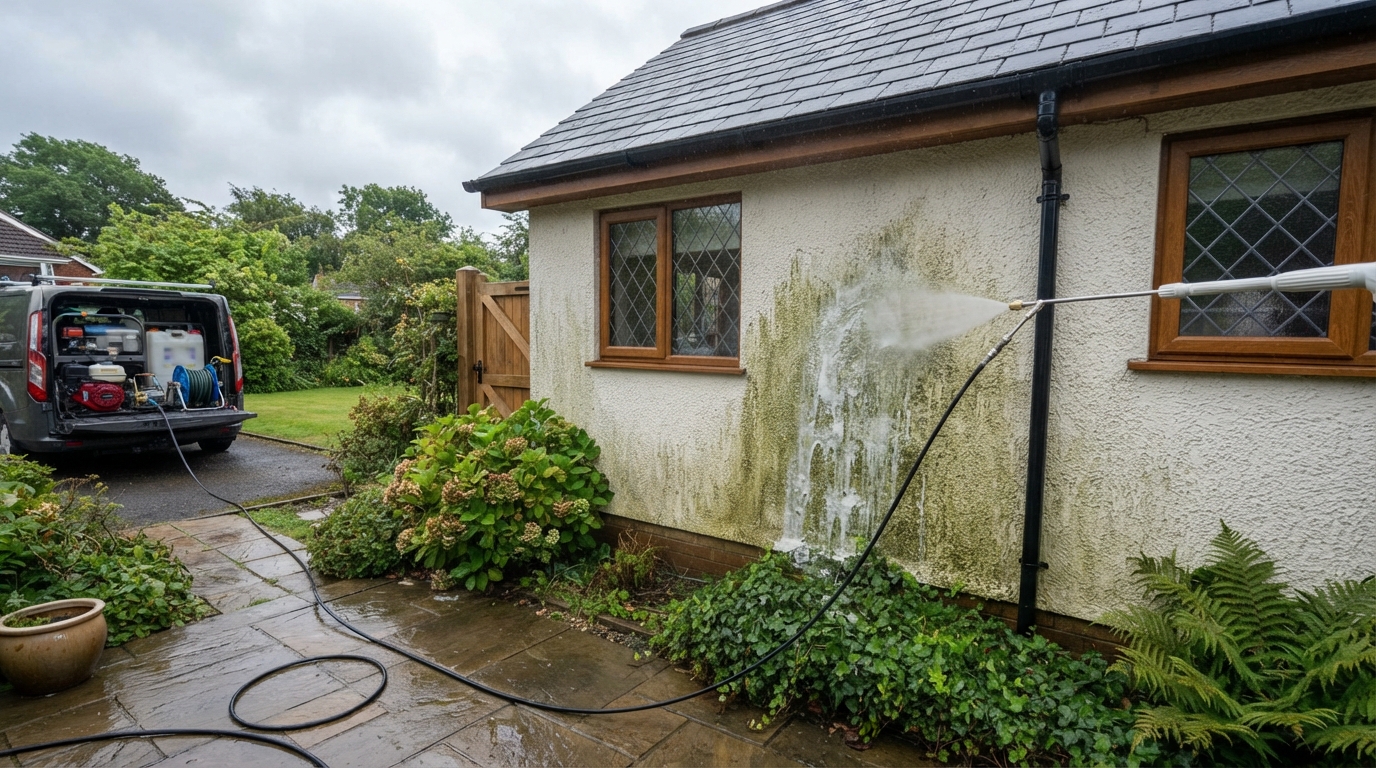
If you are looking at a green, stained or tired-looking rendered wall and wondering whether a pressure washer is the quickest way to bring it back to life, you are asking exactly the right question before picking up the lance. Render is one of the most common exterior surfaces we are asked about across Sussex and Surrey, and it is also one of the most easily damaged.
Sometimes—but not always. Whilst some rendered surfaces may tolerate carefully controlled low-pressure cleaning, many modern render systems are better suited to specialist soft washing techniques. The correct method depends on the render itself rather than applying the same approach to every property.
In this guide, we explain exactly when pressure washing may be appropriate for render, when it should be avoided, and why different render systems require different cleaning methods. If you are considering cleaning the render on your home, this will help you understand why a professional assessment is so important before any cleaning begins.
Why Homeowners Think Pressure Washing Is the Answer
Pressure washing has become the default cleaning method for many exterior surfaces, and for good reason. On block paving, concrete, patios and brickwork, a pressure washer can remove years of ingrained dirt, moss and algae quickly and effectively. It is easy to see why homeowners assume the same logic applies to render.
The problem is that render is not a solid, load-bearing surface like a patio or driveway. It is a relatively thin, often coloured coating applied to the exterior walls of a property. Many render systems rely on a delicate surface finish or a through-coloured top coat that can be permanently marked or removed by excessive pressure.
So whilst pressure washing feels like the obvious solution, applying it to the wrong render system is one of the most common causes of avoidable exterior damage we see across Sussex and Surrey.
Are All Render Systems the Same?
No—and this is the single most important point to understand before cleaning any rendered wall. There are several different render systems commonly used on UK homes, and they behave very differently when exposed to water pressure.
The most common render types include:
- Monocouche render: A through-coloured render that is scraped back to expose the aggregate. The colour runs throughout, but the surface texture is delicate.
- K Rend: A popular silicone-render system with a coloured top coat. It is designed to be water-resistant but the surface can be marked by high pressure.
- Weber render: Another widely used silicone or mineral render system with a fine surface finish that requires careful handling.
- Silicone render: Flexible and water-resistant, but the thin coloured top coat can be stripped by excessive pressure.
- Acrylic render: A painted-style finish that is particularly vulnerable to pressure damage.
- Painted render: Traditional render that has been over-painted. The paint layer is usually the weakest point and the most easily damaged.
Each of these systems has been designed and manufactured to perform in a specific way. Cleaning them with the wrong method can compromise that performance, sometimes irreversibly.
Which Render Types Require Extra Care?
All render systems require more care than hard surfaces like concrete or block paving, but some are particularly vulnerable.
Acrylic and painted render are generally the most at risk. Both rely on a painted or coated finish that sits on the surface of the render. High-pressure water can strip this coating, leaving patchy, faded areas that cannot be restored without re-painting the entire wall.
Monocouche and K Rend are through-coloured, which means the colour runs throughout the render rather than sitting on the surface. This makes them slightly more forgiving, but the scraped surface texture of monocouche can still be permanently altered by aggressive cleaning, leaving visible lance marks and an uneven finish.
Silicone render is designed to be water-resistant and self-cleaning to a degree, but the coloured top coat is still thin enough to be damaged by a pressure washer held too close or used at too high a setting.
In short, no common render system is truly designed to tolerate high-pressure washing.
What Can Happen If Excessive Pressure Is Used?
The risks of using excessive pressure on render go beyond simply marking the surface. The most common problems include:
- Surface stripping: The coloured top coat or painted finish is removed, leaving patchy, lighter areas.
- Water ingress: High-pressure water is forced behind the render, which can lead to internal damp or blown render over time.
- Visible lance marks: Streaks and lines appear where the pressure washer has been used, which are almost impossible to blend.
- Damage to details: Delicate areas around windows, doors and architectural features are chipped or broken.
- Uneven finish: The surface texture of scraped renders is altered, leaving an inconsistent appearance.
Once this damage is done, it is often irreversible without re-rendering or re-painting the affected area. This is why we always stress that professional render cleaning begins with an assessment, not a pressure washer.
What Is Soft Washing?
Soft washing is the preferred cleaning method for most modern render systems. Rather than relying on physical force, it uses specialist cleaning products applied at low pressure to break down algae, organic growth and environmental staining at a molecular level.
The process typically involves:
- Applying a specialist render cleaning solution that targets algae, mould and organic staining.
- Allowing the product time to work, breaking down the contamination without aggressive scrubbing.
- Rinsing the surface gently at low pressure to remove the loosened staining.
- In some cases, applying a biocide treatment to slow the return of organic growth.
Soft washing is effective because it treats the cause of the staining rather than simply blasting the surface. It is also far gentler on the render, which means the finish remains intact and the colour is not compromised.
For green algae in particular, soft washing is usually the safest and most effective option. You can read more about this in our guide on why render turns green.
When Is Low-Pressure Rinsing Appropriate?
There is an important distinction between high-pressure washing and low-pressure rinsing. A professional may use a controlled, low-pressure rinse as part of a soft washing process to remove loosened staining without saturating or marking the render.
Low-pressure rinsing is appropriate when:
- The render is in sound condition with no cracks, blown areas or loose sections.
- The correct cleaning products have already broken down the staining.
- The pressure is carefully controlled and the lance is kept at a safe distance.
- The render system is robust enough to tolerate a gentle rinse.
The key difference is control. A professional using a low-pressure rinse is doing so deliberately, with an understanding of the render system and its limitations. This is very different from a homeowner or untrained operative using a domestic pressure washer at full power close to the wall.
Why Different Render Systems Require Different Cleaning Methods
The reason we keep returning to the importance of assessment is that there is no universal cleaning method for render. A process that is safe on one property may be entirely unsuitable on another.
Consider two properties we might encounter in the same week:
Example one: A 1930s property with traditional render that has been over-painted several times. The paint is sound but aged. Here, a very gentle soft wash with a mild cleaning product and a low-pressure rinse may be appropriate, because the paint layer is stable enough to tolerate careful cleaning.
Example two: A modern new-build with a silicone render finish installed two years ago. The coloured top coat is thin and pristine. Here, soft washing without any pressure rinsing is likely the safest approach, because even a low-pressure rinse could risk marking the surface.
Both properties have render. Both have green algae. But the safest cleaning method is different for each. This is why a professional assessment is essential.
How Professionals Assess Render Before Cleaning
Before any cleaning begins, Skyhawk Exterior Cleaning assesses every rendered property individually. The factors we consider include:
- Render type: Identifying whether the system is monocouche, K Rend, Weber, silicone, acrylic or painted render.
- Age: Older render may be more fragile, more porous or more deeply stained.
- Existing condition: Checking for cracks, blown areas, loose sections or previous patch repairs.
- Type of staining: Algae, environmental dirt and mineral staining each require different treatments.
- Previous repairs: Patched or repaired areas may need a gentler approach to avoid drawing attention to the repair.
- Manufacturer guidance: Where appropriate, we consider the manufacturer's recommendations for the specific render system.
- Access: Height, obstacles and surrounding surfaces all influence the chosen method.
Only after this assessment do we decide on the safest and most effective cleaning process. Depending on the property, professional cleaning may include:
- Soft washing with specialist render cleaning products.
- Low-pressure rinsing where appropriate and safe.
- Specialist render cleaning products formulated to lift organic staining without damaging the finish.
We never apply the same method to every property, because no two rendered walls are exactly the same.
High Pressure Cleaning vs Soft Washing
| Feature | High Pressure Cleaning | Soft Washing / Low Pressure Cleaning |
|---|---|---|
| Suitable for | Hard surfaces like block paving, concrete, brickwork | Delicate surfaces including render, cladding and painted finishes |
| Risk level | High on render — can strip coatings and force water behind the surface | Low when carried out professionally — designed to protect the finish |
| Typical applications | Driveways, patios, hard landscaping | Rendered walls, cladding, painted surfaces |
| Organic growth removal | Removes surface growth but does not treat spores | Breaks down algae at the surface and treats remaining spores |
| Suitable render types | Generally not recommended for any render system | Suitable for monocouche, K Rend, Weber, silicone, acrylic and painted render |
Common Mistakes Homeowners Make
When it comes to cleaning render, the most common problems we see are caused by well-meaning attempts to clean the surface without understanding its limitations.
- Hiring the most powerful pressure washer available. More pressure does not mean better results on render. It usually means a higher risk of permanent damage.
- Assuming every render can be cleaned the same way. A method that is safe on a painted brick wall may be entirely unsuitable for a silicone render.
- Using harsh chemicals. Domestic bleach or aggressive cleaning products can discolour the render and damage surrounding plants and surfaces.
- Cleaning without identifying the render type. If you do not know whether your render is monocouche, K Rend, Weber or acrylic, it is not safe to assume any cleaning method will be suitable.
The simplest way to avoid these mistakes is to have the render professionally assessed before any cleaning is attempted.
Key Takeaways
- Pressure washing is not recommended for most render systems and can cause permanent damage.
- Soft washing is the preferred method for algae and organic staining on render.
- Different render systems—monocouche, K Rend, Weber, silicone, acrylic and painted—require different approaches.
- A professional assessment identifies the render type, condition and safest cleaning method before any work begins.
- Low-pressure rinsing may be appropriate in some cases, but only when carried out by a trained operative.
- The correct method depends on the property, not on a single technique applied to every wall.
Frequently Asked Questions
Can you pressure wash render?
In most cases, pressure washing is not recommended for render. Many render systems have a delicate coloured top coat that can be stripped or marked by high-pressure water. Soft washing is usually the safer and more effective alternative.
Can pressure washing damage render?
Yes. High-pressure water can remove the surface coating, force water behind the render, leave visible lance marks and damage details around windows and doors. In many cases this damage is irreversible without re-rendering or re-painting.
What is soft washing?
Soft washing is a low-pressure cleaning method that uses specialist products to break down algae, organic growth and staining at a molecular level. It is the preferred method for most modern render systems because it cleans effectively without damaging the surface.
Can K Rend be pressure washed?
K Rend is a silicone render system with a coloured top coat. Pressure washing is not recommended because it can mark the surface and compromise the water-resistant finish. Soft washing is the safer approach.
Can Weber render be pressure washed?
Weber render systems have a fine surface finish that can be damaged by high pressure. Professional soft washing with specialist products is the recommended method for cleaning Weber render safely.
How do professionals clean render?
Professionals assess the render type, age and condition before selecting the gentlest effective method. This usually involves soft washing with specialist render cleaning products, sometimes followed by a controlled low-pressure rinse and a biocide treatment.
Can algae be removed safely?
Yes. Green algae on render can usually be removed safely using soft washing methods. The cleaning products break down the algae without the need for aggressive pressure, protecting the render finish.
Will render cleaning change the colour?
Professional soft washing restores the original colour of the render by removing algae and staining. It should not change the colour of the render itself. If the colour appears different after cleaning, it is usually because the true colour has been revealed beneath the staining.
How often should render be cleaned?
There is no fixed interval. Shaded, north-facing walls and properties surrounded by trees will need cleaning more frequently than exposed, south-facing walls. Most rendered properties benefit from cleaning every few years, but the correct frequency depends on the environment.
When should I call a professional?
If you are unsure which render system you have, if the staining is widespread, or if the render is aged or delicate, professional assessment is the safest first step. A professional can identify the render type and recommend the safest cleaning method.
Final Conclusion
Pressure washing and render cleaning are not the same thing. Whilst pressure washing is an excellent method for hard surfaces like driveways and patios, it is rarely the right choice for render. Most modern render systems are too delicate to tolerate high-pressure water, and the damage it can cause is often permanent.
The safest approach is always to have the render professionally assessed before any cleaning is attempted. Soft washing, carried out with the correct products and an understanding of the specific render system, is the most effective way to restore the appearance of rendered walls without risking damage.
If you are considering cleaning the render on your property, explore our render and cladding cleaning services or learn more about when pressure washing is and is not appropriate.
To get an accurate, upfront price, book a free video call quote or call our expert team on 01293 922 243. You can also view our frequently asked questions for more information.
Skyhawk Exterior Cleaning Ltd
9 Hylands Close, Crawley, RH10 6RX
Phone: 01293 922 243
Website: skyhawkexteriorcleaning.co.uk
Serving 130+ locations across Surrey & Sussex
Skyhawk Exterior Cleaning – A Hawk Eye for Detail.