Homeowners across Sussex and Surrey frequently ask: Can you clean a roof yourself?
The short answer is: Whilst basic visual inspections and gutter checks can safely be carried out from ground level, climbing onto a roof or attempting DIY moss removal carries significant personal safety risks, potential for tile damage, and the risk of voiding home insurance or warranties. In almost all circumstances, hiring professional roof cleaning technicians equipped with specialist access gear and professional biocide treatments is safer, faster, and more cost-effective in the long run.
In this comprehensive guide, we discuss why homeowners consider DIY roof cleaning, what tasks can safely be performed from the ground, the physical dangers of working at height, how improper cleaning methods damage roof tiles, and when you should call in professional roof cleaning specialists like Skyhawk Exterior Cleaning.
Why Homeowners Consider DIY Roof Cleaning
It is easy to understand why homeowners consider tackling roof moss themselves. When moss cushions become visible from the driveway or drop onto patios in areas like Crawley, Horsham, Guildford, or Reigate, many people assume it is a simple weekend maintenance job similar to clearing gutters or pressure washing a driveway.
Common motivations for DIY roof cleaning include:
- Saving Money: Avoiding professional service costs by attempting a hands-on approach.
- Immediate Satisfaction: Wanting to remove unsightly moss cushions immediately after noticing them.
- Underestimating Roof Hazards: Assuming that walking on roof slopes is as straightforward as walking on flat ground.
- Online Video Tutorials: Watching generic DIY videos that fail to highlight the safety precautions, tile fragility, or UK Working at Height regulations required for safe roof maintenance.
What Can Safely Be Done From the Ground?
We always encourage proactive home maintenance, and there are several safe, routine checks every homeowner in Surrey and Sussex can undertake from ground level without climbing ladders or stepping onto roof tiles:
- Ground-Level Visual Inspections: Use binoculars or a smartphone zoom lens to safely inspect roof slopes from the lawn or driveway. Look for heavy moss accumulation, dislodged tiles, or dark algae streaks.
- Monitoring Gutter Downpipes: Watch your guttering during heavy rainfall. If water overflows over fascia boards or trickles down masonry, moss may be blocking outlets.
- Clearing Ground-Level Debris: Sweep up moss lumps that naturally dislodge during wind and rain storms to keep patios, driveways, and drains clean.
- Scheduling Professional Assessments Early: Arranging a free professional video survey early prevents moss from accumulating into severe infestations that choke gutters and cause dampness.
The Risks of Climbing Onto Your Roof
Working at height is officially classified by the UK Health and Safety Executive (HSE) as one of the single leading causes of occupational and domestic injuries. According to UK safety guidance, falling from ladders or roof edges accounts for thousands of hospital admissions every year.
Climbing onto your roof poses severe personal safety hazards:
- Slippery Surfaces: Wet moss, algae (Gloeocapsa magma), and wet tile glazes become as slick as ice. Stepping on wet moss is one of the most common causes of roof slips.
- Unstable Ladders: Standard domestic extension ladders are designed for leaning against stable walls, not for stepping onto pitched roof slopes without specialist ladder clamps and safety tie-offs.
- Lack of Fall Arrest Equipment: Professional technicians use accredited harnesses, safety ropes, mobile scaffolding, or cherry pickers. Domestic homeowners rarely possess this specialized fall-prevention gear.
- Structural Surprises: Rotten battens, weathered mortar beds, or cracked tiles underfoot can give way unexpectedly under body weight.
Can Walking on Roof Tiles Cause Damage?
Beyond personal safety, one of the biggest risks of DIY roof cleaning is causing accidental structural damage to your home's roof covering. Roof tiles are engineered to shed water, not to support heavy point loads from human footsteps.
Walking directly across roof tiles can result in:
- Cracked and Broken Tiles: Clay tiles, Rosemary tiles, and weathered concrete tiles become brittle with age. Stepping in the middle of a tile span rather than directly over the underlying batten line frequently snaps the tile.
- Disturbed Interlocks: Modern interlocking concrete tiles rely on precise plastic or concrete overlap channels. Dislodging these channels creates invisible gaps that allow wind-driven rain to penetrate into the loft space.
- Granule Loss on Concrete Tiles: Scrubbing or walking heavily across concrete tiles strips away the protective surface sand granules, accelerating tile weathering and shortening overall lifespan (read our guide on whether roof cleaning extends roof lifespan).
Why Choosing the Wrong Cleaning Method Can Create Problems
Roof cleaning is not a one-size-fits-all job. As explored in our comparative analysis on manual roof scraping vs pressure washing, using inappropriate methods or harsh chemicals can do far more harm than good.
Common DIY cleaning mistakes include:
| DIY Method | Hidden Risk / Danger | Long-Term Property Impact |
|---|---|---|
| High-Pressure Jet Washing | Forces water under tile laps into loft; strips tile granule coating | Internal ceiling leaks, damp insulation, reduced tile longevity |
| Unapproved Household Bleach | Harsh chemicals corrode lead flashing, gutters, and kill garden plants | Toxic runoff, stained brickwork, damaged leadwork sealants |
| Aggressive Metal Wire Brushes | Scratches protective factory glaze on clay and slate tiles | Increases surface porosity, causing moss to return twice as fast |
Is Pressure Washing Suitable for DIY Roof Cleaning?
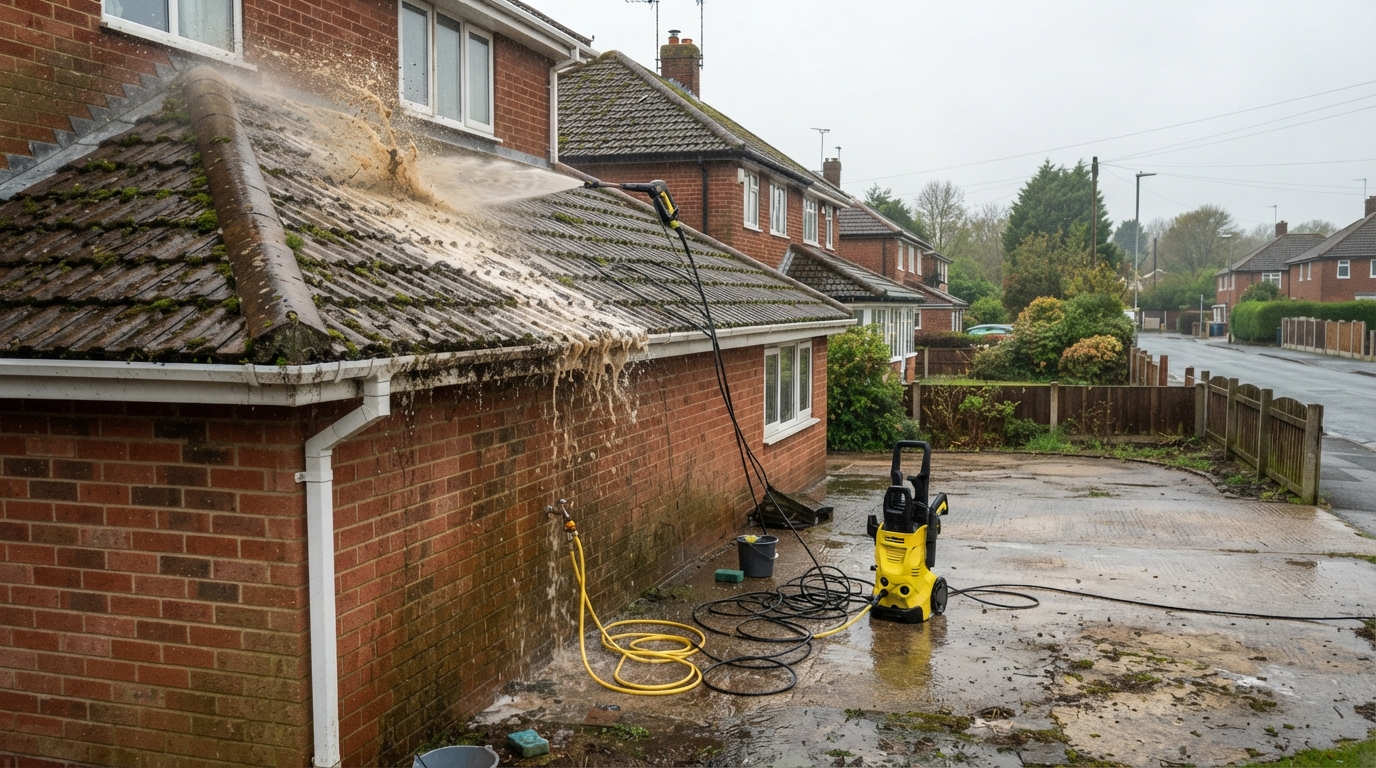
Many homeowners possess a domestic pressure washer and assume blasting moss off roof tiles is the quickest solution. However, domestic pressure washing on roofs is extremely hazardous:
Standard jet washers emit water at high pressure (often 150 to 200 bar). Pointing a pressure washer up a roof pitch forces water upward under the interlocking tile lips, soaking timber battens, sarking felt, and ceiling insulation. Furthermore, high-pressure water strips away the protective surface layer of concrete tiles, leaving them porous and far more susceptible to future moss infestation.
Professional exterior cleaning specialists use gentle waterless compressed-air scraping, custom-profiled tile scrapers, or controlled low-pressure softwashing systems specifically engineered for roof care.
Why Different Roofs Require Different Cleaning Methods
Every roof across Surrey and Sussex has unique characteristics based on age, tile material, pitch, and surrounding environment. What works safely for a 1990s concrete tile roof in Maidenbower may be destructive to a 100-year-old clay tile roof in Reigate or a natural slate roof in Chichester.
Professionals tailor their approach depending on:
- Tile Type: Clay tiles, concrete tiles, natural slate, synthetic slate, or pantiles require specific scraper profiles and chemical dilutions.
- Roof Age & Condition: Weathered roofs demand gentle, non-water methods like waterless compressed-air cleaning.
- Moss Density: Heavy moss cushions require manual scraping before applying a lingering BAC50 biocide treatment to eradicate invisible microscopic spores.
When Should You Call a Professional?
If you notice any of the following signs on your property, it is time to contact a professional roof cleaning company:
- Moss cushions covering more than 15-20% of your roof area.
- Moss constantly falling onto patios, driveways, or conservatory roofs.
- Gutters overflowing during rain storms due to internal moss blockages (explore our gutter clearing options).
- Roof moss flagged as a key defect in a recent home buyer survey (see our guide on roof survey moss and property value).
- Your property is multi-storey, steep-pitched, or difficult to access safely.
What Happens During a Professional Roof Cleaning Service?
When you choose Skyhawk Exterior Cleaning, you receive a comprehensive, safe, and fully insured roof restoration process:
- Initial Safety & Tile Inspection: We assess tile condition, roof pitch, access requirements, and identify any pre-existing broken tiles.
- Controlled Moss Removal: Depending on tile suitability, we perform manual scraping with custom-shaped tile blades or use our specialist waterless compressed-air system.
- Internal Gutter Clearing & Flush: We clear all roof moss, twigs, and silt from gutters and downpipes to ensure free water flow.
- BAC50 Biocide Application: We apply a professional-grade biocide treatment that penetrates deep into tile pores, killing hidden algae spores and providing long-term prevention.
- Full Ground & Site Clean-Up: We wash down windows, fascias, soffits, and surrounding patios, leaving your property immaculate.
- 2-Year Guarantee: You receive our written 2-year no-moss return guarantee for complete peace of mind.
Key Takeaways
- ✓ Basic visual inspections and sweeping dislodged moss from ground level can safely be done by homeowners.
- ✓ Climbing onto roofs presents severe fall hazards due to slippery wet moss and unstable footing.
- ✓ Walking on tiles frequently cracks clay or concrete coverings and dislodges weather-tight interlocks.
- ✓ High-pressure domestic jet washing forces water under tiles into loft spaces and strips protective tile coatings.
- ✓ Professional specialists use accredited working-at-height equipment, bespoke tile scrapers, and long-lasting biocide treatments.
Frequently Asked Questions
Can I scrape moss off my roof myself?
While you can physically scrape moss, doing so without specialist roof ladders, fall arrest harnesses, and custom tile scrapers carries severe safety risks and can easily crack fragile roof tiles.
Is roof cleaning dangerous?
Yes. Working at height on steep, wet, moss-covered roof slopes is one of the most dangerous domestic DIY tasks. Professional training, safety harnesses, and access towers are essential.
Can I pressure wash my own roof?
We strongly advise against domestic pressure washing. High-pressure water strips protective surface granules from concrete tiles, breaks mortar beds, and forces water under tile laps into insulation and ceilings.
Can I walk directly on roof tiles?
No. Roof tiles are not designed to support human body weight. Stepping directly onto tiles—especially older clay or slate tiles—frequently snaps them and damages the underlying battens.
How do I inspect my roof safely?
Inspect your roof safely from ground level using a pair of binoculars, a camera with a zoom lens, or by arranging a free professional video survey with a qualified exterior cleaning company.
Can moss damage roof tiles if left untreated?
Yes. As detailed in our article is roof moss damaging your roof, moss retains moisture against tiles, leading to freeze-thaw cracking during winter and blocked guttering.
Should I use household chemicals or bleach on my roof?
No. Household bleach and unapproved chemicals can corrode lead flashing, damage rubber seals, stain surrounding brickwork, and cause toxic runoff into garden borders and storm drains.
How often should my roof be inspected?
We recommend a ground-level visual inspection once a year, particularly in late autumn after leaf fall, or after major wind storms to ensure gutters are clear and tiles remain intact.
When should I call a professional roof cleaner?
Call a professional when moss covers noticeable sections of your roof, gutters are overflowing, moss is dropping onto driveways, or when preparing your property for sale.
Is professional roof cleaning worth the cost?
Yes. Professional roof cleaning typically costs between £999 and £2,160 inc VAT—a fraction of the cost of premature roof replacement (£10,000–£25,000)—while protecting your home from water damage and boosting kerb appeal.
Arrange Your Free Professional Roof Survey Today
Why risk your personal safety or property damage on DIY roof cleaning? Skyhawk Exterior Cleaning provides safe, professional, and fully insured roof cleaning services across Sussex and Surrey. Our expert technicians use gentle manual scraping, waterless compressed-air systems, premium BAC50 biocide treatments, and full gutter clearing—all backed by our 2-year no-moss return guarantee.
Book a free video call quotation with our team today or call us on 01293 922 243 for honest, professional advice.