When homeowners across Sussex and Surrey decide it is time to remove heavy moss from their roof tiles, they are quickly confronted with conflicting advice online. Some exterior cleaners insist that manual roof scraping is the only safe option, while others promote jet washing for an instant visual transformation.
This leaves property owners asking an essential question: when comparing manual roof scraping vs pressure washing, which method is actually better?
Direct Answer:
There isn't one single method that is right for every roof. The safest and most effective approach depends on the age, tile material, existing condition, and access of your property. Manual roof scraping is ideal for delicate, clay, slate, or heritage tiles, whereas controlled low pressure roof cleaning can be suitable for sturdy modern concrete tiles. Every roof requires an individual professional assessment.
In this guide, we provide an honest, balanced comparison of manual roof scraping vs pressure washing. We explore how each technique works, their respective pros and cons, the role of compressed air systems, and why a professional biocide treatment is crucial regardless of the method chosen.
Why Roof Cleaning Methods Matter
Your roof is designed to shed rainwater efficiently, protecting your home's structural timber, insulation, and interior ceilings. However, roof tile materials vary dramatically across Sussex and Surrey housing stock:
- Handmade or Machine-Made Clay Tiles: Commonly found on older period cottages and Edwardian properties in villages like Lindfield, Cuckfield, Dorking, and Midhurst. Clay tiles can become brittle with age and spall if subjected to harsh mechanical force.
- Natural or Synthetic Slate: Popular in historic town centres like Brighton, Guildford, and Chichester. Slate tiles require careful, non-aggressive handling to avoid cracking or lifting delicate copper nails.
- Interlocking Concrete Tiles: Standard on post-war and modern family estates in Crawley, Horsham, Haywards Heath, and Redhill. Concrete tiles are durable but feature a thin factory-applied surface coating that can erode if blasted aggressively.
Using the wrong cleaning technique on a fragile roof can cause irreversible tile damage, water ingress into loft spaces, and ruined mortar pointing. That is why choosing between professional roof cleaning options must always start with understanding the specific characteristics of your roof tiles.
What is Manual Roof Scraping?
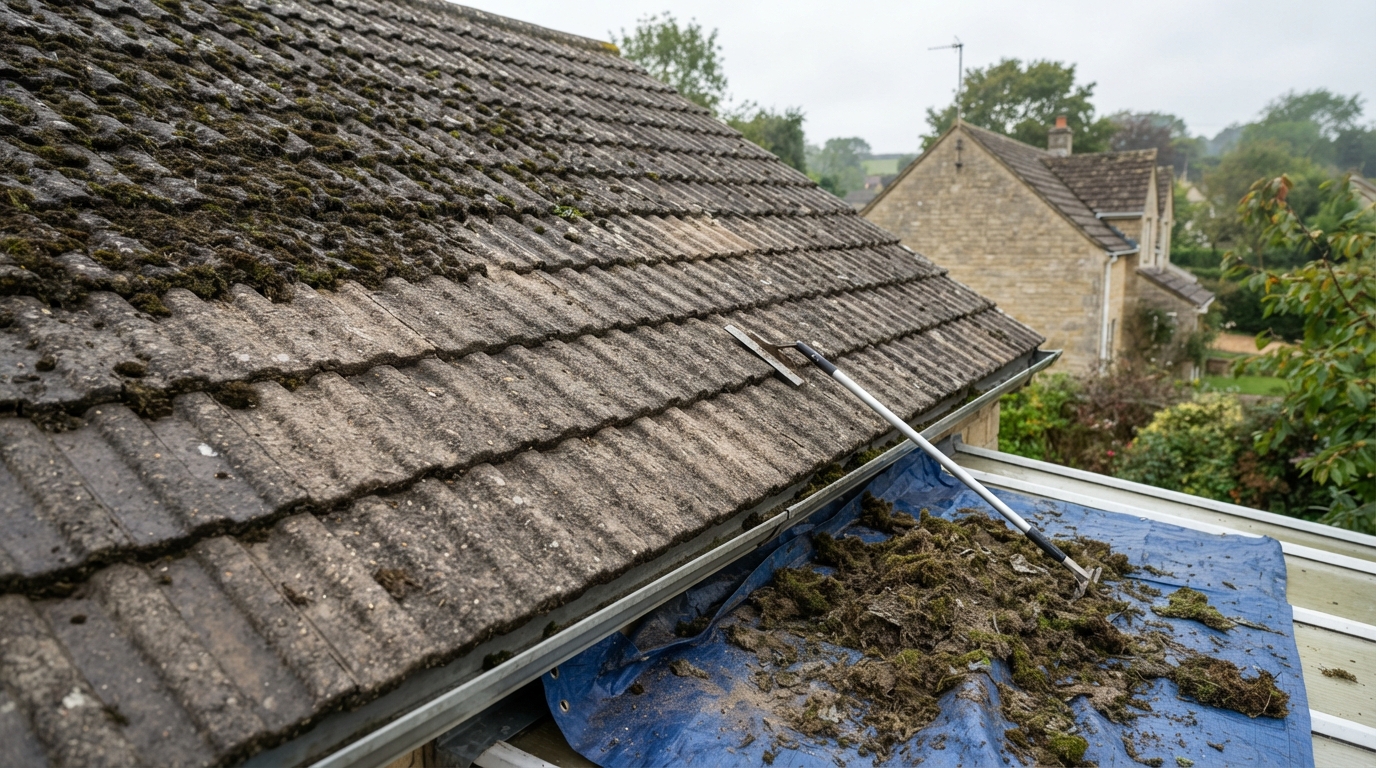
Manual roof scraping is a non-pressure, dry mechanical method of roof moss removal. Technicians work from safe access equipment (such as mobile scaffolding towers, cherry pickers, or specialist roof ladders) using hand tools specifically engineered to match the profile of your roof tiles.
The process involves gently running custom-profiled steel or plastic blades along each row of tiles. The scraper fits snugly into the contours of Marley, Redland, or Forticrete interlocking tiles, cleanly slicing the moss away at the root without applying downward pressure or using water.
Manual scraping removes 90% to 95% of all established, heavy moss cushions. The dislodged moss slides safely down the roof pitch into catchment netting on the ground, preventing mess and protecting garden beds below.
What is Pressure Washing in Roof Cleaning?
Pressure washing involves using motorized pumps to direct water through high-pressure nozzles onto tile surfaces to strip away moss, lichen, algae, and atmospheric grime.
It is important to distinguish between aggressive high-pressure jet washing (which operates at 3,000+ PSI and can be highly destructive to roofs) and controlled low pressure roof washing (often called soft washing or steam cleaning).
At Skyhawk Exterior Cleaning, we strictly avoid aggressive high-pressure jet washing on roofs. When water-based cleaning is deemed safe for a sturdy concrete roof, we utilize low pressure equipment combined with specialized soft-wash cleaning solutions operating at low bar pressure—similar to heavy rainfall—to lift surface dirt safely.
What is Waterless Compressed Air Roof Cleaning?
To enhance the efficiency of manual scraping without introducing water, Skyhawk Exterior Cleaning developed our specialist waterless roof cleaning method.
After technician hand-scrape the primary moss deposits from tile surfaces, we deploy compressed-air lances. High-volume compressed air blows away remaining loose moss particles, dirt, and organic dust lodged between tile overlaps and valley gutters.
This gives the roof a pristine, swept appearance without using a single drop of water pressure on your tiles, eliminating all risk of loft leaks or forced moisture retention behind the tile battens. Read our detailed guide on whether waterless roof cleaning is worth it.
Advantages of Manual Roof Scraping
Manual roof scraping has become the preferred choice for thousands of homeowners and heritage specialists across Sussex and Surrey for several compelling reasons:
- Zero Risk of Water Ingress: Because no water pressure is applied to the roof, there is zero chance of water leaking into loft spaces, saturating insulation, or bypassing aged roof felt membranes.
- Protects Fragile Tile Coatings: Scrapers slice away surface moss without stripping the original factory colour coat or protective granular surface off concrete tiles.
- Preserves Mortar Pointing: Manual tools do not disturb delicate mortar around ridge tiles, hips, valleys, or chimney flashings.
- Environmentally Clean & Contained: Dry moss is easy to collect, bag, and compost, leaving surrounding driveways and neighbouring properties clean.
Advantages of Pressure Washing (When Appropriate)
Controlled low pressure washing can offer specific benefits when applied to suitable roof types:
- Complete Instant Restoration: Low pressure washing removes not only moss, but also dark atmospheric traffic grime, carbon buildup, and stubborn lichen spots in a single day.
- Uniform Visual Finish: Restores the vibrant original factory colour across the entire tile pitch immediately upon completion.
- Effective on Sturdy Concrete: Highly effective on modern, structurally sound concrete interlocking tiles backed by intact felt membranes.
When Manual Roof Cleaning is the Better Option
Manual roof scraping or waterless compressed air cleaning is unequivocally the better option in the following scenarios:
- Older Properties (Pre-1980s): Roofs without modern breathable underlayment or where felt membranes are brittle, worn, or torn.
- Clay or Slate Tiles: Handmade clay tiles, peg tiles, or natural slate where water pressure could cause spalling or tile lifting.
- Fragile Ridge Pointing: Roofs with aging, cracked mortar along ridge lines or hip tiles.
- Pitched Roofs Over Conservatories: Where heavy water runoff could pool on glass or polycarbonate conservatory roofs.
- Homeowners Seeking Minimal Disruption: Those who prefer a clean, dry process without water overspray on patio or garden areas.
When Low Pressure Washing May Be Appropriate
Low pressure roof cleaning can be safely considered when:
- The roof features modern, sound concrete interlocking tiles.
- A comprehensive inspection confirms intact, undamaged under-tile felt membranes.
- Mortar pointing around ridges and hips is structurally sound.
- The homeowner wants to remove dark lichen spots ("black spot") alongside moss.
- Appropriate water catchment and gutter protection systems are installed during the job.
Comparing Both Methods Side by Side
| Feature / Factor | Manual Roof Scraping | Low Pressure Washing |
|---|---|---|
| Water Use | Zero / Minimal (Dry process) | Controlled water volume |
| Risk of Loft Ingress | None (0%) | Low (if tiles/felt intact) |
| Tile Granule Preservation | Excellent (Gentle on surface) | Good (if low bar pressure) |
| Suitable Tile Types | Clay, Slate, Concrete, Heritage | Sturdy Concrete Interlocking |
| Lichen Spot Removal | Handled via post-biocide | Immediate mechanical lift |
| Biocide Finish Required? | Yes (Essential) | Yes (Essential) |
Why Every Roof Needs a Biocide Treatment After Cleaning
A major misconception among homeowners is assuming that physical cleaning—whether scraping or washing—is the end of the process. In reality, physical tools only remove visible bulk growth on top of the tiles.
Microscopic moss roots, algae biofilms, and lichen spores remain embedded deep inside the porous tile surface. Without a chemical treatment, these spores will quickly reactivate in damp UK weather, causing moss to return within 12 to 18 months.
This is why Skyhawk Exterior Cleaning finishes every roof clean by applying a high-grade BAC50 biocide treatment:
- Cellular Sterilization: Biocide soaks deep into tile pores, killing microscopic roots and spores at a cellular level.
- Self-Cleaning Action: Over following months, natural rainfall continues to wash away dead organic residue, leaving tiles visibly cleaner over time.
- Long-Term Protection: Prevents moss, lichen, and algae regrowth for 3 to 5 years.
Common Misconceptions About Pressure Washing Roofs
Let's address two frequent myths surrounding pressure washing and roof scraping:
Myth 1: "Pressure washing is always bad and should never be done."
This is inaccurate. While high-pressure jet washing (3,000+ PSI) is indeed unsafe for roofs, professionally controlled low pressure soft washing on modern, sturdy concrete tiles is safe and effective when performed by trained technicians with proper access equipment.
Myth 2: "Scraping doesn't clean the roof as thoroughly as water."
While manual scraping leaves small microscopic specks on day one, the post-scraping biocide application kills those specks completely. Within weeks, rainfall clears the dead organic material, achieving the exact same clean, bright finish as washing without subjecting the roof to water pressure risks.
Which Roof Cleaning Method Lasts the Longest?
The longevity of a roof clean is not determined by whether the moss was scraped or washed off—it is determined by the quality and thoroughness of the biocide treatment applied afterwards.
Both manual roof scraping and low pressure cleaning will keep a roof clear of heavy moss for 3 to 5 years when paired with a professional BAC50 biocide finish. For more details on longevity, read our article on whether roof cleaning extends the life of your roof.
Why Every Roof Should Be Individually Assessed
No responsible exterior cleaning contractor should ever quote a fixed cleaning method over the phone without evaluating the specific property. At Skyhawk Exterior Cleaning, we conduct a thorough assessment before recommending a method, considering:
- Tile age, material, and structural integrity
- Condition of mortar pointing around ridge tiles, hips, and chimneys
- Integrity of underlay felt membrane inside the loft
- Property height, pitch angle, and access requirements
- Density of moss, lichen, and algae growth
To learn more about likely investment levels for your property type, consult our comprehensive roof cleaning cost guide.
Key Takeaways
- ✓ No One-Size-Fits-All: Manual scraping suits clay, slate, and delicate roofs, while low pressure washing can suit sturdy modern concrete tiles.
- ✓ Waterless Scraping is Safest: Manual scraping with compressed air eliminates all risk of loft water ingress and preserves tile surface coatings.
- ✓ Avoid High-Pressure Jet Washing: High-pressure washing (3,000+ PSI) can ruin mortar pointing, strip concrete tile glaze, and force water under tiles.
- ✓ Biocide is Vital: BAC50 biocide treatment is essential after both methods to kill microscopic spores and prevent regrowth for up to 5 years.
- ✓ Always Get a Site Survey: Method selection must be tailored to tile type, roof age, and structural condition.
Frequently Asked Questions
Is roof scraping better than pressure washing?
Neither method is universally 'better' for every building; manual scraping is much safer for delicate, heritage, clay, or older roofs without felt underlay, whereas controlled low pressure washing can offer rapid uniform cleaning on sturdy modern concrete tiles.
Can pressure washing damage roof tiles?
Yes. Aggressive high-pressure jet washing can strip the protective granular coating off concrete tiles, dislodge mortar from ridge tiles, and blast water underneath tiles directly into the loft space.
Does scraping remove all moss?
Manual roof scraping removes 90% to 95% of bulk moss from tile surfaces. To eliminate microscopic root spores deep within tile pores, a professional biocide treatment must be applied after scraping.
Why is biocide important after moss removal?
Biocide penetrates deep into porous tiles to kill remaining microscopic moss spores, algae, and lichen roots that physical tools cannot reach, delaying moss regrowth for 3 to 5 years.
How long does roof cleaning last?
When accompanied by a professional BAC50 biocide treatment, both manual scraping and low pressure cleaning keep roof tiles clean and moss-free for 3 to 5 years depending on tree shade and local humidity.
Can I scrape moss off my roof myself?
DIY roof scraping is hazardous due to severe fall risks at height and high potential for tile damage when walking directly on delicate tiles without specialist scaffolding or roof ladders.
What is compressed air roof cleaning?
Compressed air roof cleaning uses high-volume air lances to blow away loose moss, dirt, and organic debris after manual scraping without introducing any water pressure to the tile surface.
Does pressure washing remove moss permanently?
No. Pressure washing removes surface growth, but without a biocide treatment, invisible microscopic spores left behind will quickly regrow in warm, wet UK weather conditions within 12 to 18 months.
How often should roofs be cleaned?
Most roofs in Sussex and Surrey only require professional moss removal and biocide treatment once every 3 to 5 years, depending on surrounding tree cover and roof shade. For further questions, explore our frequently asked questions page.
Which roof cleaning method is safest?
Waterless manual roof scraping combined with compressed air cleaning and biocide treatment is the absolute safest method because it eliminates all risks of water ingress and high-pressure surface erosion.
Book a Free Roof Inspection with Skyhawk
Unsure whether manual roof scraping or low pressure cleaning is right for your property? The experienced team at Skyhawk Exterior Cleaning is here to help.
We serve over 130 locations across Sussex and Surrey, providing fully insured, expert roof maintenance tailored to your property's specific needs. Every roof clean includes moss removal, internal gutter clearing, fascia wipe down, BAC50 biocide treatment, full site clean-up, and our 2-year no-moss return guarantee.
To arrange a free, no-obligation assessment or speak directly with an exterior cleaning specialist, book a video call quote with our team today or give us a call on 01293 922 243.
Skyhawk Exterior Cleaning Ltd
9 Hylands Close, Crawley, RH10 6RX
Phone: 01293 922 243
Website: skyhawkexteriorcleaning.co.uk
Skyhawk Exterior Cleaning – A Hawk Eye for Detail.