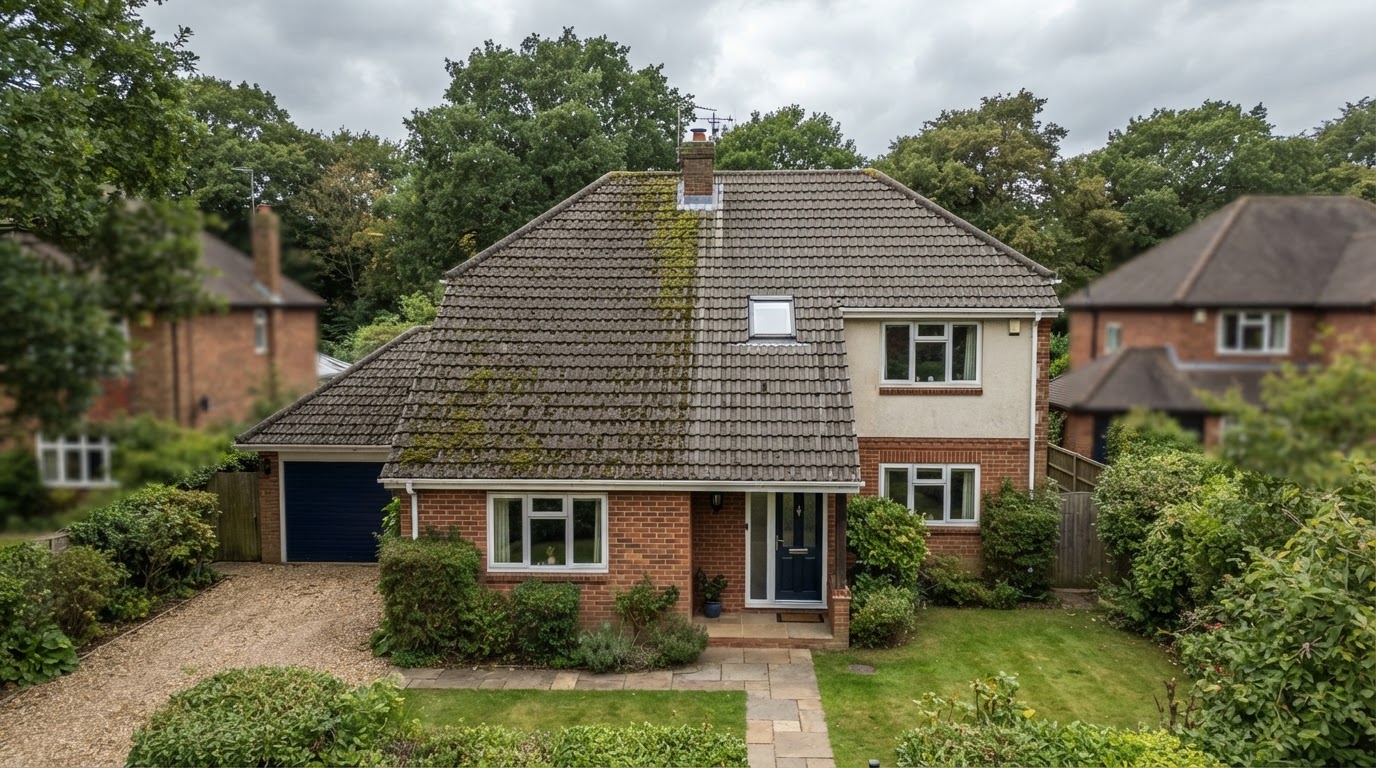
If your roof is turning green, it is usually because moss, algae or other organic growth is developing on the surface. Shade, moisture, nearby trees, roof age and limited sunlight can all encourage this natural process. While a green roof does not always indicate damage, it is often a sign that maintenance should be considered.
Across Sussex and Surrey, the damp climate and abundance of mature trees create the perfect environment for organic growth to take hold on roof tiles. The change is gradual, so many homeowners do not notice until a patch of green has spread across a visible slope or a neighbour mentions it. Understanding what is causing the discolouration — and whether it needs attention — is the first step to keeping your roof in good condition.
Why Do Roofs Turn Green?
Roofs turn green when airborne spores settle on the surface and find the conditions they need to grow. Moss, algae and lichen are all naturally occurring organisms that thrive in damp, shaded environments. Once established, they spread slowly across the tiles, feeding on moisture and organic matter.
The process is entirely natural. It does not mean your roof is defective or failing, but it does mean the surface is holding enough moisture to support growth. Over time, that growth can become thicker, more widespread and harder to remove.
Common causes of green staining on roofs
- Moss — the most common cause of a green roof, particularly on concrete and clay tiles.
- Algae — often appears as a thin green or dark green film, especially on north-facing slopes.
- Lichen — typically forms flat, crusty patches in shades of green, grey or white.
- Shade — roofs shaded by trees, chimneys or neighbouring buildings stay wetter for longer.
- Nearby trees — overhanging branches drop leaves and debris, and reduce sunlight.
- Moisture — the UK climate provides the damp conditions these organisms need.
- Roof age — older tiles often have a rougher surface that makes it easier for spores to take hold.
- North-facing roof slopes — these receive less direct sunlight and dry more slowly.
- Bird activity — birds can deposit organic matter that contributes to growth.
Is It Moss, Algae or Lichen?
Not all green staining is the same, and identifying what is growing on your roof helps determine the safest cleaning method.
Moss grows in clumps and can build up into thick cushions across the tiles. It is the most visible form of organic growth and the most likely to cause practical problems, because it holds significant amounts of moisture and can dislodge into gutters.
Algae usually appears as a smooth, thin coating rather than raised clumps. It often presents as a green or dark streaking pattern, particularly on slopes that stay damp. Algae does not have the same physical bulk as moss, but it can still make a roof look tired and neglected.
Lichen forms flat, crusty patches that bond tightly to the tile surface. It can be green, grey, white or orange, and is often slower to spread than moss. Because it adheres so firmly, lichen usually requires a specialist biocidal treatment rather than physical removal alone.
| Green Roof Cause | Typical Characteristics |
|---|---|
| Moss | Raised clumps, holds moisture, can dislodge into gutters |
| Algae | Thin green or dark film, often streaky, common on shaded slopes |
| Lichen | Flat crusty patches, bonds tightly to tiles, slow-growing |
| Tree cover | Shade and debris encourage growth on affected slopes |
| Heavy shade | Slower drying time allows spores to establish |
Why Some Roofs Are Affected More Than Others
Two identical houses on the same street can have very different roofs. One may stay clean for years while the other turns green within months. The difference usually comes down to the local environment rather than the tiles themselves.
A roof beneath a large oak or conifer will receive less sunlight, more debris and higher humidity. A north-facing slope will dry far more slowly than a south-facing one. A roof with a shallow pitch may shed water less efficiently, keeping the surface wetter for longer. All of these factors combine to determine how quickly organic growth takes hold.
Does shade and tree cover matter?
Yes. Shade is one of the biggest contributing factors. Sunlight naturally inhibits the growth of moss, algae and lichen by drying the roof surface. Where sunlight is limited — by trees, chimneys, dormer windows or neighbouring properties — the roof stays damp for longer, giving spores the time they need to establish.
Overhanging branches also drop leaves, twigs and pollen directly onto the roof. This organic matter breaks down on the tiles, providing a nutrient source that encourages further growth.
Can blocked gutters make it worse?
Blocked gutters do not cause moss to grow on the roof directly, but they do contribute to the damp conditions that allow growth to thrive. When gutters overflow, water runs back up under the roofline or down the fascia, keeping the lower roof tiles and surrounding areas wetter than they should be.
Roof moss and blocked gutters often go hand in hand. Moss breaks off and washes into the gutters, causing blockages. The blocked gutters then overflow, increasing moisture around the roof edge. This creates a cycle that allows growth to spread more quickly. Read more about this in our guide to overflowing gutters.
Do solar panels contribute to green roofs?
Solar panels do not cause moss or algae directly, but they can create conditions that allow existing growth to become more noticeable. Panels shade the roof surface beneath them, slowing evaporation. Combined with existing moss, nearby trees and trapped organic debris, this can encourage growth to spread around the array.
Bird activity beneath solar panels can also contribute. Pigeons nesting under panels bring feathers, nesting material and droppings onto the roof, all of which increase the organic matter available for moss and algae to feed on. See our article on moss around solar panels for more detail.
Can a Green Roof Become a Bigger Problem?
A light coating of algae or a few patches of moss is not a crisis. Many roofs across Sussex and Surrey carry some organic growth without suffering any immediate harm. However, when growth becomes heavier, it can contribute to several maintenance issues.
Moss acts like a sponge. It absorbs and holds rainwater against the roof tiles, keeping the surface damp for extended periods. During cold weather, this trapped moisture can freeze and thaw repeatedly, which may contribute to tile degradation over time. Heavy moss can also restrict the natural flow of rainwater down the roof, directing it into valleys, joints and guttering where it causes blockages.
The key is to treat green staining as an early warning sign rather than an emergency. Addressing it before it becomes heavy growth is simpler, more effective and usually more affordable.
How Professional Roof Cleaning Helps
Professional roof cleaning removes organic growth using methods appropriate to the roof covering. At Skyhawk Exterior Cleaning, we assess every roof individually before deciding whether roof cleaning, waterless roof cleaning or a biocidal treatment is the safest approach.
The aim is not simply to remove the visible green staining, but to treat the spores that cause it. A biocidal treatment penetrates the surface and kills the root structures of moss, algae and lichen, helping to slow regrowth and keep the roof cleaner for longer. We never apply more pressure than the roof covering can safely tolerate — choosing the correct method is far more important than using maximum force.
| Roof Maintenance Service | Why It Helps |
|---|---|
| Roof cleaning | Removes moss, algae and lichen using the safest method for the tile type |
| Gutter cleaning | Clears debris and moss so rainwater flows freely away from the roof |
| Roof inspection | Identifies damaged tiles, blocked valleys and early signs of wear |
| Solar panel cleaning | Removes debris and bird fouling that contribute to roof contamination |
| Bird proofing | Prevents pigeons nesting beneath panels and depositing organic matter |
Looking After the Complete Roof
A green roof is rarely an isolated issue. The same shade, moisture and debris that encourage moss on the tiles also affect the gutters, the fascias and any solar panels installed on the roof. The most effective approach is to maintain the complete roof system rather than treating each element in isolation.
By combining roof cleaning, gutter cleaning, solar panel cleaning and bird proofing, and routine inspections, you reduce the conditions that allow organic growth to return. A clean roof sheds water properly, gutters stay clearer for longer and the whole roofline looks better.
Questions We Get Asked On Site
Is a green roof normal?
Yes, to an extent. In the UK climate, some organic growth on roofs is completely natural, particularly on shaded or north-facing slopes. However, heavy growth is a sign that the roof would benefit from professional cleaning.
Is it moss or algae?
If the growth is raised and clumpy, it is likely moss. If it is a thin, smooth film or streaky coating, it is usually algae. Lichen appears as flat, crusty patches that bond tightly to the tile.
Will it damage my roof?
Light growth is unlikely to cause immediate damage, but heavy moss retains moisture against the tiles and can restrict water flow. Over time, this can contribute to tile degradation and blocked gutters.
Should I clean it now?
If the growth is light, there is no urgency, but it is easier to treat early. If moss is clumping, spreading or beginning to fall into the gutters, it is worth arranging cleaning before the problem becomes more established.
Can my gutters also be blocked?
Very often, yes. Moss breaks off and washes into the gutters, causing blockages. If your roof is turning green, it is worth having the gutters inspected at the same time.
Common Mistakes Homeowners Make
- Ignoring early moss growth. Small patches are easier to treat than heavy, established growth.
- Assuming rain will wash it away. Rain does not remove moss, algae or lichen — it provides the moisture they need to grow.
- Cleaning the roof aggressively. High-pressure washing can damage tiles and force water beneath the roof covering.
- Forgetting the gutters. Cleaning the roof without clearing the gutters means moss will soon wash back down and block them again.
- Waiting until the roof is heavily covered. Established growth takes longer to treat and may have already contributed to blocked gutters or tile staining.
Key Takeaways
- A green roof is usually caused by moss, algae or lichen thriving in damp, shaded conditions.
- Shade, nearby trees, north-facing slopes and roof age all influence how quickly growth develops.
- Light growth is not an emergency, but heavy moss can retain moisture and contribute to blocked gutters.
- Professional roof cleaning removes growth using the safest method for the roof covering, followed by a biocidal treatment to slow regrowth.
- Maintaining the roof, gutters and solar panels together provides better long-term results than treating each element separately.
- The best time to clean a green roof is before the growth becomes heavy and established.
A Realistic Homeowner Example
A homeowner in Horsham, West Sussex, noticed a patch of green spreading across the front slope of their concrete tiled roof. The property backed onto a line of mature trees, and the affected slope faced north-east, meaning it received very little direct sunlight. On a routine inspection, they also noticed that moss was beginning to collect in the gutters and a small amount of debris had gathered around the roof valley.
Rather than waiting for the moss to become heavy, they arranged a preventative roof clean and gutter clearance. The roof was treated using a gentle biocidal approach suitable for the tile type, and the gutters were cleared of the early moss deposits. Because the growth was treated at an early stage, the roof responded well, the tiles were not stained, and the gutters continued to flow freely. A follow-up inspection was recommended the following year to catch any regrowth before it became established.
Frequently Asked Questions
Why is my roof turning green?
Your roof is turning green because moss, algae or lichen is growing on the surface. These organisms thrive in damp, shaded conditions and are a natural occurrence in the UK climate, particularly on north-facing slopes or roofs beneath trees.
Is a green roof dangerous?
Not immediately. Light organic growth is common and rarely causes instant damage. However, heavy moss growth can retain moisture, restrict water flow and contribute to blocked gutters, so it is best addressed before it becomes established.
Is it moss or algae?
Raised, clumpy growth is usually moss. A thin, smooth or streaky green film is typically algae. Flat, crusty patches that bond tightly to the tile are usually lichen. A professional inspection can confirm which is present.
Can a green roof damage tiles?
Heavy moss can hold moisture against the tiles, which may contribute to degradation over time, particularly during freeze-thaw cycles. Light growth is less likely to cause damage, but it is easier to treat early.
Can blocked gutters make it worse?
Yes. Blocked gutters cause water to overflow back onto the lower roof tiles, keeping them wetter for longer and creating the damp conditions that encourage moss and algae to spread.
Will rain clean my roof?
No. Rain provides the moisture that moss, algae and lichen need to grow. It does not remove established growth or kill the spores beneath the surface.
Can I remove roof moss myself?
DIY removal is possible in some cases, but working at height carries significant safety risks. Aggressive scraping or pressure washing can also damage tiles. Professional cleaning uses the safest method for the roof covering and includes a biocidal treatment to slow regrowth.
Should my gutters be cleaned too?
Yes. If moss is growing on the roof, it is likely that some has already washed into the gutters. Cleaning the roof and gutters together prevents the cycle of moss breaking off and causing blockages.
When should I arrange roof cleaning?
If you have noticed green staining spreading, moss clumping on the tiles, or debris collecting in the gutters, it is worth arranging an assessment. The best time to clean a roof is before heavy growth becomes established.
How often should roofs be professionally cleaned?
There is no fixed schedule. Some roofs stay clean for years, while others — particularly those in shaded or wooded locations — may need cleaning more frequently. The best approach is to arrange an inspection when growth becomes visible.
Final Conclusion
A green roof is usually a sign that moss, algae or lichen has found the conditions it needs to grow. It is not a sign that your roof is failing, but it is an indication that the surface is holding moisture and that maintenance should be considered. The most effective response is preventative roof cleaning that removes the growth, treats the spores and addresses any contributing factors such as blocked gutters or nearby debris.
At Skyhawk Exterior Cleaning, we provide roof cleaning, waterless roof cleaning, gutter cleaning and solar panel cleaning and bird proofing as part of one integrated roof maintenance programme. If your roof is turning green, arrange a free video quotation and we will assess the full roof system. You can also read our FAQs for more information.