The Complete Guide to Solar Panel Cleaning & Bird Proofing
Solar panels are one of the most significant investments many homeowners make in their property. They sit on the roof, generate electricity day after day, and are expected to perform reliably for decades. Yet they are also one of the most neglected parts of the home when it comes to maintenance.
The truth is that solar panels are only one part of the roof. They share the same space as the tiles, the gutters, the fascias and the valleys — and what happens to one part of the roof almost always affects the others. Moss grows on the tiles and sheds debris onto the panels. Birds nest beneath the array and drop feathers into the gutters. Blocked gutters overflow and wash organic material back up onto the roof. Everything is connected.
This guide brings together everything we have learned from maintaining solar panels, roofs and gutters across Sussex and Surrey. It explains why panels become dirty, how birds create wider maintenance issues, why cleaning alone is rarely enough, and how looking after the whole roof system produces far better long-term results than treating each problem in isolation.
Throughout this guide, we will reinforce a simple principle: the roof is one complete system, and the most effective maintenance plan addresses it that way.
How Solar Panels Work
Solar panels generate electricity by converting sunlight into direct current (DC) through photovoltaic cells. An inverter then converts this into alternating current (AC), which is what your home uses. The amount of electricity generated depends on how much sunlight reaches the surface of the panels.
Anything that blocks or scatters that sunlight — whether it is dust, pollen, bird droppings, leaves or moss fragments — reduces the amount of light reaching the cells. The panels still work, but they may not generate as much electricity as they would if the glass were clean and clear.
It is also worth remembering that solar panels are designed to be durable, but they are not indestructible. The glass surface, the seals around the edges, the frame and the fixings all need to be treated with care. Manufacturer guidance should always be considered when cleaning or maintaining solar panels, and the cleaning method matters just as much as the cleaning itself.
Why Solar Panels Become Dirty
Solar panels are exposed to everything the sky and the surrounding environment throw at them. Over time, a range of contaminants settle on the surface:
- Bird droppings — often the most impactful because they are opaque and can adhere firmly to the glass.
- Dust and dirt — carried by wind, particularly during dry spells common in Sussex and Surrey summers.
- Pollen — seasonal contamination that can create a visible film across the array.
- Tree sap and leaf debris — more common on properties with overhanging branches.
- Moss fragments — dislodged from the roof tiles above or around the panels.
- Airborne pollution — atmospheric particles that settle gradually over months and years.
The combination and severity of these contaminants varies from property to property. A home surrounded by mature trees in rural Surrey will face different challenges to a property on a modern estate near the Sussex coast, but both will see some level of build-up over time.
Does Rain Clean Solar Panels?
Rain helps wash away loose dust, but it is not a substitute for professional cleaning. Bird droppings, tree sap and baked-on contamination often remain even after heavy rainfall. In fact, light rain can sometimes make things worse by creating a muddy film that dries onto the glass. Rain is natural, but it is not a cleaning system.
Does Cleaning Improve Performance?
Dirt, bird droppings and organic debris can reduce the amount of sunlight reaching the photovoltaic cells. Removing that contamination allows the panels to receive as much available sunlight as possible.
However, the impact varies significantly from property to property. The amount of contamination, the type of soiling, the panel orientation, the weather and the surrounding environment all play a part. We do not quote specific percentage improvements because every installation is different, and any claim should be based on the individual circumstances of the property.
What we can say with confidence is this: keeping panels clean helps ensure they can operate as intended, and cleaning is most effective when it forms part of a wider roof maintenance plan rather than a one-off job.
How Often Should Panels Be Cleaned?
There is no fixed schedule that suits every home. The ideal cleaning frequency depends on several factors:
- Nearby trees — properties surrounded by trees collect more debris, pollen and leaf litter.
- Bird activity — pigeons and other birds nesting beneath or near the panels dramatically increase contamination.
- Roof condition — moss on the roof sheds fragments onto the panels and surrounding area.
- Local environment — rural, coastal and urban locations each present different challenges.
- Weather patterns — prolonged dry spells allow dust to accumulate more quickly.
For most homes across Sussex and Surrey, an annual inspection is a sensible starting point. If contamination is visible, cleaning is recommended. If the panels remain clean, the inspection provides reassurance and helps identify other developing issues — such as bird activity or gutter blockages — before they become serious.
Signs Your Panels Need Cleaning
- Bird droppings are visible on the glass.
- Pigeons are nesting beneath the panels.
- Leaves, pollen and dirt are collecting around the array.
- Moss from the roof is accumulating nearby.
- Your gutters regularly contain feathers or nesting material.
- One section of the array looks dirtier than the rest.
- You can hear birds beneath the panels.
- You cannot remember the last professional clean.
Why Birds Love Nesting Beneath Solar Panels
The gap beneath roof-mounted solar panels provides birds — particularly pigeons — with exactly what they look for in a nesting site: warmth, shelter from rain, protection from predators and a flat, secure surface to build on. The panels themselves generate a small amount of heat, which makes the space beneath them warmer than the surrounding roof, especially during cooler months.
Once a pair of pigeons establishes a nest beneath an array, they tend to return year after year. The nest grows, droppings accumulate, and the problems spread well beyond the panels themselves.
Problems Caused by Pigeons
Bird nesting beneath solar panels is not just a nuisance. It creates a chain of maintenance issues that affect the panels, the roof and the gutters:
- Bird droppings on panels — opaque, acidic and difficult to remove, reducing available sunlight.
- Debris beneath panels — nesting material, feathers and droppings accumulate in the gap.
- Blocked gutters — feathers and nesting material wash into the gutters during rain.
- Moss and organic growth — the damp, debris-rich environment around the nest encourages moss and algae on the roof.
- Noise and odour — nesting birds create persistent noise and unpleasant smells.
- Increased maintenance — the cycle of fouling, blocking and growth repeats until the underlying cause is addressed.
Bird Droppings on Solar Panels
Bird droppings are one of the most problematic contaminants for solar panels. Unlike dust or pollen, which tend to settle evenly, droppings create concentrated patches that block sunlight entirely. They can also adhere firmly to the glass and become more difficult to remove over time, particularly after exposure to sun and rain.
Blocked Gutters Caused by Nesting
When pigeons nest beneath solar panels, feathers, nesting material and droppings are continually dislodged by wind and rain. Much of this debris ends up in the gutters. Over time, the gutters become packed with a dense mix of organic material that blocks the flow of rainwater, causing overflow and potential damp issues.
This is one of the clearest examples of why solar panels cannot be maintained in isolation. Cleaning the panels without clearing the gutters leaves a significant problem unresolved.
Moss Around Solar Panels
The damp, sheltered environment created by bird nesting — combined with overflowing gutters washing water back onto the roof — encourages moss and algae growth on the tiles surrounding the solar array. Moss then sheds spores and fragments onto the panels, perpetuating the cycle of contamination.
Removing moss from the roof as part of a coordinated maintenance visit helps keep the panels cleaner for longer and reduces the frequency of future cleaning.
Why Roof Cleaning and Solar Panel Cleaning Work Together
A roof covered in moss is constantly shedding material. Spores, fragments and organic debris are washed down the roof by rain, and where solar panels are fitted, much of this material collects on or around the array. Cleaning the panels without addressing the moss on the roof means the panels will become dirty again far more quickly.
This is why we recommend combining roof cleaning with solar panel cleaning wherever both are needed. Removing moss from the roof reduces the source of contamination, while cleaning the panels restores the glass surface. Carried out together, the results last longer and the roof as a whole is in much better condition.
Why Gutter Cleaning Should Never Be Overlooked
Gutters are the drainage system of the roof. When they are blocked, water has nowhere to go except over the edges and down the walls. For homes with solar panels, blocked gutters are particularly problematic because:
- Overflowing water washes debris and organic material back up onto the roof and around the panels.
- Nesting material from birds beneath the panels frequently ends up in the gutters.
- Damp caused by blocked gutters encourages moss and algae growth on the tiles.
- The cycle of blockage, overflow and growth repeats until the gutters are cleared.
Clearing gutters as part of a planned maintenance visit — alongside solar panel cleaning and bird proofing — ensures the whole roof system is functioning properly. It is one of the most cost-effective maintenance tasks a homeowner can carry out.
Professional Bird Proofing Explained
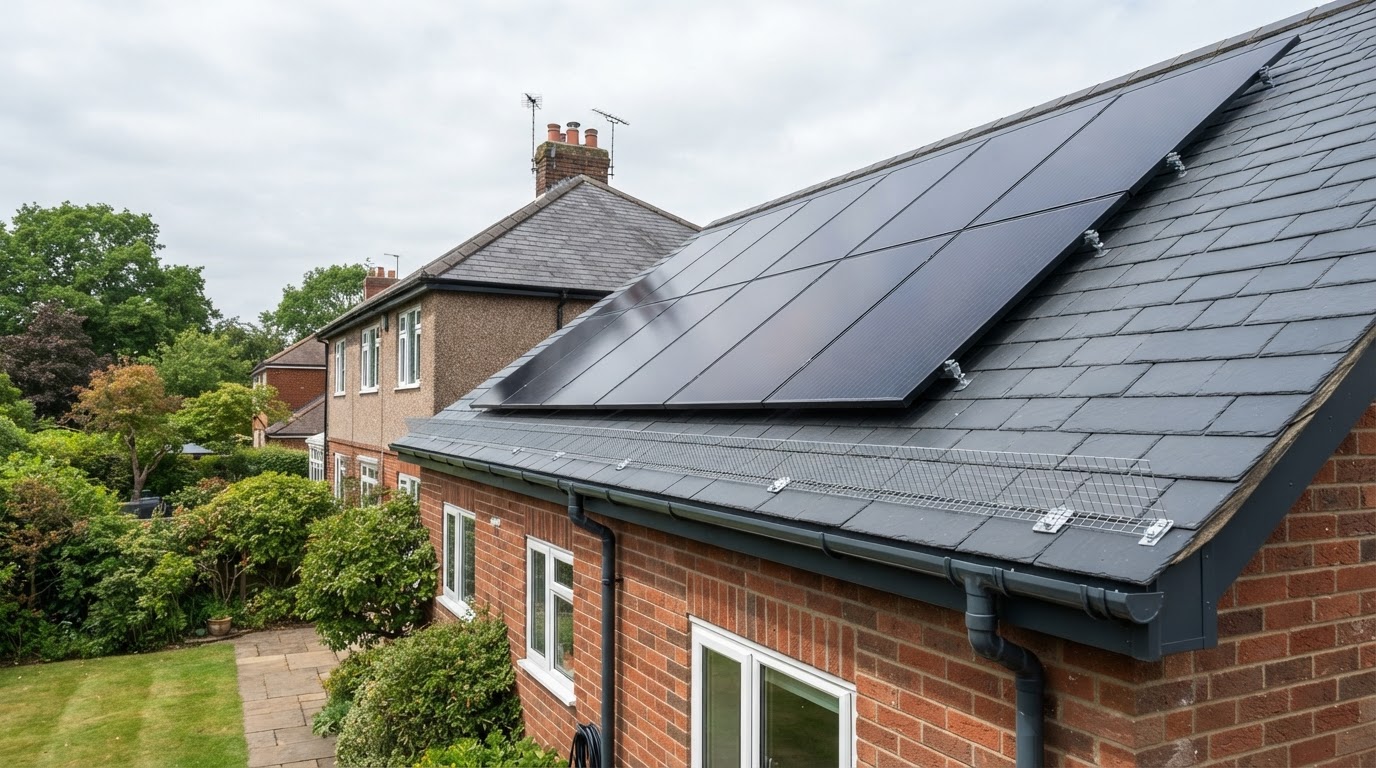
Bird proofing involves fitting a specialised mesh around the perimeter of the solar array to prevent birds from accessing the gap beneath the panels. The mesh is secured using clips or brackets that hold it firmly in place without drilling into the panels or compromising the roof covering.
When professionally installed, bird proofing is one of the most effective ways to break the cycle of nesting, fouling and blockage. It prevents pigeons from returning to the space beneath the panels, which in turn reduces droppings on the glass, nesting material in the gutters and organic build-up on the roof.
UK wildlife legislation protects active nests and nesting birds. Bird proofing should always be planned responsibly — ideally once nesting has finished — and carried out in accordance with the law. Professional installers understand these requirements and time their work accordingly.
How Long Does Bird Proofing Last?
A professionally installed system is designed for long-term protection, but its lifespan depends on the quality of materials, the standard of installation, weather exposure and bird activity. Periodic inspections — particularly after storms — help ensure the mesh remains secure and gap-free. Damaged sections can usually be repaired without replacing the entire system.
DIY vs Professional Cleaning
Some homeowners consider cleaning their own solar panels, particularly where access seems straightforward. In some cases, light cleaning of accessible panels may be possible. However, roof-mounted systems often present significant challenges:
- Roof safety — working at height is inherently risky and should not be undertaken without proper training and equipment.
- Access — most domestic solar arrays are on pitched roofs that are difficult to reach safely.
- Equipment — professional cleaning uses purified water and appropriate brushes designed for solar glass, not standard pressure washers or household detergents.
- Inspection — a professional visit provides the opportunity to inspect the wider roof, gutters and bird activity at the same time.
Professional cleaning is not just about the panels. It is about assessing the whole roof system and identifying issues that a homeowner standing on the ground may never notice.
| DIY Cleaning | Professional Cleaning |
|---|---|
| Roof access is the homeowner's responsibility and risk | Trained professionals use safe access methods and equipment |
| Limited to basic equipment such as hoses or brushes | Purified water systems and specialist brushes designed for solar glass |
| No inspection of wider roof, gutters or bird activity | Full assessment of the roof system, gutters and bird proofing |
| Risk of using unsuitable products or excessive pressure | Methods follow manufacturer guidance where appropriate |
| Single task only — panels cleaned in isolation | Combined roof, gutter, panel and bird proofing service available |
Can You Pressure Wash Solar Panels?
Pressure washing is generally not the preferred method for cleaning solar panels. Most professional cleaning is carried out using purified water, soft brushes where appropriate and techniques designed to protect both the panels and their surrounding components.
Excessive pressure can affect seals, fixings and surrounding components. The safest cleaning method depends on the panel manufacturer, the type of contamination and the installation. Where manufacturers provide cleaning recommendations, these should always be followed.
Looking After the Whole Roof System
The most effective approach to solar panel maintenance is to treat the roof as one complete system. Every element interacts with the others:
- Solar panel cleaning removes contamination from the glass and restores the surface.
- Bird proofing prevents pigeons from nesting beneath the array, reducing the source of droppings and debris.
- Roof cleaning removes moss and algae that would otherwise shed material onto the panels.
- Gutter cleaning ensures rainwater drains freely, preventing overflow that washes debris back onto the roof.
- Roof inspections identify developing issues before they become costly problems.
When all of these are maintained together, the roof stays cleaner, the panels perform better, the gutters flow freely and the bird proofing is subjected to less contamination. This coordinated approach reduces the frequency of future maintenance visits and helps protect your investment in both the roof and the solar array.
| Roof Issue | Possible Consequences |
|---|---|
| Bird nesting | Droppings on panels, feathers in gutters, debris beneath array, increased maintenance |
| Blocked gutters | Overflowing water, damp, moss growth on roof, debris washed around panels |
| Roof moss | Spores and fragments on panels, accelerated re-soiling, potential tile damage |
| Dirty panels | Reduced sunlight reaching cells, possible reduction in generation |
| Fallen leaves | Organic debris on panels and in gutters, moisture retention, moss encouragement |
| Service | Why It Matters |
|---|---|
| Solar panel cleaning | Removes contamination from the glass so panels receive maximum available sunlight |
| Bird proofing | Prevents pigeons nesting beneath the array, reducing the source of fouling and debris |
| Roof cleaning | Removes moss and algae that shed material onto the panels and surrounding roof |
| Gutter cleaning | Ensures rainwater drains freely, preventing overflow that washes debris back onto the roof |
| Roof inspection | Identifies developing issues — bird activity, loose tiles, mesh damage — before they worsen |
Roof Health Checklist
Use this checklist to assess the condition of your roof and solar panels. If you cannot safely check any of these items yourself, a professional inspection can confirm them for you.
- ✓ Solar panels visually clean — no visible bird droppings, heavy dust or debris on the glass
- ✓ No bird activity — no pigeons seen landing on or beneath the panels, no noise from the roof
- ✓ Gutters flowing freely — no overflow during rain, no feathers or nesting material visible
- ✓ No roof moss build-up — tiles are clear of heavy moss, particularly around the solar array
- ✓ Bird proofing intact — mesh is secure, gap-free and not corroded or dislodged
- ✓ No debris behind panels — the gap beneath the array is clear of nesting material and leaves
If any of these items cannot be ticked off, it may be time to arrange a professional assessment.
Real Homeowner Examples from Sussex and Surrey
Case Study 1: Heavy Pigeon Nesting Beneath Solar Panels
A homeowner in Horsham, West Sussex, contacted us after noticing a steady decline in their solar generation and persistent noise from the roof. On inspection, we found a well-established pigeon nest beneath one side of the array. The panels were heavily fouled with droppings, the gutters were packed with feathers and nesting material, and moss had begun to spread across the tiles surrounding the panels.
We carried out a coordinated maintenance visit: the panels were cleaned using purified water, the gutters were cleared of all nesting debris, the roof was treated to remove moss, and bird proofing mesh was fitted around the full perimeter of the array. The homeowner reported an immediate improvement in the appearance of the panels and a noticeable reduction in noise. Because the underlying cause — the nesting — had been addressed, the panels remained far cleaner for longer.
Case Study 2: Roof Moss and Blocked Gutters Contaminating the Array
A property in Reigate, Surrey, had solar panels that were becoming dirty within months of each clean. The homeowner assumed the panels simply needed more frequent cleaning. On inspection, we found that the roof tiles were covered in moss and the gutters were partially blocked, causing water to overflow and wash organic material back up onto the roof and around the panels.
Cleaning the panels alone would have provided only a short-term improvement. Instead, we cleaned the roof to remove the moss, cleared the gutters to restore proper drainage, and then cleaned the solar panels. With the source of contamination removed, the panels stayed significantly cleaner for much longer, and the homeowner avoided the cost of repeated panel-only cleans.
Case Study 3: Combined Preventative Maintenance Visit
A homeowner in Haywards Heath, West Sussex, had recently had their roof cleaned and wanted to ensure their solar panels and gutters were also in good condition before winter. Rather than booking separate visits, they arranged a single preventative maintenance appointment.
In one visit, we cleaned the solar panels, inspected and cleared the gutters, checked the existing bird proofing mesh for gaps, and carried out a visual roof inspection. The bird proofing was intact, the gutters were cleared of light debris, and the panels were left clean and ready for the darker winter months. The homeowner valued the efficiency of a single visit and the reassurance that the entire roof system had been assessed together.
Questions We Get Asked On Site
Will rain clean my solar panels?
Rain washes away some loose dust but does not remove bird droppings, tree sap or baked-on contamination. Professional cleaning is still needed periodically.
Do pigeons really make that much difference?
Yes. Pigeons nesting beneath panels create a continuous cycle of fouling, debris and gutter blockage that affects the panels, the roof and the gutters.
Can I use washing-up liquid on my panels?
Household detergents are not designed for solar glass and may leave residue. Purified water and specialist cleaning methods are preferred.
Can I stand on my solar panels?
No. Standing on solar panels risks cracking the glass and damaging the cells beneath. Professional cleaning uses safe access methods that avoid placing weight on the panels.
Does bird proofing harm the birds?
No. Bird proofing simply denies birds access to the space beneath the panels. It does not trap or harm them. Work should be timed to avoid disturbing active nests, in accordance with UK wildlife legislation.
Should I clean my gutters at the same time as my panels?
Yes. If birds were nesting beneath the panels, the gutters often contain feathers and nesting material. Clearing them together is more efficient and ensures the whole roof system is functioning.
Why are my gutters full of feathers?
This is a strong indication that birds are nesting nearby — usually beneath the solar panels. Feathers and nesting material are dislodged by wind and rain and wash into the gutters.
Can everything be done in one visit?
In many cases, yes. Solar panel cleaning, bird proofing, roof cleaning and gutter clearing can often be combined into a single coordinated visit, which is usually more efficient and more cost-effective than booking separate appointments.
Will the birds come back after proofing?
Quality mesh that is professionally installed prevents birds from regaining access. Pigeons may test the perimeter, but a secure system keeps them out.
How do I know when the panels need cleaning?
Visible bird droppings, heavy dust, debris around the array, pigeon activity or a drop in generation are all signs. An annual inspection is a sensible starting point.
Should I clean the panels after roof cleaning?
Yes. Roof cleaning dislodges moss and debris, some of which may settle on the panels. Cleaning the panels afterwards — or as part of the same visit — ensures the glass is left clear.
Common Roof Maintenance Mistakes
- Ignoring pigeons — hoping the birds will go away on their own. They rarely do, and the problems compound over time.
- Cleaning panels but not gutters — leaving blocked gutters full of nesting material that will cause further issues.
- Leaving moss untreated — allowing the roof to continue shedding debris onto the panels.
- Waiting until gutters overflow — by the time water is cascading over the edges, damage may already be occurring.
- DIY bird proofing with gaps — poorly fitted mesh that leaves gaps allows pigeons straight back in, wasting time and money.
- Using pressure washers on panels — excessive pressure can affect seals and fixings; purified water is the preferred method.
- Treating each problem separately — booking a panel clean, then a gutter clean, then a roof clean, when a single coordinated visit would be more efficient.
Key Takeaways
- Solar panels are only one part of the roof and should be maintained alongside the tiles, gutters and bird proofing.
- Dirt, bird droppings and organic debris can reduce the amount of sunlight reaching the panels, but the impact varies from property to property.
- Pigeons nesting beneath panels create a cycle of fouling, gutter blockage and moss growth that affects the whole roof.
- Bird proofing is one of the most effective ways to break that cycle, provided it is professionally installed and periodically inspected.
- Pressure washing is generally not the preferred cleaning method for solar panels; purified water and specialist techniques are safer.
- Roof cleaning removes the moss that sheds debris onto the panels; gutter cleaning ensures rainwater drains freely.
- The most effective maintenance plan treats the roof as one complete system rather than a collection of separate services.
- Combining solar panel cleaning, bird proofing, roof cleaning and gutter maintenance into a single visit is usually more efficient and more cost-effective.
- Manufacturer guidance should always be considered when cleaning or maintaining solar panels.
- An annual inspection helps identify developing issues before they become costly problems.
Frequently Asked Questions
Does solar panel cleaning improve performance?
Dirt and bird droppings can reduce the amount of sunlight reaching the panels. Cleaning removes that contamination so the panels can receive as much available sunlight as possible, though the impact varies from property to property.
How often should solar panels be cleaned?
There is no fixed schedule. Cleaning frequency depends on nearby trees, bird activity, roof condition and the local environment. An annual inspection is a sensible starting point.
Why do birds nest under solar panels?
The gap beneath the panels provides warmth, shelter and protection from predators, making it an attractive nesting site for pigeons.
Is solar panel bird proofing worth it?
For homes affected by pigeon nesting, yes. Bird proofing prevents birds from returning, reducing droppings, gutter blockages and roof maintenance.
Can I clean solar panels myself?
Some light cleaning of accessible panels may be possible, but roof-mounted systems often require professional access, specialist equipment and the opportunity to inspect the wider roof.
Can you pressure wash solar panels?
Pressure washing is generally not the preferred method. Purified water and specialist brushes are safer for the glass, seals and fixings.
Do dirty solar panels affect electricity bills?
Potentially, yes. Contamination can reduce the amount of sunlight reaching the cells, which may reduce generation. The impact varies and we do not promise specific savings.
How long does solar panel bird proofing last?
A professionally installed system is designed for long-term protection, but its lifespan depends on material quality, installation, weather exposure and bird activity. Periodic inspections are recommended.
Should gutters be cleaned at the same time as solar panels?
Yes. If birds were nesting, the gutters often contain feathers and nesting material. Clearing them together ensures the whole roof system is functioning.
Does roof moss affect solar panels?
Yes. Moss on the roof sheds spores and fragments onto the panels, accelerating re-soiling. Removing moss as part of a coordinated clean helps the panels stay cleaner for longer.
Will rain clean my solar panels?
Rain removes some loose dust but does not remove bird droppings, tree sap or baked-on contamination. Periodic professional cleaning is still needed.
Can bird droppings damage solar panels?
Droppings can block sunlight and adhere to the glass, becoming harder to remove over time. Cleaning prevents long-term build-up.
Does bird proofing affect solar panel performance?
No. Bird proofing mesh is fitted around the perimeter of the array and does not cover the glass or interfere with the panels' operation.
Can I install bird proofing myself?
DIY installation often leaves gaps or uses unsuitable materials. Professional installation ensures the full perimeter is secured without gaps that birds can exploit.
Should I clean the roof before or after cleaning the panels?
If both are needed, they are usually carried out together. Roof cleaning dislodges debris that may settle on the panels, so cleaning the panels as part of the same visit ensures the glass is left clear.
How do I know if birds are nesting under my panels?
Common signs include noise from the roof, feathers in the gutters, droppings on the panels and pigeons seen landing on the roof.
Is solar panel cleaning safe?
When carried out by trained professionals using safe access methods and appropriate equipment, yes. The cleaning methods are designed to protect the panels, the roof and the operatives.
Can everything be done in one visit?
In many cases, yes. Solar panel cleaning, bird proofing, roof cleaning and gutter clearing can often be combined into a single coordinated visit.
When should I arrange professional cleaning?
If you can see visible contamination, hear bird activity, or notice feathers in your gutters, it is time to arrange an assessment. An annual inspection is a good starting point.
Final Conclusion
Solar panels are a valuable investment, but they do not maintain themselves. Dirt, bird droppings, moss and nesting material all take their toll over time — and the panels are only one part of a larger roof system that needs coordinated care.
The most effective approach is to treat the roof as a whole. Solar panel cleaning, bird proofing, roof cleaning and gutter maintenance work best when they are carried out together, as part of a planned maintenance programme rather than a series of reactive, one-off fixes. This keeps the panels cleaner for longer, the gutters flowing freely, the roof free of moss, and the entire system in better condition.
If you would like honest advice about your solar panels, bird proofing or wider roof maintenance, arrange a free video quotation and we will assess your property individually. We work across Sussex and Surrey and provide a complete roof maintenance service — not just a single cleaning task.