Why Do Birds Nest Under Solar Panels?
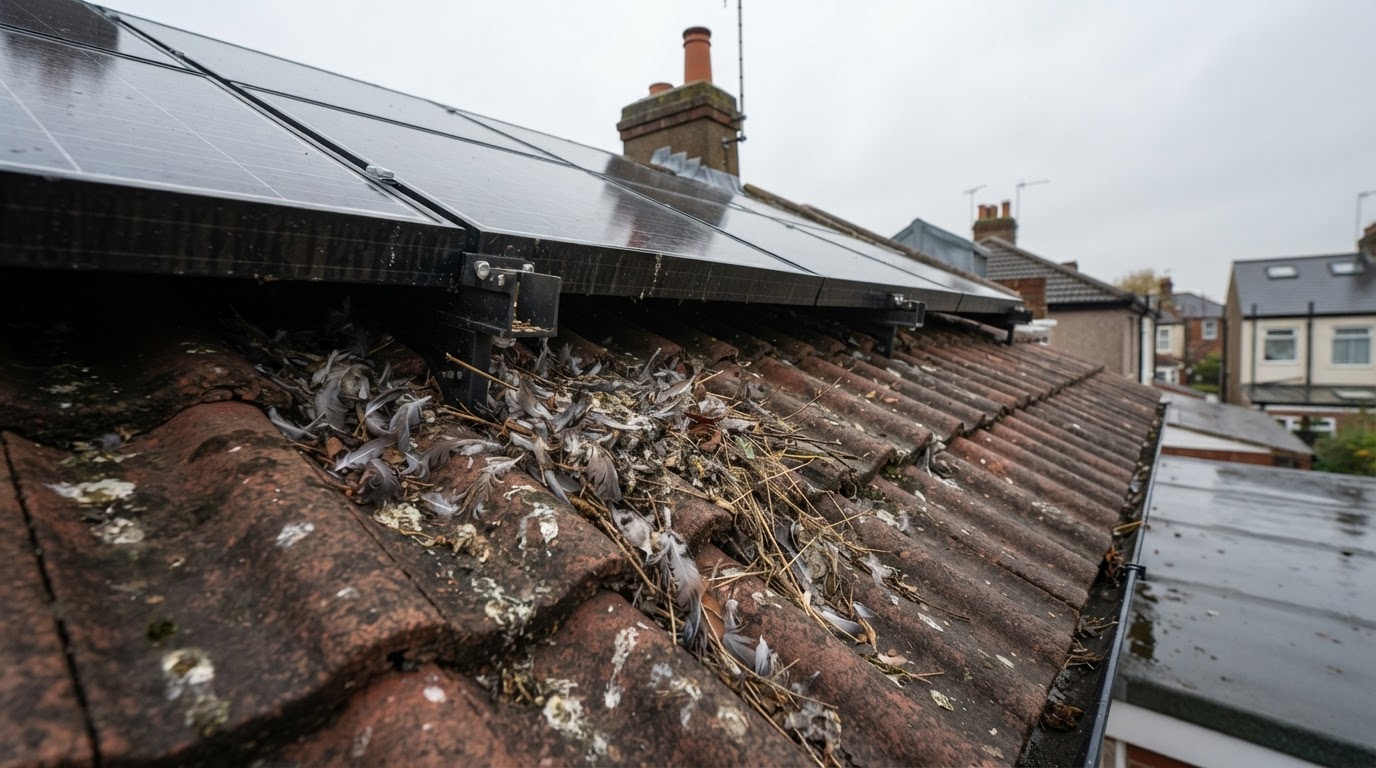
The gap beneath roof-mounted solar panels provides birds, particularly pigeons, with warmth, shelter and protection from predators. Whilst this makes an attractive nesting location for birds, it can create maintenance issues for the roof, gutters and solar panels if left unchecked.
Why Birds Choose Solar Panels
Solar panels are installed slightly above the roof surface, creating a sheltered gap between the array and the tiles. For birds, this space offers several advantages:
- Warmth — the panels absorb heat from the sun and radiate it downwards, keeping the gap beneath warmer than the surrounding roof.
- Shelter — the panels provide a solid overhead cover that protects against rain, wind and direct sunlight.
- Safety from predators — the enclosed space is difficult for larger birds and animals to access.
- Elevation — being high off the ground keeps nests away from ground-based threats.
In essence, a solar panel array creates a near-perfect nesting environment — and once birds discover it, they tend to return year after year.
Why Pigeons Are the Most Common Problem
Whilst several bird species may investigate the space beneath solar panels, pigeons are by far the most common cause of issues for homeowners across Sussex and Surrey. Pigeons are adaptable, territorial and highly likely to return to the same nesting site each season.
Once a pigeon establishes a territory beneath a solar array, it will actively defend the space and attract a mate. A single pair can produce several broods in a year, meaning the problem tends to escalate rather than resolve itself. Unlike some garden birds that nest briefly and move on, pigeons are year-round residents that treat the gap beneath your panels as permanent accommodation.
What Happens Once Birds Start Nesting?
Once birds begin nesting under solar panels, the effects tend to spread quickly across the roof system. Bird nesting commonly leads to:
- Bird droppings covering the panels — fouling builds up on the glass surface faster than rainfall can remove it.
- Feathers across the roof — loose feathers accumulate around the array and in the gutters.
- Nesting material collecting in gutters — twigs, straw and debris dragged under the panels frequently end up in the guttering.
- Blocked gutters and overflowing rainwater — nesting material causes blockages that prevent proper drainage.
- Moss and debris accumulating around the roof — organic material encourages moss growth on the tiles.
- Increased roof maintenance — the longer the nest remains, the more widespread the contamination becomes.
- Unpleasant noise — pigeons are surprisingly noisy, particularly during the early morning and breeding season.
- Reduced appearance of the property — visible staining and droppings detract from kerb appeal.
Can Birds Damage Solar Panels?
Birds do not generally peck through or break solar panels, but the environment they create beneath the array can lead to secondary issues. Droppings are acidic and, over time, can etch into the glass coating if left untreated. Nesting material can also trap moisture against the panel framework and the roof beneath, creating conditions that may affect wiring, flashing and surrounding tiles.
More commonly, the damage is indirect: blocked gutters cause overflowing water, moss growth accelerates on contaminated tiles, and the roof around the array becomes harder to maintain because access is restricted by the panels themselves.
How Bird Droppings Affect Solar Panels
Bird droppings are one of the most stubborn contaminants found on solar panels. Unlike light dust or pollen, droppings are thick, opaque and adhesive — they bond to the glass surface and are rarely shifted by rainfall alone. Because they block sunlight from reaching the photovoltaic cells beneath, even a small number of droppings in the right location can have a disproportionate effect on the panel's ability to generate electricity.
Over time, accumulated droppings can form a hardened crust that is difficult to remove safely without specialist cleaning products. This is why professional solar panel cleaning is often recommended alongside bird proofing — cleaning removes the existing contamination, whilst proofing prevents it from returning.
Why Nests Can Block Gutters
Pigeons build their nests from twigs, straw, grass and whatever material they can gather from the surrounding area. A significant amount of this material ends up in the gutters rather than staying beneath the panels. Once in the gutter, it forms a dense mat that catches leaves, moss and other debris, accelerating the formation of blockages.
Blocked gutters cause rainwater to overflow down the roof and the side of the property, which can contribute to staining on render, damp issues and accelerated organic growth on the surrounding roof. This is why gutter cleaning is frequently recommended as part of a complete bird proofing and solar panel maintenance plan.
Can Nesting Encourage Moss and Organic Growth?
Yes. The combination of nesting material, droppings and trapped moisture creates ideal conditions for moss, algae and lichen to establish on the surrounding roof tiles. Organic debris breaks down over time, providing nutrients that support further growth. Once moss takes hold around the panel edges, it can spread across the roof and shed spores onto the panel surface.
This is one of the reasons why roof cleaning is often recommended alongside solar panel maintenance. Removing moss from the surrounding tiles reduces the source of spores and helps keep both the roof and the panels cleaner for longer.
Why Bird Proofing Is Often the Best Long-Term Solution
Cleaning the panels alone is rarely a lasting solution when birds are nesting beneath them. The birds simply return and recontaminate the surface within weeks. Bird proofing addresses the root cause by sealing the gap beneath the panels with a discreet mesh that prevents birds from accessing the space, whilst still allowing air to circulate and water to drain.
It is important to note that, under UK wildlife legislation, active nests and nesting birds are legally protected. Bird proofing should always be carried out responsibly and in accordance with the law — typically once nesting has finished and the young have fledged. Professional installers plan their work accordingly to ensure compliance and avoid disturbing active nests.
Once proofing is in place, the panels can be cleaned, the roof treated and the gutters cleared — and the results are far more likely to last because the source of the contamination has been removed.
Looking After the Whole Roof
Maintaining solar panels alone isn't enough. The panels are part of a wider roof system, and each element affects the others. A complete approach to roof maintenance includes:
- Clean gutters — to allow rainwater to drain freely and prevent overflow.
- A moss-free roof — to stop spores spreading onto the panels and into the gutters.
- Regular roof inspections — to identify bird activity, damaged tiles and contamination early.
- Clean solar panels — to maximise sunlight exposure and remove acidic droppings.
- Professional bird proofing — to prevent birds from re-establishing nests beneath the array.
These services work together to maintain the roof as a complete system. There is little benefit in cleaning the panels if the roof above them is shedding moss onto the glass the following week, or if blocked gutters are causing water to overflow around the array. A joined-up approach ensures the whole system stays cleaner and functions correctly for longer.
Problems and Their Potential Effects
To help illustrate the impact of bird nesting, the table below summarises the common problems and their effects on the roof system.
| Problem | Potential Effect |
|---|---|
| Bird droppings | Opaque staining on panels, reduced sunlight, acidic etching over time. |
| Nesting material | Trapped moisture, blocked gutters, moss encouragement on tiles. |
| Feathers | Debris in gutters, unsightly accumulation around the roof. |
| Moss build-up | Spores spread onto panels, tiles retain moisture, accelerated weathering. |
| Blocked gutters | Overflowing water, staining on render, damp risk, debris around array. |
With or Without Bird Proofing
The difference between a roof maintained with bird proofing and one without is significant over time.
| Without Bird Proofing | With Professional Bird Proofing |
|---|---|
| Birds repeatedly nesting each season. | Gap sealed; birds unable to re-establish nests. |
| Continual build-up of droppings and debris. | Panels stay cleaner for longer after professional cleaning. |
| Reactive roof maintenance as problems escalate. | Planned maintenance keeps the whole roof system in better condition. |
| Appearance steadily deteriorates. | Roof, gutters and panels remain presentable and functional. |
Questions We Get Asked On Site
When visiting properties across Sussex and Surrey, we are regularly asked the following questions about bird nesting and solar panels:
- Will birds come back? — Yes. Pigeons are territorial and tend to return to the same nesting site each season unless the gap is proofed.
- Can birds damage my roof? — Direct damage is rare, but nesting material and droppings can cause blocked gutters, moss growth and secondary maintenance issues.
- Do birds reduce solar panel performance? — Droppings block sunlight, which can reduce the amount of light reaching the photovoltaic cells.
- Will bird proofing harm the birds? — No. Professional bird proofing is a deterrent, not a trap. It simply prevents access to the gap beneath the panels.
- Should I clean the roof first? — Often it makes sense to clean the roof, gutters and panels together, then install proofing so the whole system starts clean.
Common Mistakes Homeowners Make
- Ignoring pigeons because they seem harmless. A single pair can quickly establish a persistent nesting site.
- Cleaning the panels without removing the nesting problem. The birds return and recontaminate the surface within weeks.
- Waiting until gutters become blocked. By then, overflow may have caused staining or damp elsewhere.
- Trying DIY bird proofing that leaves gaps. Pigeons are persistent and will find even small openings to regain access.
Key Takeaways
- The gap beneath solar panels provides warmth, shelter and protection — making it an attractive nesting site for pigeons.
- Bird nesting leads to droppings on panels, blocked gutters, moss growth and increased roof maintenance.
- Cleaning alone is rarely a lasting solution because the birds return; bird proofing addresses the root cause.
- Under UK wildlife legislation, active nests are protected — bird proofing should be planned responsibly once nesting has finished.
- Maintaining the whole roof system — panels, roof, gutters and bird proofing together — produces the longest-lasting results.
A Real Example From Sussex
A homeowner near Horsham contacted us after noticing pigeons congregating on their roof each morning. On inspection, we found an established nest beneath the solar array, with droppings across the panel surface, moss accumulating on the surrounding tiles and the gutters packed with a mix of nesting material and leaves. The panels were cleaned using specialist products, the roof was treated to remove moss, and the gutters were cleared. Once nesting had finished, discreet bird proofing was installed to seal the gap beneath the panels. The result was a clean, functional roof system — and no further pigeon activity.
Frequently Asked Questions
Why do pigeons nest under solar panels?
The gap beneath solar panels offers warmth, shelter and protection from predators, making it an ideal nesting location for pigeons.
Can birds damage solar panels?
Birds rarely damage the panels directly, but droppings, nesting material and trapped moisture can cause secondary issues across the roof system.
Can bird droppings affect solar panel performance?
Yes. Droppings are opaque and block sunlight from reaching the photovoltaic cells, which can reduce the amount of energy generated.
Will birds block my gutters?
Nesting material frequently ends up in gutters, causing blockages and overflowing rainwater that can lead to staining and damp.
Can nesting encourage roof moss?
Yes. Organic debris and trapped moisture from nesting material create ideal conditions for moss and algae to grow on surrounding tiles.
Is bird proofing worth it?
For properties with active pigeon nesting, bird proofing is usually the most effective long-term solution because it prevents birds from returning.
Will the birds be harmed?
No. Professional bird proofing is a deterrent that prevents access to the gap beneath the panels. It does not trap or harm the birds.
Can I install bird proofing myself?
DIY installation often leaves gaps that pigeons exploit. Professional installation ensures the mesh is fitted securely and discreetly.
Should I clean the roof before bird proofing?
It often makes sense to clean the roof, gutters and panels together before installing proofing, so the whole system starts clean and functions correctly.
When should I arrange professional bird proofing?
Bird proofing should be planned once nesting has finished and the young have fledged, in accordance with UK wildlife legislation.
Final Conclusion
Birds nest under solar panels because the gap provides an ideal environment — but the resulting contamination affects far more than just the panels. Droppings, blocked gutters and moss growth spread across the whole roof system, turning a single nesting issue into a wider maintenance problem. The most effective solution is a coordinated approach: clean the panels, clear the gutters, treat the roof and install professional bird proofing to prevent the birds from returning. If you have noticed pigeon activity around your solar panels, arrange a free video quotation and we will assess the whole roof system honestly.