10 Signs Your Solar Panels Need Cleaning
Solar panels are designed to generate electricity quietly and efficiently for decades, but they sit exposed to everything the British weather — and the local wildlife — can throw at them. Because contamination builds up so gradually, many homeowners across Sussex and Surrey do not realise how dirty their panels have become until they compare photographs, notice bird activity on the roof, or see debris collecting around the array.
Recognising the early signs that your solar panels need cleaning helps prevent heavier soiling, reduces the risk of bird-related damage, and keeps the wider roof in better condition. In many cases, visible contamination on the panels is a symptom of broader roof maintenance issues such as pigeon nesting, blocked gutters or moss growth on the tiles.
Why Recognising the Signs Early Matters
The longer contamination is left on solar panels, the more difficult it becomes to remove. Bird droppings can bake onto the glass during dry spells, pollen films bond to the surface, and moss spores from the surrounding roof settle and trap moisture. Early intervention keeps cleaning straightforward and helps prevent the wider maintenance issues that often accompany dirty panels.
It is also worth remembering that the panels are only one part of the roof. Signs of bird activity, moss growth or gutter blockages often indicate that the whole roof system would benefit from attention, not just the panels alone.
1. Bird Droppings Are Visible on the Panels
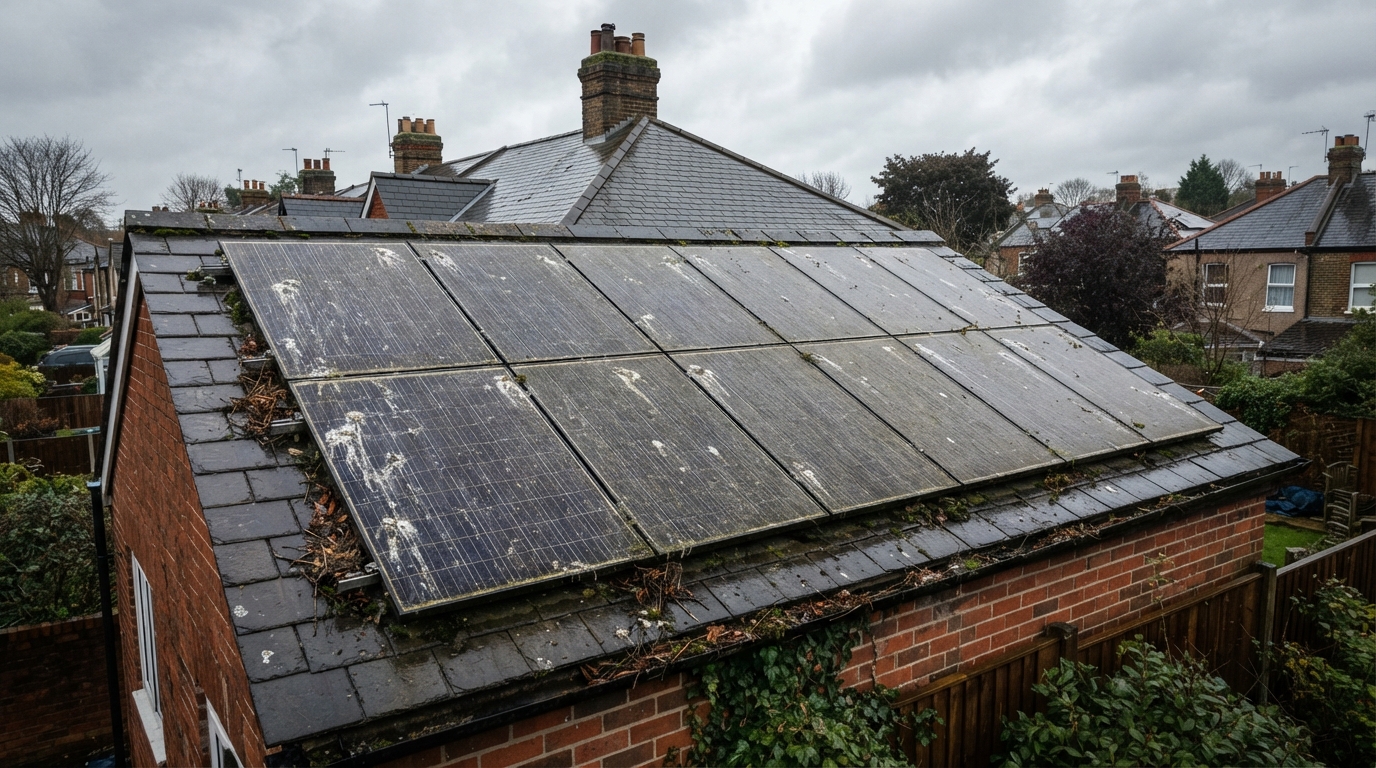
Bird droppings are one of the most obvious signs that your solar panels need cleaning. Unlike light dust, which forms an even film, droppings are thick, opaque and concentrated in specific areas. A single large dropping can block sunlight from reaching a section of photovoltaic cells entirely, and because droppings are not easily dissolved by rain, they tend to accumulate rather than wash away.
Visible droppings usually indicate that birds are regularly visiting the roof. If you can see mess on the panels from the ground, there is a good chance that birds are also roosting or nesting beneath the array, which is worth investigating before the problem worsens.
2. Pigeons Are Nesting Beneath the Panels
The gap beneath roof-mounted solar panels provides pigeons with warmth, shelter and protection from predators, making it an attractive nesting location. Once pigeons establish themselves beneath an array, they tend to return year after year, fouling the panels above them and dropping nesting material across the roof.
Nesting beneath the panels is the single biggest cause of heavy, recurring contamination. If pigeons have moved in, cleaning the panels alone will only provide a temporary improvement — bird proofing is usually needed to prevent the birds returning.
3. Leaves, Pollen and Dirt Are Collecting Around the Panels
Seasonal contamination is another common sign that cleaning is due. In autumn, leaves can collect around the edges of the array and in the gaps beneath the panels, where they trap moisture and encourage organic growth. In spring and early summer, pollen can form a visible yellow-green film across the glass. Dust and airborne pollution settle year-round, particularly during dry spells.
If you can see debris collecting around the panels, it is likely that contamination is also building up on the glass surface itself, even if it is not immediately visible from the ground.
4. Moss From the Roof Is Accumulating Around the Array
Moss growing on roof tiles releases spores, particularly during damp weather, and these spores settle on the glass surface of the panels. Over time, moss fragments can also break away from the tiles and collect around the edges of the array or in the gaps beneath the panels. This is a clear sign that the roof and the panels are affecting each other.
If moss is visible on the tiles around your solar panels, roof cleaning is often recommended alongside panel cleaning to reduce the amount of organic debris landing on the glass and keep the panels cleaner for longer.
5. Your Gutters Regularly Contain Feathers or Nesting Material
Many homeowners first discover bird activity not by looking at the panels, but by noticing feathers, twigs and nesting material in their gutters. Pigeons nesting beneath solar panels drop debris onto the roof, which washes into the gutters during rain. Over time this can contribute to blockages, overflowing water and further contamination of the roof and panels.
If your gutters regularly contain feathers or nesting material, it is a strong indication that birds are active on the roof and that the panels are likely being fouled as a result.
6. One Section of the Panels Looks Dirtier Than the Rest
Contamination rarely builds up evenly across the whole array. One section may be dirtier because of shading from nearby trees, prevailing wind direction, or because pigeons prefer to roost beneath a particular part of the array. If one strip of panels looks noticeably worse than the rest, it usually indicates a localised source of contamination that is worth identifying.
Professional cleaning addresses the entire array, but identifying the cause of uneven soiling helps determine whether additional maintenance — such as tree trimming, bird proofing or roof cleaning — would help prevent the problem returning.
7. You Can Hear Birds Beneath the Panels
If you can hear pigeons cooing or scrabbling beneath your solar panels, particularly early in the morning or during the breeding season, it is a strong sign that birds are nesting under the array. Nesting birds are protected by UK wildlife legislation, so any bird proofing work should be planned responsibly and carried out once nesting has finished.
Hearing birds is often the first sign homeowners notice before they realise the extent of the contamination on the panels and the debris collecting in the gutters.
8. You Cannot Remember the Last Professional Clean
If you cannot recall when your solar panels were last professionally cleaned, it is usually time to have them inspected. Solar panel cleaning is preventative maintenance — waiting until the panels look obviously dirty often means contamination has already become established and more difficult to remove.
Regular inspections of the panels, roof and gutters help identify issues early, before bird activity, moss growth or blockages become more serious and more expensive to resolve.
9. You Have Recently Had Your Roof Cleaned
If you have recently had your roof cleaned, it can be an ideal time to have the solar panels cleaned too. Moss removal from the tiles will have dislodged spores and fragments, some of which will have settled on the panel glass. Cleaning the panels immediately after roof cleaning ensures the whole roof system is left in the best possible condition.
It is also a good opportunity to inspect any existing bird proofing and check whether the gutters need clearing as part of the same visit.
10. You're Arranging Other Roof Maintenance
One of the most efficient ways to maintain solar panels is to combine the clean with other roof maintenance. If you are already arranging roof cleaning, gutter clearing or bird proofing, adding solar panel cleaning to the same visit often makes sense — it reduces the number of visits required and ensures the whole roof system is addressed together.
Treating the roof as one complete system, rather than individual isolated jobs, usually produces better long-term results and reduces the frequency of future maintenance.
Can Every Solar Panel System Be Professionally Cleaned?
Most roof-mounted domestic solar arrays can be professionally cleaned, but every property should be assessed individually before any work begins. Factors that influence the cleaning approach include:
- Roof access — safe access is the first consideration for any roof-mounted system.
- Panel condition — existing damage or degradation may affect the cleaning method.
- Type of contamination — bird droppings, pollen and moss debris each require different approaches.
- Bird activity — nesting beneath the panels may require bird proofing alongside cleaning.
- Surrounding environment — tree cover, pollution and roof condition all affect how quickly the panels re-soil.
Skyhawk Exterior Cleaning provides solar panel cleaning, bird proofing, roof cleaning and gutter cleaning as one coordinated roof maintenance solution. Rather than treating each element in isolation, we assess the whole roof and recommend the most appropriate combination of services for the individual property.
Warning Signs and Why They Matter
| Warning Sign | Why It Matters |
|---|---|
| Bird droppings | Opaque deposits block sunlight; usually indicates regular bird activity on the roof. |
| Pigeon nesting | The biggest cause of recurring fouling; often requires bird proofing to resolve. |
| Moss around panels | Indicates moss on the roof is shedding spores onto the glass; roof cleaning recommended. |
| Blocked gutters | Overflowing water re-soils the panels; feathers and nesting material indicate bird activity. |
| Heavy dirt | Gradual build-up reduces the amount of sunlight reaching the cells. |
| Tree debris | Leaves and sap collect around the array and trap moisture against the glass. |
Roof Issues and Recommended Inspection
| Roof Issue | Recommended Inspection |
|---|---|
| Bird activity | Check for nesting beneath panels; arrange bird proofing if pigeons are present. |
| Roof moss | Inspect the tiles around the array; roof cleaning helps reduce spores settling on panels. |
| Gutters overflowing | Clear gutters of feathers, nesting material and debris; check for bird activity on the roof. |
| Dirty panels | Arrange professional solar panel cleaning using purified water and soft brushes. |
| Fallen leaves | Remove debris from around the array; check gutters and valleys for blockages. |
Looking After the Whole Roof
Keeping solar panels clean is only one part of maintaining a healthy roof. The condition of the surrounding roof directly affects how quickly the panels become dirty again, which is why treating the roof as one complete system often produces better long-term results than treating each element in isolation.
Regular maintenance may also include:
- Roof cleaning — removing moss that sheds spores onto the panels.
- Gutter cleaning — preventing overflowing water from re-soiling the glass.
- Bird proofing — stopping pigeons from nesting beneath the array.
- Roof inspections — identifying issues early before they affect generation.
- Solar panel cleaning — removing contamination that blocks sunlight.
By combining these services, homeowners can keep the entire roof system in better condition and reduce the frequency of individual maintenance visits.
Questions We Get Asked On Site
Will rain wash the panels?
Rain rinses away loose dust but does not remove bird droppings, tree sap or bonded pollution. Periodic professional cleaning is still recommended.
Should I clean them after roof cleaning?
Yes, cleaning the panels immediately after roof cleaning is often ideal, as moss removal dislodges spores that settle on the glass.
Can pigeons reduce performance?
Yes. Pigeons nesting beneath the panels foul the glass repeatedly, blocking sunlight and causing recurring contamination.
Why are my gutters full of feathers?
Feathers and nesting material in the gutters are a strong sign that birds are nesting beneath the solar panels and dropping debris onto the roof.
Can everything be done in one visit?
In many cases, yes. Solar panel cleaning, bird proofing, roof cleaning and gutter clearing can often be combined into a single planned maintenance visit.
Common Mistakes Homeowners Make
- Ignoring birds nesting beneath the panels. Nesting is the biggest cause of recurring fouling and usually requires bird proofing to resolve.
- Assuming rain keeps panels clean. Rain does not remove bird droppings, sap or bonded pollution.
- Cleaning the panels but not clearing blocked gutters. Overflowing water re-soils the glass and undermines the clean.
- Leaving bird proofing until the problem becomes severe. Early installation prevents nests forming and reduces ongoing maintenance.
- Waiting until contamination is obvious. Gradual build-up is harder to remove; early intervention keeps cleaning straightforward.
Key Takeaways
- Bird droppings, nesting and moss debris are the most common signs that solar panels need cleaning.
- Visible contamination on the panels often indicates wider roof maintenance issues.
- Bird proofing is usually needed when pigeons are nesting beneath the array.
- Roof cleaning and gutter clearing help keep panels cleaner for longer.
- Combining solar panel cleaning with other roof maintenance produces better long-term results.
- Every property should be assessed individually before any work is carried out.
A Homeowner Example From Sussex
A homeowner near Horsham contacted us after noticing bird droppings visible on their solar panels from the ground. When we inspected the roof, we found pigeons actively nesting beneath the array, the gutters were full of feathers and nesting material, and moss was growing on the tiles immediately around the panels. The droppings on the glass were only the most visible symptom of a wider maintenance issue affecting the whole roof.
Rather than simply cleaning the panels and leaving, we carried out a full roof maintenance visit. The panels were cleaned using purified water and a soft brush, the gutters were cleared of nesting debris, the roof was treated to remove moss, and bird proofing mesh was installed around the perimeter of the array to prevent the pigeons returning. The homeowner was left with clean panels, clear gutters, a moss-free roof and a long-term solution to the bird activity that had been causing the contamination in the first place.
Frequently Asked Questions
How do I know my solar panels need cleaning?
Common signs include visible bird droppings, pigeons nesting beneath the panels, moss debris collecting around the array, feathers in the gutters and a dull or streaky appearance on the glass.
Can bird droppings affect solar panels?
Yes. Bird droppings are opaque and block sunlight from reaching the cells. They do not wash off easily in rain and tend to accumulate over time.
Can roof moss affect my panels?
Yes. Moss releases spores and fragments that settle on the panels and trap moisture. Roof cleaning helps reduce this contamination.
Do blocked gutters matter?
Yes. Blocked gutters cause overflowing water that runs across the roof and panels, leaving streaks and deposits that re-soil the glass.
How often should solar panels be cleaned?
There is no fixed schedule. The ideal frequency depends on bird activity, tree cover, roof condition and how quickly contamination builds up.
Can rain clean solar panels?
Rain rinses away loose dust but does not remove bird droppings, tree sap or bonded pollution. Periodic professional cleaning is still recommended.
Can I clean them myself?
Some homeowners can clean safely accessible panels, but roof-mounted systems often benefit from professional cleaning due to safe access, specialist equipment and the opportunity to inspect the wider roof.
Should bird proofing be installed first?
If pigeons are actively nesting, bird proofing should be planned alongside cleaning. Active nests are protected by UK wildlife legislation, so timing matters.
Can roof cleaning and panel cleaning be combined?
Yes. Combining roof cleaning, gutter clearing, solar panel cleaning and bird proofing in one visit often produces better results and reduces future maintenance.
When should I arrange professional cleaning?
If your panels look dull, streaky or dotted with bird mess, or if you notice bird activity on the roof, it is usually time to arrange a professional inspection and clean.
If your solar panels are showing any of these signs, book a free video call with Skyhawk Exterior Cleaning. We assess every property individually and provide honest advice on the most appropriate maintenance for your roof, gutters and solar panels. You can also read our FAQs for more information.