How Often Should Solar Panels Be Cleaned?
Most solar panels benefit from periodic professional cleaning, but there isn't a single schedule that suits every home. The ideal cleaning frequency depends on where you live, nearby trees, bird activity, roof condition and how much contamination builds up on the panels. Rather than following a fixed interval, the best approach is to have your panels cleaned when contamination begins to affect them — and to keep an eye on the roof and gutters at the same time.
Do Solar Panels Really Need Cleaning?
Solar panels are designed to be durable and are often described as self-cleaning to a degree. Rainfall does wash away some loose dust, but it is rarely enough to remove bird droppings, pollen films, tree sap or established organic staining. Over time, these contaminants build up on the surface and reduce the amount of sunlight reaching the photovoltaic cells beneath.
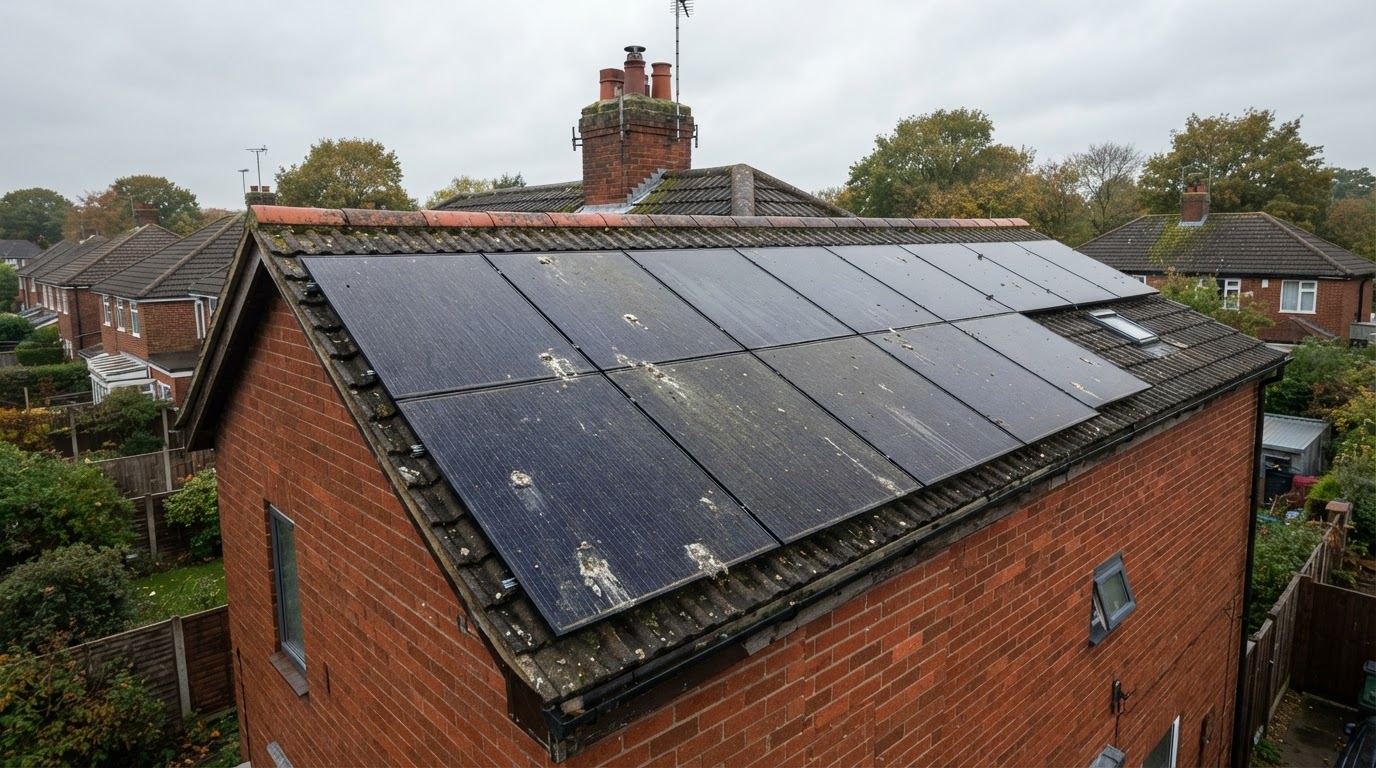
For many homeowners across Sussex and Surrey, the first sign that panels need cleaning is a visible dulling of the glass or noticeable patches of staining. Because the change happens gradually, it is easy to overlook until output drops or the panels look noticeably dirty when the sun catches them at the right angle.
Recognised UK solar panel maintenance guidance recommends periodic inspection and cleaning as part of a wider roof care routine, rather than waiting until performance is noticeably affected.
What Affects How Often They Should Be Cleaned?
Every property is different, and a number of factors influence how quickly contamination builds up on solar panels:
- Bird activity — pigeons and other birds roosting beneath or near panels are the single biggest cause of rapid soiling.
- Nearby trees — overhanging branches drop leaves, sap, pollen and organic debris onto the roof and panels.
- Roof condition — moss, lichen and algae on the surrounding tiles can spread towards the panel edges and shed spores onto the glass.
- Local environment — properties near busy roads may experience more airborne dust and traffic pollution.
- Weather exposure — prolonged dry spells allow contamination to settle and adhere, whilst heavy rain may shift some but not all deposits.
- Roof pitch and orientation — flatter roofs and shaded elevations tend to retain debris for longer.
Because these factors vary so widely, there is no universal answer to how often panels should be cleaned. A home surrounded by mature trees with active pigeon nesting will need very different attention to a modern property on an open estate with no bird activity.
Contamination Types
The type of contamination also affects how quickly panels become soiled and how difficult they are to clean:
- Bird droppings — thick, opaque and resistant to rainfall.
- Pollen — forms a sticky film, particularly in spring.
- Moss fragments — shed from the roof and collect at panel edges.
- Lichen — can colonise shaded panel edges over time.
- Dust — settles during dry periods, usually lighter and easier to rinse.
- Leaves — collect in gaps and valleys, trapping moisture.
- Tree sap — sticky and stubborn, often requiring specialist cleaning.
- Airborne pollution — more common near main roads and urban centres.
Why Nearby Trees Make a Difference
Properties surrounded by mature trees — common in many parts of Sussex and Surrey — tend to experience faster build-up of organic debris on roofs and solar panels. Overhanging branches drop leaves directly onto the array, whilst pollen and sap coat the glass during spring and summer. Even after the trees shed their leaves in autumn, residual sap and organic residue can remain on the panels for months.
If your property has trees close to the roof, it is worth inspecting the panels more frequently. In some cases, trimming back overhanging branches can reduce the amount of debris reaching the panels — but this should only be carried out where it is safe and appropriate to do so.
Why Birds Often Increase Cleaning Requirements
Birds — particularly pigeons — are one of the most significant factors affecting solar panel cleaning frequency. Pigeons frequently nest in the warm, sheltered gap beneath roof-mounted panels, and once established, they foul the surface above on a daily basis.
Birds nesting beneath panels can lead to:
- Increased fouling — droppings accumulate on the panel surface faster than rainfall can remove them.
- Moss accumulation on the roof — nesting material and organic debris encourage moss growth around the array.
- Gutters filling with feathers and nesting material — leading to blockages and overflowing water.
- Water overflowing from blocked gutters — which can contribute to staining on render, walls and the surrounding roof.
- Additional roof maintenance — the longer the nest remains, the more widespread the contamination becomes.
In these situations, cleaning the panels alone is rarely a lasting solution. The birds simply return and recontaminate the surface within weeks. This is why solar panel bird proofing is often recommended alongside cleaning — it addresses the root cause rather than just the symptom.
How Roof Moss Affects Solar Panels
Moss, lichen and algae growing on the surrounding roof tiles do not stay confined to the tiles. Spores are carried by wind and rain onto the panel surface, particularly where leaves and organic debris collect in the gaps between the array and the roof. Over time, moss can lift the edges of panels, trap moisture and create conditions that encourage further organic growth.
This is one of the reasons why roof cleaning and solar panel cleaning are often best carried out together. Removing moss from the roof reduces the source of spores that would otherwise continue to settle on the panels. It also helps maintain the condition of the tiles beneath and around the array — areas that are easily overlooked once panels are installed.
Why Gutter Maintenance Is Closely Linked
Solar panels sit on top of a roof drainage system that relies on clear gutters and downpipes to carry rainwater away safely. When birds nest under panels, they frequently drag nesting material, twigs and debris into the gutters, leading to blockages. Blocked gutters can cause water to overflow down the roof and around the panel edges, contributing to staining and organic growth.
This is why gutter cleaning is frequently recommended as part of a complete solar panel maintenance plan. Addressing the gutters, the roof and the panels together helps keep the entire system functioning as it should — rather than treating each element in isolation.
Roof Health Matters Too
Solar panels do not exist in isolation. They are part of a wider roof system that includes the tiles, the gutters, the downpipes and the flashing around the array. When one element is neglected, it often affects the others. Moss on the roof sheds spores onto the panels. Blocked gutters cause water to overflow around the array. Birds nesting beneath the panels foul the surface, block the gutters and encourage moss growth on the tiles.
Keeping the roof, gutters and solar panels maintained together helps prevent larger maintenance issues from developing. It also means that each visit is more efficient — there is no point cleaning the panels if the roof above them is shedding moss onto the glass the following week. A joined-up approach ensures the whole system stays cleaner for longer.
Signs Your Panels Need Cleaning
Because contamination builds up gradually, it helps to know what to look for. Common signs that your solar panels may benefit from professional cleaning include:
- Visible staining or dull patches on the panel surface.
- Bird droppings that do not wash away after rainfall.
- Moss or lichen appearing at the edges of the panels.
- Leaves and organic debris collecting in roof valleys or around the array.
- Pigeons seen roosting on or beneath the panels.
- Gutters overflowing or showing signs of blockage.
- A noticeable drop in energy generation during settled weather.
If you notice any of these signs, it is worth arranging a professional assessment rather than waiting for a specific time of year.
Can Regular Inspections Identify Problems Early?
Yes. Regular visual inspections — whether carried out by a homeowner from ground level or by a professional during a roof visit — can identify contamination before it becomes severe. Spotting bird activity, moss growth or gutter blockages early means cleaning can be arranged before the panels become heavily soiled or before nesting debris causes wider damage.
For many properties, combining a solar panel inspection with a roof or gutter inspection makes practical sense. It allows the whole roof system to be assessed in a single visit, and any issues can be addressed together rather than as separate, reactive jobs.
Which Properties Need More Frequent Cleaning?
To help illustrate how cleaning frequency varies, the table below compares common property types and the factors that influence how often panels may need attention.
| Property Type | Cleaning Considerations |
|---|---|
| Rural property | Often surrounded by trees and hedgerows. Pollen, leaves and sap can build up quickly, particularly in spring and autumn. |
| Urban property | More exposed to airborne dust and traffic pollution, but typically fewer trees. Light dust may be the main contaminant. |
| Heavy tree cover | Leaves, sap and organic debris accumulate rapidly. Panels may need cleaning more frequently, particularly after autumn leaf fall. |
| Coastal property | Salt spray and atmospheric moisture can combine with dust. Shaded coastal elevations may also develop algae more quickly. |
| Homes with pigeons | Bird droppings accumulate fast and are resistant to rainfall. Bird proofing is usually required alongside cleaning to prevent rapid recontamination. |
Factors That Affect Cleaning Frequency
| Factor | Effect on Cleaning Frequency |
|---|---|
| Bird activity | The most significant factor. Active pigeon nesting beneath panels can require cleaning far more frequently than a property with no bird activity. |
| Moss on roof | Sheds spores onto panels and encourages organic growth at the edges. Roof cleaning helps reduce this source of contamination. |
| Tree cover | Drops leaves, pollen and sap. Properties with overhanging branches typically need more frequent attention. |
| Pollen | Creates a sticky film in spring and early summer. More noticeable on properties near mature trees and hedgerows. |
| Dust | Settles during dry spells. Usually lighter and easier to rinse, but can combine with other contaminants to form a stubborn film. |
Questions We Get Asked On Site
When we visit properties across Sussex and Surrey to clean solar panels, homeowners often ask similar questions about maintenance frequency and how cleaning fits into looking after the whole roof.
Doesn't rain clean solar panels?
Rain removes some light dust, but it is rarely effective on bird droppings, pollen films or organic staining. If panels look visibly marked after rain, professional cleaning is usually required.
Do pigeons make them dirtier?
Yes. Pigeons roosting beneath panels foul the surface above on a daily basis. If pigeons are present, bird proofing is usually needed alongside cleaning to prevent rapid recontamination.
Should I have my gutters cleaned too?
In most cases, yes. Birds nesting under panels often drop debris into gutters, causing blockages. Cleaning gutters as part of the same visit helps maintain the whole roof drainage system.
Does roof moss affect my panels?
It can. Moss on the surrounding tiles sheds spores onto the panel surface and can spread towards the edges of the array. Roof cleaning helps reduce this source of contamination.
Can I combine roof cleaning and bird proofing?
Yes. Combining roof cleaning, gutter clearing, solar panel cleaning and bird proofing in a single visit is often the most efficient way to maintain the entire roof system and prevent problems returning.
Common Mistakes Homeowners Make
- Waiting until the panels look obviously dirty. Contamination can affect performance before it becomes highly visible. Regular inspections help identify issues earlier.
- Ignoring pigeons nesting beneath the panels. Cleaning alone will not last if the birds return. Bird proofing addresses the cause.
- Cleaning the panels but not the blocked gutters. Overflowing gutters contribute to staining and organic growth around the array.
- Cleaning the roof but leaving bird proofing until later. Birds will continue to foul the panels and drop debris into the gutters until the nest is prevented.
- Assuming a fixed cleaning schedule suits every property. Every home is different. The best time to clean is when contamination begins to build up — not simply because a certain number of months have passed.
Key Takeaways
- There is no fixed cleaning schedule for every property — frequency depends on bird activity, trees, roof condition and local environment.
- Birds nesting beneath panels are the biggest cause of rapid soiling and often require bird proofing alongside cleaning.
- Roof moss, blocked gutters and solar panel contamination are closely linked and are best addressed together.
- Rain alone does not remove bird droppings, pollen films or established organic staining.
- The best time to clean solar panels is when contamination begins to affect them — not after waiting a fixed interval.
- Skyhawk Exterior Cleaning maintains the whole roof system, including panels, roof, gutters and bird proofing.
A Real Example From Sussex
A homeowner near Horsham contacted us after noticing their solar panels looked dull and their gutters were overflowing during rainfall. On inspection, we found a colony of pigeons had established a nest beneath the array. The panels were heavily fouled with droppings, moss was collecting around the roof valleys, and the gutters were packed with feathers, twigs and nesting material.
Rather than simply cleaning the panels and leaving, we carried out a combined service: solar panel cleaning to remove the fouling, bird proofing mesh installation to prevent the pigeons returning, roof cleaning to clear the moss from the surrounding tiles, and gutter clearing to remove the nesting debris. Because the root cause was addressed, the panels stayed cleaner for longer and the gutters were able to flow freely again. Had we cleaned the panels alone, the birds would have returned within weeks and the same contamination would have built up again.
Frequently Asked Questions
How often should solar panels be cleaned?
There is no fixed interval. Panels should be cleaned when contamination is visible or when bird activity is present. Properties beneath trees or with active pigeon nesting may need more frequent attention.
Does rain clean solar panels?
Rain removes some light dust but is rarely effective on bird droppings, pollen films or organic staining. If panels look visibly marked, professional cleaning is usually required.
Do pigeons affect solar panels?
Yes. Pigeons nesting beneath panels foul the surface above and drop debris into gutters. Bird proofing is usually needed alongside cleaning to prevent rapid recontamination.
Can roof moss affect solar panels?
Yes. Moss on the surrounding tiles sheds spores onto the panel surface and can spread towards the edges of the array. Roof cleaning helps reduce this source of contamination.
Should gutters be cleaned at the same time?
In most cases, yes. Birds nesting under panels often drop debris into gutters, causing blockages. Cleaning gutters as part of the same visit helps maintain the whole roof drainage system.
Can I clean the panels myself?
Light rinsing from ground level can remove loose dust, but accessing panels usually means working at height. Professional cleaning is generally safer and more effective, particularly where bird activity or roof moss is involved.
How do I know they need cleaning?
Visible staining, dull patches, bird droppings, moss at the panel edges or a noticeable drop in generation during settled weather are all signs that cleaning is worth arranging.
Does bird proofing reduce maintenance?
Yes. Bird proofing prevents pigeons from nesting beneath the panels, which significantly reduces fouling, gutter blockages and moss accumulation on the roof.
When should I arrange professional cleaning?
When contamination becomes visible, when birds are nesting beneath the panels, or when gutters and roof moss need attention. There is no need to wait for a specific season.
Is solar panel cleaning worth it?
For most properties, yes. Cleaning helps maintain the panels by removing contamination that rainfall alone cannot shift, and when combined with bird proofing, roof cleaning and gutter clearing, it helps maintain the entire roof system.
Final Conclusion
There is no single answer to how often solar panels should be cleaned, because every property is different. The best approach is to have your panels cleaned when contamination begins to affect them — and to keep an eye on the roof, gutters and bird activity at the same time. Birds nesting beneath panels, moss on the roof and blocked gutters are all connected, and addressing them together helps keep the entire roof system functioning properly.
If your solar panels are looking dull, if pigeons are nesting beneath the array, or if your gutters and roof need attention, book a free video call with Skyhawk Exterior Cleaning. We assess every property individually and recommend the most appropriate combination of cleaning, bird proofing and maintenance — without suggesting services you do not need. You can also read our FAQs or learn more about our solar panel cleaning and bird proofing service.